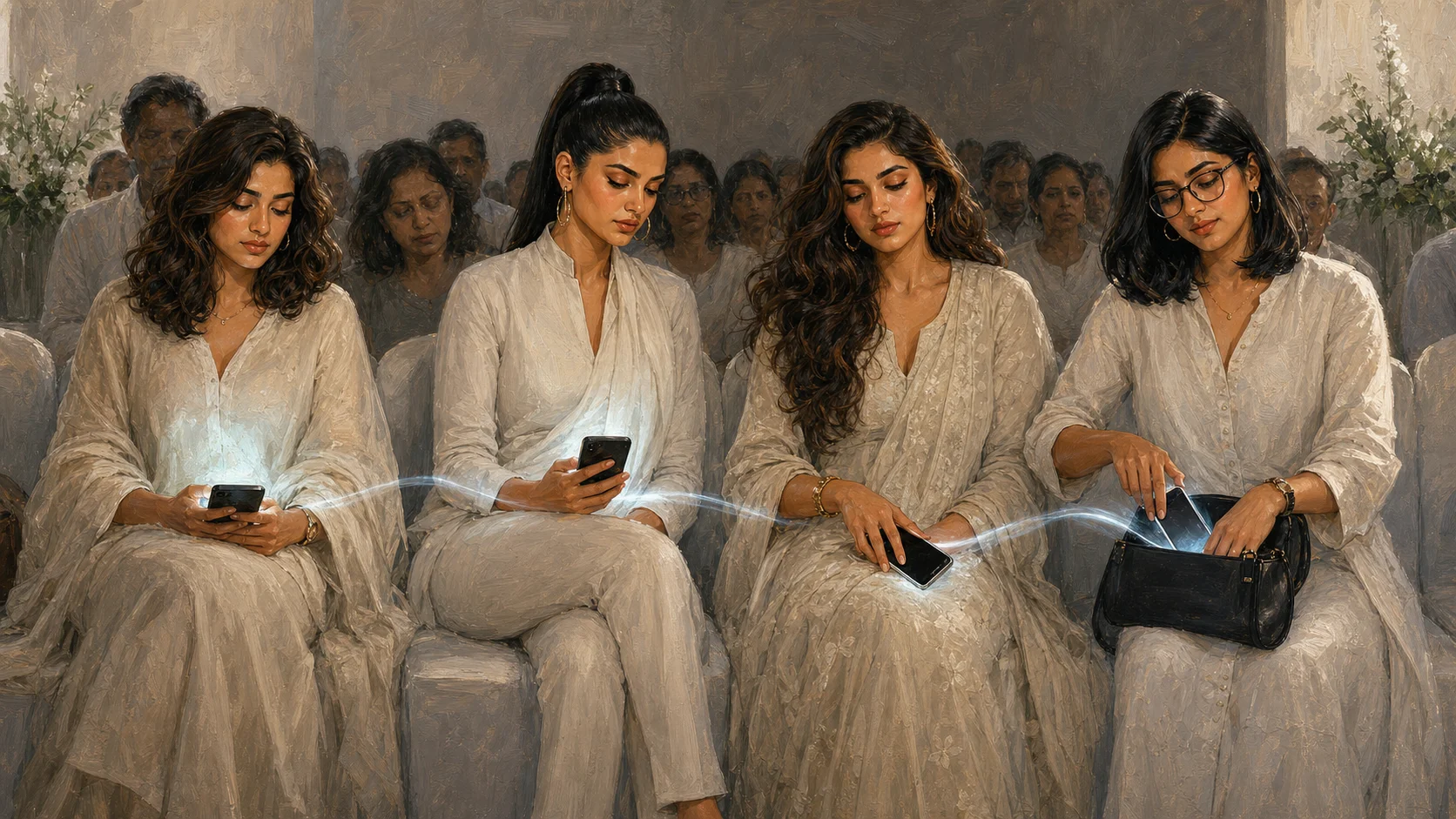
The condolence meeting was for the father of a school friend none of them had seen in six years. It was not the proper setting for romantic discovery, which made it perfect for their lives.
They sat in a quiet hall wearing pale clothes and respectful expressions. At 5:17, four phones vibrated within seconds.
Tanya glanced down.
Kabir: Tonight became impossible. Tomorrow?
Rhea locked her screen. Meher turned hers face down. Naina placed hers inside her handbag with the care of a bank deposit.
The women looked at one another.
“Office,” Meher whispered.
“Client,” Rhea said.
“Bank alert,” Naina said.
“School,” Tanya said.
They returned to mourning, united by lies.
Outside afterward, the four stood near the parking area and discussed mortality because it was easier than discussing messages.
“We should meet more,” Meher said.
“We are meeting now,” Rhea replied.
“At a condolence gathering.”
“Life has scheduling constraints.”
Naina’s phone vibrated again. She looked at it and smiled before catching herself.
“Bank is affectionate,” Tanya said.
“New customer-retention strategy.”
Kabir rescheduled Tanya for Sunday afternoon. At his flat she found an unfamiliar silver earring beneath the sofa.
“Yours?” she asked.
“If it suits me.”
“Whose?”
“Sam’s sister stayed here after an event.”
There were four teas in the cupboard, two phone chargers beside the bed and receipts from restaurants Kabir had never mentioned. Every clue arrived with an explanation before Tanya could decide it was a clue.
“Many guests leave accessories?”
“You left a book, a hair tie and a moral atmosphere.”
He made her laugh. The earring disappeared into the bowl near the door.
Later, Kabir ordered dinner. Halfway through, Tanya became ill.
The evening lost glamour quickly. Kabir found medicine, tied back her hair, called the restaurant with offended loyalty and slept on the floor when she needed the bed. At three in the morning he brought water without being asked.
Care was inconvenient evidence. Tanya had expected deception, if it existed, to look cold. Kabir was not cold. Nothing became simpler.
In the morning he made plain toast and cancelled a meeting to drive her home.
“You don’t have to,” she said.
“I know.”
That answer stayed with her longer than any compliment.
Dev tried to warn her two days later over coffee.
He had messaged saying he needed “ethical advice from someone judgmental.” Tanya agreed because the description was insulting but accurate.
“Hypothetically,” Dev began, “if a man was dating more than one person in the same circle—”
“Sam?”
“Why does everyone assume Sam?”
“Probability.”
“Not Sam. Hypothetically.”
“Exclusive relationships?”
“No. But the people don’t know about each other.”
“Then the man is contractually safe and ethically an idiot.”
Dev stirred his coffee. “What if he thinks disclosure will cause unnecessary pain?”
“He means consequences.”
“Yes.”
“Delayed consequences collect interest.”
Dev nodded with confusing relief. Tanya assumed she had helped someone unimportant.
That Friday, Ishita sent Tanya a screenshot.
Your Goa person?
It showed Meher’s private story: cocktails at a rooftop bar. In the mirror behind her was part of a man in a blue shirt.
Tanya enlarged the image until the pixels became abstract.
Could be anyone, she replied.
It is anyone wearing Kabir’s watch.
Tanya called Meher and hung up before the connection completed.
There were reasonable explanations. Meher worked with brands. Kabir worked in events. Delhi was smaller than it pretended to be. Tanya did not want to become a woman building a case from reflections.
She messaged Kabir instead.
Did you work at the Meridian rooftop this week?
His reply arrived quickly.
Tuesday. Brand meeting. Why?
Truth, presented efficiently.
Meher was there.
The typing bubble appeared.
Yes. Her company’s agency was involved. I said hello.
Also true, perhaps.
When Tanya met Meher the next day, she almost asked. Meher spoke first.
“How is your migraine man?”
“What?”
“The person for whom you keep cancelling plans and inventing health problems.”
Tanya’s surprise exposed her.
Meher smiled without warmth. “We all edit.”
“Who is yours?” Tanya asked.
“When you tell me yours.”
They sat with the challenge between them. Neither moved.
That night, Kabir was affectionate, funny and attentive. Tanya watched him put his phone face down.
“What?” he asked.
“Nothing.”
“You are staring at me like a badly written paragraph.”
“Maybe I am looking for what should be deleted.”
He kissed her hand. “Keep the interesting parts.”
Tanya let him turn suspicion into flirtation again.
On the way home she retrieved Ishita’s screenshot from the recently deleted folder.
An English teacher knew context could change any sentence. She also knew context was sometimes decoration around the obvious.
The condolence meeting remained in Tanya’s mind for reasons that embarrassed her. She remembered the family’s grief, of course. She also remembered four women receiving four messages and lying in perfect sequence.
On Monday morning she opened the group chat and typed: Did everyone survive their mysterious work emergency?
Rhea replied with a photograph of court files.
Meher sent a photograph of her laptop.
Naina wrote: Yes.
Tanya considered sending a photograph of Kabir’s kitchen, where she had eventually spent Sunday afternoon. She sent a stack of unmarked exam papers instead.
Evidence could be true without being honest.
At school, the half-yearly examinations produced a particular kind of collective panic. Students who had ignored instructions for months began asking whether handwriting affected marks. Parents requested “brief calls” that lasted entire free periods. Mrs Suri moved through corridors carrying timetables and a headache.
Tanya welcomed the noise. Suspicion required spare attention.
Kabir did not mention the silver earring again. It remained in the bowl near his door beside coins and a hotel key card. Tanya saw it each time she visited. Its refusal to disappear made the innocent explanation almost convincing. Surely a guilty man would hide evidence.
One evening she picked it up.
“Still interested?” Kabir asked from the sofa.
“Sam’s sister has not reclaimed it.”
“She lives in Bengaluru.”
“Name?”
“Why?”
“Polite curiosity.”
“Simran.”
The answer came quickly. Tanya placed the earring back.
Sam’s social profile contained years of photographs, gym promotions, birthday posts and family weddings. Tanya searched while Kabir showered. There was no obvious Simran, but absence from social media proved little. She closed the app before Kabir returned.
“What are you doing?” he asked, towelling his hair.
“Checking school email.”
It was a lie told while investigating a possible lie. Tanya disliked the symmetry.
Kabir sat beside her. “Stay tonight.”
“School.”
“You leave at six-thirty.”
“My clothes are not here.”
“You have left enough clothing to begin a small person.”
He opened a drawer. Inside were Tanya’s T-shirt, one kurta, underclothes folded without skill and the green dress from Goa she had forgotten after wearing it in Delhi.
The drawer moved her. Not because it meant commitment. Because it made space.
“You folded these terribly,” she said.
“Stay and correct them.”
She did.
In the morning, while Kabir made coffee, Tanya opened the wrong cupboard and found two blue mugs identical to his chipped favourite.
“Backup?” she asked.
“Client gift set.”
“You told me the white mug was from a client set.”
“Different client.”
“Your clients give significant crockery.”
“Events create surplus.”
He handed her coffee in the original blue mug. Tanya felt foolish for conducting archaeology in a kitchen.
The food-poisoning incident happened that evening after they ordered noodles from a place Kabir swore was reliable. Tanya became nauseated first. Within an hour, every romantic possibility had been replaced by bathroom logistics.
“Go home,” she told him between waves of sickness.
“This is my home.”
“Then move.”
He held back her hair, found medicine at a late-night chemist and called the restaurant as though prosecuting attempted murder.
“Sir, I don’t need a voucher,” he said into the phone. “I need you to stop telling me nobody else complained. I have the person who complained here.”
Tanya, lying on the sofa with a towel over her eyes, said, “Tell him the spring rolls lacked structural integrity.”
Kabir repeated it.
At three in the morning she woke and found him asleep on the floor beside the bed. A glass of water and the next tablet waited on the table. His neck was bent at an impossible angle.
“Kabir.”
He woke immediately. “Sick?”
“No. Get on the bed.”
“You need space.”
“I need you not to require spinal treatment.”
He lay above the blanket at the far edge. Tanya fell asleep holding his wrist.
Care was inconvenient evidence. She had expected deception, if it existed, to look cold. Kabir was not cold. The possibility that he could be caring and dishonest at the same time seemed unfairly complex.
The next morning, he made toast and cancelled a meeting to drive her home.
“You don’t have to,” Tanya said.
“I know.”
That answer remained after every suspicion.
Sunita met them downstairs. Tanya had called ahead with a reduced version of events, omitting where she had slept and how the illness began.
Kabir carried her bag upstairs despite Tanya’s objections. Sunita opened the door and took in Tanya’s pale face, Kabir’s wrinkled shirt and the hour.
“Food poisoning,” Tanya said.
“At his house?”
“Mummy.”
“I am locating the poisoning.”
Kabir said, “I ordered dinner. My fault.”
“Did you cook it?” Sunita asked.
“No.”
“Then not your fault. Which restaurant?”
Within minutes Sunita had fed Kabir tea, obtained the restaurant name and explained why Tanya required curd rice. Rajiv emerged in his slippers and asked whether Kabir’s car was parked legally.
Tanya sat at the dining table watching her separated worlds speak to one another. Kabir was polite without overperforming. He remembered Sunita’s name. He told Rajiv what he did for work in plain language.
When he left, Sunita closed the door.
“Friend?” she asked.
“Yes.”
“Good friend.”
Tanya could not disagree.
Dev’s warning came two days later. He asked to meet near Tanya’s school because he was visiting a client in the area. They sat in a café where students occasionally passed outside, increasing Tanya’s discomfort.
“Ethical advice,” he said.
“From me?”
“You looked judgmental in Goa.”
“That is my resting professional face.”
He began the hypothetical about a man dating several people inside one social circle.
Tanya assumed Sam because Sam’s life looked statistically capable of such architecture.
“Not Sam,” Dev said.
“You sound defensive.”
“I am tired of Sam receiving credit for other people’s disasters.”
“Are the relationships exclusive?”
“No.”
“Do the people know about each other?”
“No.”
“Has anyone asked?”
Dev hesitated. “Not exactly.”
“Then your hypothetical friend has found a loophole and moved his furniture into it.”
“He says disclosure causes unnecessary hurt.”
“He means consequences.”
“What if telling now damages friendships?”
“Whose friendships?”
Dev looked at the table.
The question almost reached Tanya. Then a group of Eastbridge students entered the café. She shifted instantly into Miss Sachdeva, straightened her posture and lowered her voice.
“Tell your friend delayed consequences collect interest,” she said. “And choose a different café next time.”
Dev nodded with relief she misunderstood as gratitude.
That evening, Dev called Kabir.
Tanya did not hear the conversation, but later she would reconstruct it from both men’s accounts.
“I spoke to her,” Dev said.
“Why?”
“Not directly.”
“What did you say?”
“Hypothetical.”
Kabir swore.
“She thinks it’s Sam,” Dev added.
There was a long silence.
“Fix this,” Dev said.
“I will.”
Kabir’s definition of fixing remained postponement.
Ishita’s screenshot arrived Friday night. Meher stood at the centre of the rooftop image, smiling over a cocktail. Behind her, in the mirror, was a man wearing Kabir’s watch.
Tanya zoomed in until the face became blocks of colour. The watch remained clear because she had given him a replacement strap after the original broke.
Could be anyone, she wrote.
Ishita called immediately.
“Anyone wearing the strap you bought?”
“How do you know I bought it?”
“You posted a close-up of coffee. Reflections exist.”
“Please use your degree for public benefit.”
“I am benefiting the public named you.”
“Meher works with brands. Kabir works in events.”
“Then ask Meher.”
“I will.”
“You are lying.”
“Good night, Ishita.”
Tanya called Meher. The line rang once before she ended it. Direct questions were simple only in theory. If Meher said Kabir’s name, the answer would demand decisions. If she denied him, Tanya would have revealed suspicion and perhaps her own relationship.
She messaged Kabir instead.
His explanation arrived efficiently: brand meeting, Meher’s agency involved, brief hello. Each fact was plausible and partially verifiable.
The next day Meher and Tanya met at a salon. Tanya planned to ask after the first coffee. Then after the appointment. Then outside.
Meher spoke first.
“How is your migraine man?”
“What?”
“The person for whom you cancel plans and invent illness.”
Tanya’s face exposed her.
“Food poisoning was real.”
“I believe the poisoning. I do not believe we know your calendar.”
“You call your dates client situations.”
Meher’s expression hardened. “So you admit dates.”
“Do you?”
“When you tell me yours.”
“Why is this a trade?”
“Because you want my honesty without offering yours.”
The accusation was correct enough to anger Tanya.
“I saw your rooftop story,” she said.
Meher became still. “And?”
“Nothing.”
“Then why mention it?”
“There was someone in the background.”
“There were sixty people in the background. It was a launch.”
“Right.”
Both women stepped away from the opening.
Afterward they bought coffee and discussed school friends. The near-conversation remained between them, evidence of how strongly both preferred suspicion to exposure.
That night, Kabir was affectionate, funny and attentive. He cooked because Tanya refused to risk delivery. The meal was uneven but safe.
“You are staring at me like a badly written paragraph,” he said.
“Maybe I am looking for what should be deleted.”
He kissed her hand. “Keep the interesting parts.”
Tanya let suspicion become flirtation again. Later, she lay awake beside him and listened to his phone vibrate twice on the table.
He did not check it.
The restraint felt like loyalty until Tanya asked herself to whom.
September gave Kabir an excuse for every irregularity. Festival campaigns began. Corporate year-end budgets woke from sleep. Hotels wanted launches before wedding season occupied every ballroom. He sent Tanya photographs of half-built stages at midnight and called from loading bays at dawn.
The evidence of work was real. So were the spaces inside it.
On a Wednesday, Kabir cancelled dinner because a client had moved rehearsal. Tanya accepted the explanation and took exam papers home. At eight, Meher posted a close-up of two cocktails with no location. At nine, Rhea disappeared from the group chat after complaining about a cancelled hearing. At ten, Naina reacted to a message Tanya could not see because it was private.
The four women lived inside the same evening without comparing clocks.
Kabir met Meher at the Meridian rooftop at seven-thirty. Her agency genuinely had a campaign meeting there. The official discussion ended at eight-fifteen. Kabir stayed.
“This is not a date,” Meher said while accepting a second drink.
“Then it cannot disappoint you.”
“Work already does that.”
He told her she was the only person in the room who could see both the idea and the invoice. She laughed because the compliment understood her profession. When he kissed her in the lift lobby, he asked first. Meher said yes, then told him she had an early meeting and did not want the night to become a promise.
“I never promise after cocktails,” he said.
She mistook the line for respect.
At nine-fifty, Kabir left the hotel and called Rhea from the car. She was still near chambers, furious after a senior had taken credit for her argument.
“Come for coffee,” he said.
“It is ten.”
“Lawyers recognise no clocks.”
They met at a twenty-four-hour café. Kabir listened to the entire story, remembered the senior’s name and never told Rhea to calm down. When she finished, he said, “You should invoice people for surviving your restraint.”
“This is restraint.”
“I know. It’s attractive.”
Rhea kissed him because anger had left her wanting a different use for energy. She went home before midnight. Kabir messaged Naina that his event had ended late and asked about Saturday.
At twelve-twenty, he sent Tanya a photograph of an empty stage with the caption Still working. Rescue me tomorrow.
Every sentence contained a true fragment.
Tanya spent Thursday at school moderating exam papers with Mrs Suri.
“This answer receives four,” Tanya said.
“Three,” Mrs Suri replied.
“The interpretation is valid.”
“Unsupported.”
“The student uses textual evidence.”
“One quotation.”
“Relevant quotation.”
They debated the mark for five minutes before Mrs Suri conceded half a point, which the software refused to accept.
“Institutions dislike nuance,” Tanya said.
“Nuance cannot be entered in a spreadsheet,” Mrs Suri replied.
The sentence reminded Tanya of her own relationship. Every attempt to assign a category failed because she kept treating ambiguity as sophistication.
After work, she met Kabir for the promised rescue. He looked genuinely exhausted.
“You smell like a hotel,” she said.
“What does a hotel smell like?”
“Air-conditioning and false calm.”
They ate at a roadside stall because neither wanted atmosphere. Kabir leaned against the car and closed his eyes between bites.
“Come home,” Tanya said.
He opened one eye. “Yours?”
“Mine has parents.”
“They have met me.”
“They met food poisoning.”
“Strong first impression.”
At his flat, Kabir fell asleep before Tanya finished washing her face. She covered him with a sheet and sat beside him reading. His phone vibrated. M again. Then R. Then a banking notification followed by a message preview from Naina A: Saturday works. Same place?
The screen lit for only seconds. The name was unmistakable.
Tanya’s body became still.
There were possible explanations. Naina worked at a bank. Kabir had asked for financial advice. Same place could be a branch, café or group event. Tanya could wake him and ask.
She reached toward his shoulder.
Kabir looked so tired that compassion became an excuse. Tanya withdrew her hand.
In the morning, the message was gone from the lock screen. Kabir made coffee and complained about his neck. Tanya said nothing.
At lunch with Naina that Friday, she placed several openings in the conversation.
“How is the mystery man?”
“Fine.”
“Seeing him tomorrow?”
Naina looked up. “Why?”
“You protect Saturdays.”
“Maybe.”
“What does he do?”
“Freelance.”
The word struck.
“Which field?”
Naina smiled. “When you disclose yours.”
Tanya could have said Kabir. If Naina’s man were different, the suspicion would disappear. If he were the same, they would know before more damage.
“Creative,” Tanya said.
Naina’s smile tightened. “Mine too.”
They ordered dessert.
On Saturday, Naina met Kabir at a quiet restaurant in Lodhi Colony. He arrived on time, which mattered to her. He had researched a financial-news story she mentioned and asked intelligent questions without pretending expertise.
“You listen differently from my friends,” Naina told him.
“How?”
“They wait for me to finish so they can tell me what I should feel.”
“What do you feel?”
“Suspicious that you asked correctly.”
Kabir smiled. “Occupational benefit.”
Naina asked whether he was seeing anyone serious.
“Nothing conventional,” he said.
“Anyone I know?”
“Knowing is a spectrum.”
“That sounds like avoidance.”
“It sounds like Delhi.”
Naina did not laugh. Kabir took her hand across the table.
“I like this,” he said. “I do not want to make it less real by comparing it.”
The sentence gave her exactly enough emotion to leave the missing fact untouched.
Meanwhile, Tanya spent Saturday with her parents at a family engagement. Neelam introduced the dentist. He was polite, fit and spoke about productivity during dessert.
“No days off,” he said.
“I teach children,” Tanya replied. “Days off prevent crime.”
He did not laugh.
Sunita watched them for twenty minutes, then rescued Tanya by announcing a headache.
In the cab home, she said, “You did not like him.”
“He called sleep a weak habit.”
“Unacceptable.”
“Thank you.”
“Kabir?” Sunita asked.
Tanya looked out the window. “Complicated.”
“Complicated is usually a simple fact nobody likes.”
“You and Mrs Suri should start a quotation service.”
Sunita let the subject go.
That night Kabir messaged Tanya at eleven-thirty: Long day. Missed you.
Naina had left his car twenty minutes earlier.
Tanya replied: Tomorrow.
The word made the next meeting possible and every earlier question easier to postpone.
When Tanya returned to Kabir’s flat Sunday, the masala-tea box had moved from the cupboard to the counter. A second cup dried beside the sink.
“Guest?” she asked.
“Dev.”
“Dev drinks black coffee.”
Kabir paused while opening the fridge. “You know everyone’s beverages?”
“Naina does.”
The name entered the kitchen and stayed.
“Why Naina?” Kabir asked.
Tanya watched his face. “No reason.”
“Then strange example.”
“She remembers orders.”
“Useful skill.”
He turned toward the fridge. Tanya saw tension in the back of his neck and recognised evidence her desire did not want processed.
Instead of asking, she picked up the silver earring from the bowl.
“And Simran?”
“Still in Bengaluru.”
“Sam has never mentioned a sister.”
“Sam rarely mentions family.”
Both knew this was false. Sam mentioned his mother’s cooking weekly.
Kabir stepped closer. “What is happening?”
“I’m asking questions.”
“Questions or accusations?”
“Does the distinction change the answers?”
For several seconds, neither moved.
Then Kabir said, “Aisha. The earring belongs to Aisha, a former colleague. She stayed here after an event. Nothing happened.”
The truth arrived only after the invented sister failed.
“Why lie?” Tanya asked.
“Because ‘former colleague’ sounds like more.”
“Was it more?”
“Last year. Not now.”
“You made the truth suspicious by protecting me from suspicion.”
Kabir sat down. “You are right.”
The admission disarmed her.
He apologised without a joke. Tanya accepted because the specific matter appeared resolved. She did not ask what other truths had received protective substitutes.
When she left, the earring remained in the bowl. Kabir threw it away the next morning, then took it from the bin and placed it in a drawer because disposal felt like evidence too.
The following week, Tanya used Kabir’s spare key for the first time.
He was at an event in Gurugram and had left a folder needed by a courier. Tanya’s school was closer to his flat. The request sounded practical enough to prove trust.
“Top shelf beside the speaker,” he said. “Blue folder, not black.”
“Your organisational system is colour?”
“You organise adolescents by uniform.”
“That is the school, not me.”
The flat felt different without Kabir. Less intimate, more legible. Tanya found the blue folder and placed it near the door. On the dining table lay four café loyalty cards held by a rubber band. One bore Naina’s handwriting: Do not lose again.
Tanya recognised the neat block letters from years of birthday cards.
She held the card until the courier rang.
“Where did this come from?” she asked Kabir that evening.
There was a short pause. “What?”
“Loyalty card. Naina wrote on it.”
“We met for coffee after Goa. I asked about a banking thing.”
“Same place?”
“A few times.”
“Why did neither of you say?”
“Why would coffee require group disclosure?”
The answer reduced the clue to something Tanya could feel foolish about.
“It doesn’t,” she said.
“You sound upset.”
“I sound tired.”
“Come over after the courier leaves.”
“School tomorrow.”
Tanya locked the flat and took the spare key from her ring. She almost placed it on the table. Instead she returned it to her handbag.
At school the next day, she watched Class Twelve write an examination. Silence filled the room with scratching pens and shifting chairs. Aakash raised his hand to ask whether he could clarify the question.
“You may clarify your answer,” Tanya said. “The question remains.”
The phrase followed her into lunch.
She messaged Naina: Did you meet Kabir for banking advice?
The typing bubble appeared, vanished and returned.
Once. Long ago. Why?
Both details were false enough to matter. Tanya stared at the reply.
Saw your handwriting on café card.
Naina took six minutes.
He kept losing it. I wrote reminder. Not important.
Tanya wanted to ask how often a person had to use a loyalty card before loss became recurring. Instead she reacted with a thumbs-up. The symbol ended a conversation that language might have saved.
Naina sat at her bank desk and looked at the same screen. She nearly wrote: Are you seeing him? She deleted it because Tanya had asked only about coffee, and because the answer might turn Naina’s hope into competition.
Kabir learned about the exchange when Naina called him.
“She found the card,” Naina said.
“I explained.”
“You said one coffee?”
“I said a few.”
“I said one.”
They heard the mismatch.
“We should tell her,” Naina said.
“Tell her what? We are not exclusive. Tanya knows I see others.”
“Does she know me?”
“She knows we had coffee.”
“That is not what I asked.”
Kabir rubbed his forehead. “Let me handle it.”
“You have been handling it.”
Naina ended the call. Her anger lasted until Kabir arrived at her office with lunch and an apology. He did not pressure her to continue. He said he was afraid the women would turn a private connection into a group referendum.
That fear was plausible because the group did exactly that with most dates.
Naina agreed to one more dinner. She told herself she was choosing privately. In reality, Kabir had shaped the information available to the choice.
The overlapping calendar produced near collisions with increasing frequency.
Kabir left a bookstore with Tanya ten minutes before Meher entered for a meeting. Rhea saw his car outside Naina’s bank and accepted his explanation about a client. Meher found a red-pen mark in Kabir’s copy of a novel and believed he had annotated it himself.
He survived not through brilliant lies but through ordinary assumptions. Delhi was large. Work overlapped. Friends shared recommendations. Similar objects belonged to coincidence until someone compared ownership.
At the condolence meeting, four messages had arrived because Kabir was cancelling everyone.
His event client had added an emergency dinner. He wrote four variations, then simplified them into the same sentence: Tonight became impossible. Tomorrow?
The women hid their screens because each wanted privacy. Kabir’s system depended on that privacy appearing virtuous.
After the gathering, he met Dev at a bar.
“This ends badly,” Dev said.
“Nothing is exclusive.”
“You keep saying the contract is legal when the building is on fire.”
“I have been clear.”
“With whom?”
Kabir listed conversations. Tanya knew he saw others. Rhea knew he disliked labels. Meher knew he was casual. Naina knew nothing conventional existed.
“Do they know the others are close friends?” Dev asked.
Kabir said nothing.
“That is the disclosure.”
“It will destroy the group.”
“You mean revealing it will expose the damage already done.”
Kabir ordered another drink and did not touch it.
“I need time.”
“You have used time as a hiding place.”
Dev left. Kabir stayed until the ice melted.
The next day he drafted a group message, something impossible to tailor.
I need to tell you something about overlapping relationships.
He selected no recipients. He deleted the draft.
Instead he scheduled Tanya for Sunday, Rhea for Monday, Meher for Thursday and Naina for Saturday. One more week, he told himself. Separate conversations would be kinder.
Kabir’s scheduling looked efficient only from his calendar. Inside each woman’s life, the meetings produced anticipation, cancelled alternatives and emotional cost.
Rhea declined drinks with colleagues because Monday belonged to him, then pretended she preferred rest when he cancelled.
Meher moved a client dinner to protect Thursday and received professional irritation she never told Kabir about.
Naina rejected a family introduction scheduled for Saturday. Her mother believed the refusal meant she disliked marriage. In truth, Naina wanted one evening chosen for desire rather than evaluation.
Tanya rearranged school marking for Sunday and called the effort spontaneous.
None of the women merely occupied an empty square. Kabir’s colour-coded blocks displaced other lives.
He understood this when Meher sent a photograph from the dinner she had moved. Her team sat without her. The caption said: Hope your event deserves this.
Kabir typed an apology and deleted it because apology required explaining who received the sacrificed time.
He thought of cancelling everyone and telling the truth. Then Tanya sent: Sunday. We talk properly.
Fear made him believe one more carefully managed week would create a kinder opening.
Kabir’s final attempt at separate conversations began with Rhea on Monday.
He chose a café near her chambers because convenience looked considerate. Rhea arrived carrying files and distrust.
“Are you seeing Tanya?” she asked before sitting.
Kabir had planned to tell her about Tanya first, then allow time before mentioning Meher and Naina. The plan already depended on controlled release.
“Tanya and I have spent time together.”
“Physical?”
“That is her privacy.”
“Your participation is your information.”
Kabir looked at the menu. “Yes.”
Rhea’s face remained still. “Since Goa?”
“Yes.”
“Did she know about me?”
“Not fully.”
“Did I know about her?”
“You knew we were friends.”
“That answer is insulting.”
“I am trying to tell you now.”
“After Sam tagged a photograph.”
Rhea closed the menu. “Who else?”
Kabir had rehearsed honesty and reached its cost.
“I need to speak to people before naming them.”
“How many people?”
“Rhea.”
“Number.”
He did not answer.
She stood. “You have until tomorrow morning to tell Tanya. Then I do.”
The ultimatum forced the identical-message mistake. Kabir left intending to contact Tanya but received a client emergency, Meher’s call and Naina’s question about Saturday. His calendar filled while consequence waited.
On Thursday, Meher expected a separate conversation but Kabir cancelled for work before admitting why he wanted to meet. She read the cancellation as another instance of being deprioritised, not evidence of a collapsing system.
“If you want to end this, say it,” she messaged.
Kabir replied: I don’t. We need to clarify things.
Clarify what?
He stared at the screen and typed: In person.
Meher sent no answer.
Naina’s Saturday was last in his plan because he believed she would respond best to complete facts. This assumption was another customised story. Naina’s calm was not consent to being told last.
Kabir bought four coffees for Rhea’s apartment on Sunday because he finally understood separate meetings had failed. He did not know the women had already assembled the timeline.
In the lift, he looked at the four labelled cups and recognised how precisely he had remembered preference while refusing relationship.
The doors opened before he found a fifth version of the explanation.
The week became Chapter Six.