“An unreliable narrator,” Tanya Sachdeva told Class Twelve B, “is not necessarily a liar.”
Thirty-eight faces watched her with the disciplined suspicion of people who had been promised an examination hint and feared they were receiving literature instead.
It was the second week of April, ten minutes before lunch, and Delhi had already entered its annual argument with the sun. The classroom air-conditioner had three settings—Arctic, Tractor and Dead—and was currently making a noise that suggested agricultural work. Two ceiling fans pushed warm air between the rows. Outside the window, a gardener was watering dust.
Tanya wrote UNRELIABLE NARRATOR on the whiteboard and underlined it twice.
“Sometimes the narrator deliberately deceives the reader. Sometimes they misunderstand events. And sometimes”—she capped the marker—“they tell the truth in a way that protects the version of themselves they prefer.”
Her phone vibrated on the desk.
She ignored it.
It vibrated again.
Then three times in quick succession.
Aakash Mehra, who treated every class as a negotiation, raised his hand. “Ma’am, I think someone urgently needs you.”
“I think someone urgently needs to pass English.”
The class laughed. Aakash placed a hand over his heart as though wounded by an institution rather than a sentence.
Tanya turned to the board and, using her body as cover, glanced at the screen.
Rhea: HOLIDAY CRIME NUMBER SEVEN: KISS A STRANGER.
Meher: Too vague. Define stranger.
Naina: Define kiss. Costs may vary.
Rhea: Tanya will provide rubric.
Tanya turned the phone face down.
“Now,” she said, with more authority than the moment deserved, “what evidence tells us that the narrator’s account may not be complete?”
Three hands rose. At the back, someone whispered. The phone vibrated once more.
She continued teaching while an image formed unwanted and precise in her mind: a beach at night, a man without a name, and herself behaving in a way that would make Class Twelve B require counselling.
“Ma’am?” Aakash said.
“Yes?”
“You stopped talking.”
“I was allowing you time to think. I appreciate that the experience is unfamiliar.”
The bell rang before he could reply. Chairs scraped, notebooks snapped shut and thirty-eight students became a crowd at once.
“Read the next story for Monday,” Tanya called over them. “And no, watching a five-minute summary does not count.”
“How will you know?” someone asked from the door.
“Your vocabulary becomes suspiciously American.”
When the room emptied, Tanya checked her phone properly.
There were twenty-six new messages in the group chat named Four People, One Brain Cell.
Rhea had expanded the list.
HOLIDAY CRIMES
1. Wear something our mothers would call incomplete.
2. Dance without checking who is filming.
3. Drink something served inside fruit.
4. Talk to attractive men without checking LinkedIn.
5. Stay out until sunrise.
6. No discussing marriage potential before first names.
7. Kiss a stranger.
8. Tanya wears the red bikini.
Tanya typed beneath her desk.
Tanya: Crime 9: I murder Rhea and teach symbolism through the evidence.
Rhea replied immediately.
Rhea: She didn’t deny owning the bikini.
Tanya locked the phone and collected her books.
At twenty-six, she had been teaching English at Eastbridge International School for four years. She could stop a paper aeroplane without turning around, identify copied homework by the sudden appearance of semicolons, and conduct a parent meeting using only calm sentences and internal screaming. Students believed teachers slept in cupboards behind the staff room. Parents believed teachers were publicly funded extensions of their anxiety. The administration believed teachers could generate time by being told something was urgent.
She liked the work more than she admitted during difficult weeks. She liked the instant when a bored face changed because a sentence had finally reached it. She liked finding the shy student’s essay that was much funnier than the child ever dared to be aloud. She even liked the small rituals: dates in the left margin, names on the right, no glitter on assignments unless the subject was an active volcano and even then preferably no glitter.
What she disliked was the moral halo people attached to the word teacher.
A teacher, according to the world, did not lose her temper in traffic, buy wine in her own neighbourhood, wear shorts where a parent might exist, or have romantic preferences more complicated than “nice settled boy.” A teacher could analyse adultery in classic literature at nine in the morning but was expected to become personally unfamiliar with desire by lunchtime.
In the staff room, Arjun Khanna was reading a newspaper as if personally responsible for the Mughal period.
“You look guilty,” he said without looking up.
“You look unemployed.”
“Free period. It’s an important distinction.”
Arjun taught history and believed gossip became respectable if described as institutional observation. He was thirty, permanently in need of a haircut, and one of the few colleagues with whom Tanya could complain without later hearing her complaint quoted in a meeting.
She placed her books on the table and opened her lunch.
“Goa planning?” he asked.
“How do you know?”
“You have checked your phone eleven times since morning and smiled at least twice. School communication produces neither behaviour.”
“We are finalising the itinerary.”
“You have been finalising it since March.”
“April.”
“My apologies. A model of decisiveness.”
The staff-room door opened. Mrs Anita Suri entered carrying two files, a laptop and the moral urgency of someone arriving from a minor administrative fire.
“Tanya, the Class Eleven holiday worksheet?”
“Sent last night.”
“The revised version?”
“Sent this morning.”
“With the new header?”
“Sent at ten-fifteen.”
Mrs Suri checked her phone, found the email and appeared faintly disappointed not to have discovered negligence.
“Good. We will need another activity for students who finish early.”
Arjun lowered the newspaper. “Could they experience leisure?”
Mrs Suri looked at him.
“A worksheet,” he translated.
After she left, Tanya opened the group chat again.
Meher had sent a poll: North Goa base with South Goa day trip OR split stay?
Naina had replied: Split stay adds transport and check-in time. Same base.
Rhea had replied: Where are the men statistically better?
Meher: This is itinerary planning, not wildlife distribution.
Tanya voted for the same base.
The trip had begun as a joke at Rhea’s birthday dinner in March. They were discussing how difficult it had become to coordinate one evening when Meher had said, “At this rate, we will next travel together after someone’s divorce.”
“Whose?” Naina had asked.
“We’ll decide based on destination.”
Goa emerged because it was familiar enough to plan and distant enough to feel irresponsible. The last week of May fit the school vacation, Rhea’s court calendar, Naina’s approved leave and the narrow space between Meher’s two campaigns. By April, flights had been booked. Once money left their accounts, the joke developed legal standing.
That afternoon Tanya taught two more classes, supervised a club meeting and returned three essays with comments longer than the essays themselves. At four-ten, she walked out through the school gate wearing a pale-blue kurta and carrying two bags. Heat rose from the pavement. The guard saluted. A line of cars idled beneath a NO IDLING sign while drivers called children who could not hear them.
Her mother had messaged twice.
Coming home?
Bring coriander. Not the sad one from downstairs.
Tanya booked an auto and spent the ride checking guesthouse reviews.
One guest praised the breakfast and complained about geckos. Another had given one star because the sea was “too noisy at night.” Tanya sent the review to the group.
Rhea: We should demand quieter ocean.
Naina: Guesthouse deposit becomes non-refundable tomorrow.
Meher: Booking tonight. Tanya please check safety/location once more.
There it was: Tanya’s official role. Meher planned, Naina calculated, Rhea provoked and Tanya prevented death.
She checked the map again.
Their friendship had begun in Class Seven at a school in South Delhi. Rhea had argued with the science teacher about marks. Meher had redesigned the noticeboard without permission. Naina had collected money for chart paper and produced exact change. Tanya had corrected the spelling of environment in the heading, earning Meher’s lifelong gratitude and Rhea’s immediate suspicion.
They had remained together through subject selections, university entrance results, first jobs, bad bosses, unsuccessful diets, one almost-engagement, three breakups and the repeated discovery that adulthood contained far more email than advertised.
They knew one another too well in some directions and not at all in others.
The auto stopped outside the Sachdevas’ building in Lajpat Nagar. Tanya climbed two flights of stairs because the lift had been “under modernisation” since Diwali. Inside the flat, the air smelled of cumin and fried onions.
Her father sat at the dining table with three printed sheets arranged before him.
“I printed your itinerary,” Rajiv Sachdeva said.
Tanya put down the coriander. “Why?”
“For reference.”
She looked at the first page.
THE SHARMAS’ GOLDEN GOA ANNIVERSARY — FIVE DAYS OF TOGETHERNESS
“Papa, this is for a family from Pune.”
Rajiv adjusted his glasses. “The link opened this.”
“What link?”
“The one your mother forwarded.”
Sunita Sachdeva appeared from the kitchen carrying tea and innocence.
“I only wanted to see the hotel,” she said.
“We haven’t booked this hotel.”
“Good. Reviews mention plumbing.”
“You both searched the internet using a stranger’s anniversary itinerary.”
Rajiv tapped the paper. “Their flight times are convenient.”
Tanya sat opposite him. “We already booked flights.”
“Send me the details.”
“They’re in the family group.”
“Too many good-morning messages. Important information gets lost.”
Sunita placed a cup of tea before Tanya and lowered the television volume. The movement was small but official. Casual parental conversation was about to begin, which meant nothing about it would be casual.
“Four girls alone?” Sunita asked.
“Four adult women together.”
“That is what I said.”
“No, you said it like we are being released into a forest.”
“Goa has forests.” Rajiv examined the wrong itinerary. “And tell me the taxi number when you get it.”
“I will.”
“Hotel landline.”
“Guesthouse.”
“Then guesthouse landline.”
“Papa, it is 2026.”
“Emergencies do not care about the year.”
Sunita pushed the plate of biscuits toward her. “Do not take drinks from strangers.”
“What if the stranger is a waiter?”
“Don’t be clever.”
“What if the waiter introduces himself?”
“Tanya.”
She smiled into her tea.
Her parents were not especially strict by the standards of their world. Rajiv worried in spreadsheets. Sunita asked questions designed like traps but rarely locked a door. They trusted Tanya because she had spent years producing trustworthy evidence: good marks, steady work, predictable hours, no public disasters.
Their trust created a peculiar kind of guilt. Open rebellion would have been easier. Instead Tanya edited.
Yes, they would visit churches and markets. She omitted clubs.
Yes, the guesthouse had excellent reviews. She omitted the review praising its walking distance from nightlife.
Yes, she would try swimming. She omitted the red bikini waiting in her shopping cart.
“We will probably be too tired to go out much,” she said.
Somewhere in the moral universe, an unreliable narrator received her wings.
On Saturday, the four women met at a café in Connaught Place for the official planning summit.
Meher Bedi arrived first in a beige trouser suit despite the heat, placed her laptop on the table and asked the waiter for the Wi-Fi password before saying hello. At twenty-six, she was a brand strategist at a multinational company in Gurugram and could turn any human activity into a campaign. She had once described her breakup as “a necessary repositioning.”
Naina Arora arrived next, wearing a navy dress and carrying a cross-body bag containing a charger, tissues, antacid, two pens and financial judgment. She worked as a relationship manager at a private bank, a title that had disappointed Rhea when she learned the relationships involved money rather than romance.
Rhea Malhotra came eleven minutes late and entered like the café had delayed her. She was twenty-seven, a junior litigation lawyer, and dressed in black even when weather and occasion objected. Rhea did not express opinions. She filed them.
Tanya arrived last because Mrs Suri had called about an optional holiday activity that became compulsory during the conversation.
“Quorum,” Rhea announced. “Begin crimes.”
“Itinerary first,” Meher said.
She connected her laptop to a portable mini-projector.
Tanya stared. “Did you bring presentation equipment to a café?”
“We need to see the route.”
“We have phones.”
“Phones are why civilisation is losing alignment.”
The first slide appeared on the white wall behind Naina.
GOA 2026: RECLAIMING OUR TWENTIES
Beneath the title were four words: Freedom. Friendship. Flexibility. Photographs.
Rhea raised her hand. “Question. Why are we reclaiming a decade we are currently inside?”
“Because work has stolen the usable portion.”
“Objection withdrawn.”
Meher clicked to the itinerary.
“Day one: arrive, transfer, check-in, nearby beach, relaxed dinner.”
“Define relaxed,” Naina said.
“No reservation.”
“That is not relaxed. That is operational risk.”
“Day two: beach, café exploration, optional shack evening. Day three: Panjim and Old Goa. Day four—”
“You have scheduled spontaneous sunset,” Tanya said.
Meher looked at the slide. “Only the time. The sunset itself will be organic.”
Rhea leaned toward Naina. “Our friend is ill.”
“The split is approximately twenty-two thousand each before food and nightlife,” Naina said, opening her spreadsheet. “Imported alcohol is separate. Personal shopping is separate. Anyone who changes flights pays the difference. I am not subsidising personality.”
“My personality contributes atmosphere,” Rhea said.
“Your personality ordered a bottle at my birthday and forgot her wallet.”
“Counsel was emotionally occupied.”
Tanya laughed. This was the part she had wanted without admitting it: not Goa specifically, but a week in which the four of them existed in the same place long enough to become foolish together again.
Their adult lives had reduced friendship to scheduled evidence—birthdays, brunches, crisis calls, weddings belonging to other people. In school they had known everything: who had failed mathematics, whose parents were fighting, which boy had looked twice during assembly. Now entire months passed in voice notes.
Rhea placed a yellow legal pad on the table.
“Holiday crimes.”
“Call them holiday plans,” Tanya said.
“Plans have accountability.”
“We are not committing crimes,” Naina said.
“That depends on what Meher wears.”
Meher did not look up. “Jealousy is not legal analysis.”
Rhea read the list aloud. Loud dancing. Bold clothes. Talking to strangers. Ordering drinks without calculating calories. No checking professional profiles before flirting. No asking what a man’s parents did before knowing what he did.
“Kiss a stranger is not a group objective,” Tanya said.
“It is an elective.”
“With practical assessment?” Naina asked.
“Peer review,” Meher said.
The waiter arrived with coffee during a debate about whether kissing somebody from Delhi in Goa counted as travel. He placed the cups down with professional blankness.
“Anything else?” he asked.
“A table farther from us,” Tanya said.
He almost smiled.
The conversation shifted, as it always did among people who had known one another before shame acquired good tailoring, from jokes to details.
“If someone wants to leave with a man,” Rhea said, “she messages the group. Name, photograph, location.”
“Nobody leaves alone,” Tanya said.
“What if he is extremely attractive?” Meher asked.
“Especially then. Beauty has never improved administration.”
“Live location stays on,” Naina said. “We check in. Nobody gets abandoned because two people want different things.”
“And nobody pressures anyone to do anything,” Tanya added. “This list is jokes, not targets.”
Rhea’s expression became serious. “Consent can be withdrawn at any point. After flirting. After kissing. After going to a room. Even after—”
“We know,” Meher said gently.
“Then we say it once and know together.”
They did.
The directness embarrassed Tanya less than it should have. They discussed contraception, safety, old experiences and the difference between adventure and obligation. Their language was frank without becoming graphic. Desire was not treated as scandalous. Carelessness was.
“I am not going there for boys,” Tanya announced when the conversation returned to flirting.
Three women stared at her.
“That sentence,” Rhea said, “has never survived a holiday.”
“I have a job.”
“In Delhi,” Meher said. “The job will remain here.”
“I live with my parents.”
“Also in Delhi,” Naina said.
“I don’t do casual… things.”
Rhea rested her chin on her hand. “What things?”
“Exactly.”
“You teach English. Find a noun.”
“Romantic adventures.”
“That sounds like a library category for people wearing bonnets.”
Tanya stirred her coffee though the sugar had dissolved. “I don’t like complications.”
“Nobody does,” Naina said. “We like attractive causes and resent their consequences.”
It was the most accurate sentence of the afternoon.
Tanya had spent years being called sensible. At first it had been praise. Then it became a prediction. She wore practical shoes because her feet hurt, saved receipts because returns were useful, lived with her parents because Delhi rent was absurd and because she liked dinner with them more often than she disliked questions. None of this meant she had no appetite for disorder. It meant disorder had always required a permission slip.
Meher changed the slide to accommodation photographs. “Casa Estrela. Two twin rooms, courtyard, small pool, ten-minute walk from the beach. Excellent reviews. Strict manager.”
“How strict?” Rhea asked.
“One reviewer says she made him pay for a broken lamp.”
“That is called commerce,” Naina said.
“Another says she disapproved of visitors.”
Tanya read the review. “She disapproved because he brought twelve people to a room booked for two.”
“Context is oppressive,” Rhea said.
They booked it.
The payment confirmation appeared on all four phones. For a moment, no one spoke.
The trip was no longer a future conversation. It had an address.
“We’re actually going,” Tanya said.
Meher lifted her coffee. “Obviously.”
Naina opened a new expense line.
Rhea grinned. “Crime begins.”
The remaining weeks of April were consumed by the logistics of escape.
Meher created a packing list containing categories Tanya had never considered. Naina found a better airport transfer and saved each person three hundred and twelve rupees. Rhea rejected every restaurant that described itself as family-friendly until Tanya pointed out that this did not mean families would be assigned to their table.
The group debated North Goa versus South Goa with the intensity of a constitutional division. They settled on a base in North Goa and one day trip south, subject to weather, hangovers and “spontaneous operational changes,” Meher’s phrase for admitting Rhea might refuse to wake up.
At school, Tanya built holiday assignments while mentally packing. She designed a reading project for Class Nine, a comparative essay for Ten, a dramatic monologue for Eleven and an unreliable-narrator analysis for Twelve. Every time she wrote the word unreliable, the group chat seemed to vibrate.
One Wednesday, Mrs Suri stopped her in the corridor.
“You will be reachable during the vacation?”
“Within reason.”
“What does that mean?”
“It means if the school is on fire, call me. If a heading is misaligned, allow it to experience freedom.”
Mrs Suri’s mouth tightened, then betrayed a smile.
“Goa?” she asked.
Tanya blinked. “Who told you?”
“You requested the final week before reopening free of workshops. Also, Arjun has no confidentiality.”
“True.”
“Enjoy yourself,” Mrs Suri said. “But please check email occasionally.”
“How occasionally?”
“When I send something.”
That evening, Tanya opened the shopping app.
The red bikini waited in her cart.
She had chosen it two weeks earlier and abandoned it before payment. It was not especially daring by objective standards: simple, well-cut, the colour of a traffic signal announcing a decision. On the model, it looked natural. On Tanya, in her imagination, it looked like a public statement requiring citations.
She removed it.
She added it again.
She read reviews.
Great fit, wore in Bali.
Colour runs slightly.
One star. Husband did not like.
Tanya bought it out of solidarity.
The package arrived while she was at school. Sunita placed it on Tanya’s bed without opening it, which was somehow more alarming than inspection.
Tanya tried it on after locking the door. She stood before the mirror with her arms folded across herself, then forced them down.
The woman in the reflection was not transformed. She still had a faint pen mark on her wrist. Her hair was tied in the same careless knot. A small scar crossed one knee from a school basketball fall. The bikini did not make her fearless or scandalous. It simply showed more of a body that had existed all along.
She took a photograph and sent it to the group with her face cropped out.
Rhea responded with eleven fire symbols.
Meher: Perfect. White shirt over it. Gold hoops.
Naina: Remove tag before wearing. No returns after swim.
Tanya smiled.
Sunita knocked.
“What?” Tanya called too loudly.
“Dinner.”
“Coming.”
“Why is the door locked?”
“Privacy.”
“That is not an activity.”
At dinner, Rajiv announced that he had researched Goa taxi scams. Sunita asked whether Tanya had packed sunscreen. Tanya ate dal and thought about the red bikini drying on a balcony her parents would never see.
“We may try swimming,” she said.
Sunita looked pleased. “Good exercise.”
The sentence was entirely true and completely inadequate.
The following Sunday, Sunita invited Tanya’s aunt and cousin for lunch without mentioning that the gathering had a secondary purpose.
Tanya understood the purpose when Auntie Neelam arrived carrying a box of sweets and the name of an eligible dentist.
“Very modern family,” Neelam said before removing her sandals. “They let their daughter-in-law work.”
“How revolutionary,” Tanya said.
Sunita gave her a warning look. “Nobody is forcing anything. We are only talking.”
Ishita Sethi, Neelam’s twenty-four-year-old daughter, followed them into the living room and whispered, “The dentist has posted fourteen gym selfies this month. Two are captioned ‘grind never stops.’ Proceed accordingly.”
“Why did you investigate him?”
“Mummy gave me a name and a city. That is basically a research grant.”
Ishita was studying media and believed all human secrets were waiting behind incorrect privacy settings. Tanya occasionally found this useful and usually found it terrifying.
At lunch, the dentist remained an invisible fifth guest.
“He has his own clinic,” Neelam said.
“Teeth?” Rajiv asked.
Everyone looked at him.
“What?” he said. “Some dentists specialise.”
“He is well settled,” Sunita added.
Tanya tore a piece of roti. “I am also settled.”
“You are going to Goa with three unmarried women,” Neelam said. “This is not the traditional image of settled.”
Ishita coughed into her water.
“It is a holiday,” Tanya said.
“Of course. Enjoy now. Later responsibilities come.”
The sentence was not cruel. That made it harder to reject. Neelam genuinely believed life was a corridor of closing doors and considered herself helpful for pointing out the exits.
“Perhaps Tanya does not want those responsibilities,” Ishita said.
Neelam turned. “You finish your degree before contributing.”
“Academic censorship.”
Rajiv changed the subject to flight delays. Sunita began serving more food, which was her preferred response to conflict. Tanya felt affection, irritation and the old pressure to become grateful in the approved direction.
After lunch, Ishita followed her into the bedroom.
The red bikini was hidden inside a shopping bag at the back of the cupboard. Ishita found it within thirty seconds while looking for a charger.
“Ma’am,” she said.
“Put that down.”
“Is this for swimming or the collapse of family civilisation?”
Tanya took it from her. “You are twenty-four. Stop behaving like a twelve-year-old.”
“At twelve I would have informed your mother.”
“At twelve you stole my lipstick and blamed the maid.”
“We have all grown.” Ishita sat on the bed. “Are you nervous?”
“About wearing fabric near water?”
“About being a person where your students and parents can’t see you.”
Tanya looked toward the half-open door. Family voices came from the living room. Neelam was describing the dentist’s clinic location.
“I am already a person,” Tanya said.
“You know what I mean.”
She did.
Ishita picked up Tanya’s phone and took a photograph of the bikini laid across the bedspread.
“What are you doing?”
“Archival documentation. When you panic in Goa, I will send this back with the caption ‘too late for returns.’”
“Naina already checked the return policy.”
“I like your friends.”
“You like surveillance.”
“Related skill set.”
Before leaving, Ishita gave her the dentist’s public profile.
“In case you want to make an informed rejection.”
Tanya looked at the photograph of a handsome man leaning against exercise equipment, the phrase NO DAYS OFF printed beneath his face.
“I have Sundays,” she said. “Fundamental incompatibility.”
On Monday morning, Tanya arrived at school to discover a parent waiting outside Mrs Suri’s office.
Mrs Bhalla’s daughter, Kiara, had received seven out of ten on a creative-writing assignment. This had apparently damaged the family’s faith in objective systems.
“Creativity cannot be marked like mathematics,” Mrs Bhalla said after they sat down.
“That is why the rubric includes language, structure, originality and adherence to the prompt.”
“Kiara’s story was extremely original.”
Tanya opened the notebook. The story concerned a teenage singer selected by four internationally famous musicians to join their band. Several passages had been copied from a popular novel, including an American high-school cafeteria in a story supposedly set in Chandigarh.
“The assignment asked for an original monologue,” Tanya said.
“She was inspired.”
“Very precisely.”
Mrs Suri shifted beside her. It was the administrative signal for diplomacy.
Tanya breathed once.
“Kiara has a lively voice,” she said. “I would like her to trust it. The score reflects work that depends too heavily on someone else’s voice.”
Mrs Bhalla considered this. “Can she resubmit?”
“She can write a new piece during the holiday for feedback. The original grade remains.”
It was a compromise that satisfied nobody completely, which meant it was good institutional work.
In the corridor afterward, Mrs Suri said, “You handled that well.”
“I wanted to climb out the window.”
“That is why the windows do not open.”
Tanya laughed. Mrs Suri checked that the parent had gone.
“People think teachers are born patient,” she said. “Really, we are simply employed in rooms with witnesses.”
It was the most personal thing Mrs Suri had ever said to her.
“Do you ever get tired of being what everyone expects a teacher to be?” Tanya asked.
Mrs Suri glanced at her.
“Constantly. That is why I travel alone every December and tell almost nobody.”
“Where?”
“That would defeat the system.”
She walked away before Tanya could ask more.
The revelation stayed with her all day. Mrs Suri, who treated revised headers as ethical duties, possessed a secret geography. Perhaps everyone did. Perhaps adulthood was not the achievement of one stable identity but the management of several legitimate versions.
That evening, the four friends went shopping for the final items on Meher’s list.
The trip began efficiently in a pharmacy. Sunscreen, mosquito repellent, painkillers, hydration sachets, bandages. Naina compared unit prices. Tanya checked expiry dates. Rhea placed a packet of condoms in the basket and looked directly at Tanya.
“What?” Tanya said.
“Nothing. Public-health initiative.”
“Why are you looking at me?”
“You teach senior classes. I assumed you support education.”
Meher added another packet. “We are four people.”
Naina looked into the basket. “This holiday now has unrealistic projections.”
They were still laughing when the young cashier scanned the items. Tanya reminded herself that adults purchased adult things every day. The cashier did not sound an alarm or call Eastbridge International School.
Next came clothes. Meher treated changing rooms as a production line, sending dresses over the partition. Rhea rejected anything requiring special underwear. Naina bought one black swimsuit after examining the stitching like a loan application.
Tanya tried on a short green dress and emerged with both hands pulling at the hem.
“Stop doing that,” Meher said.
“It moves when I breathe.”
“So do most clothes.”
Rhea circled her. “Approved.”
“By which authority?”
“The court of obvious facts.”
Tanya looked at herself in the mirror. The dress did not turn her into someone else either. That was becoming a pattern.
She bought it.
At a bar afterward, they ordered one round and finalised practical rules in Naina’s notes app.
Emergency phrase: Did you submit the worksheet? It meant call me, interrupt this, or create an excuse now.
Nobody rode a scooter after drinking.
Nobody accepted an open drink from someone else.
Nobody posted a photograph without group approval.
Nobody used the trip to settle old friendship scores.
“That rule is suspiciously specific,” Rhea said.
“Because you become argumentative after two drinks,” Meher replied.
“I am argumentative before two drinks. Alcohol has been falsely accused.”
They ended with a rule Tanya added herself: Fun is optional. Honesty is not.
Rhea read it twice. “Very teacher.”
“Very necessary.”
Naina saved the list.
Months later, Tanya would remember the sentence and understand that writing a rule was not the same as living by it.
May accelerated.
The school held an assembly, two inter-house competitions and a parent orientation, as if attempting to use all remaining institutional energy before summer. Tanya corrected notebooks late into the evening. Her friends sent voice notes from offices and cabs. The holiday became a shared tunnel at the end of every bad day.
Meher’s manager scheduled a campaign review for the morning of departure; Meher replied with a calendar block titled MANDATORY MEDICAL COMMITMENT and later admitted the medical commitment was prevention of workplace homicide. Rhea’s senior assigned a hearing two days into the trip, then discovered another associate could attend when Rhea used the phrase “non-refundable fare” with unusual menace. Naina’s leave approval vanished inside the bank’s internal system and was recovered only after she presented three emails and the precise time her manager had verbally agreed.
Tanya’s problem was holiday homework.
Mrs Suri requested revisions on Friday. On Monday, she requested solutions. On Tuesday, the principal wanted “more creativity.” Tanya stared at the email.
How creative? she typed to Arjun.
Add colour, he replied. Management recognises colour.
She called him.
“I hope an empire falls during your vacation,” she said.
“History will provide.”
He paused. “Nervous?”
“About worksheets?”
“About leaving the version of you who loves worksheets.”
“I do not love worksheets.”
“Defensive. Interesting.”
Tanya looked around her room. Clothes lay in planned piles. On her desk, a notebook contained emergency numbers beside a list titled Places with Live Music.
“I’m going for seven days,” she said. “Not changing identity.”
“Of course not.”
His agreement irritated her.
“What?”
“Nothing. Send photographs suitable for colleagues.”
“There will only be photographs suitable for colleagues.”
Arjun laughed so hard he had to end the call.
Two nights before departure, the friends gathered at Meher’s apartment for final packing and “pre-holiday orientation.” Her living room looked like a small retail operation. Dresses hung from cupboard handles. Shoes formed rival political parties on the floor. Naina sat with the luggage scale.
“Cab arrives at four-thirty in the morning,” she said. “Check-in closes—”
“If you tell us the check-in time again, it will arrive from repetition,” Rhea said.
Meher held up two dresses. “Black or green?”
“Green,” Tanya said.
“Black,” Rhea said.
“Whichever is lighter,” Naina said.
Meher looked offended by democracy.
They opened wine. One glass each became two over the course of several hours. With departure close enough to touch, their jokes became more honest.
“What do you actually want from this trip?” Meher asked.
“Sleep,” Naina said.
“Lies,” Rhea said. “You can sleep in Delhi.”
“Not with my work phone.”
“I want photographs where I don’t look like I’m trying,” Meher said.
“You will try for three hours,” Tanya replied.
“That is how effortlessness is made.”
Rhea leaned back against the sofa. “I want one week where nobody asks when I’m getting married, whether litigation is too aggressive for a woman, or why I drink whisky.”
Naina lifted her glass. “I want to spend money without hearing my own internal branch manager.”
They looked at Tanya.
She could have said the beach. She could have said friends. Both were true.
“I want nobody to need me to be sensible,” she said.
The room went quiet for one respectful second.
Then Rhea said, “So red bikini on day one.”
Tanya threw a cushion at her.
They slept badly and worked through the final two days.
On the last day of school, Class Twelve B submitted reflections on unreliable narration. Aakash remained behind after the bell.
“Ma’am,” he said, “if a person leaves out something because it is private, are they unreliable?”
Tanya stacked papers. “Privacy is not dishonesty.”
“Then how do you tell the difference?”
“Ask whether the missing information changes what another person would choose.”
“That sounds complicated.”
“It is. Enjoy your vacation.”
“You too, ma’am. Don’t check email.”
“Excellent advice. I will not take it.”
At home, Sunita had prepared parathas for the journey despite repeated explanations that food existed inside airports. Rajiv wanted the taxi registration number. Tanya sent him the flight, guesthouse and driver details in a clean document with headings. He printed it immediately.
“Now enjoy,” he said, as though permission had been pending formatting.
At four in the morning, Delhi was briefly cool and almost polite. The cab collected Naina first, then Rhea, then Tanya. Meher entered last with a suitcase large enough to contain a smaller holiday.
“That will be overweight,” Naina said before the door closed.
“It contains options.”
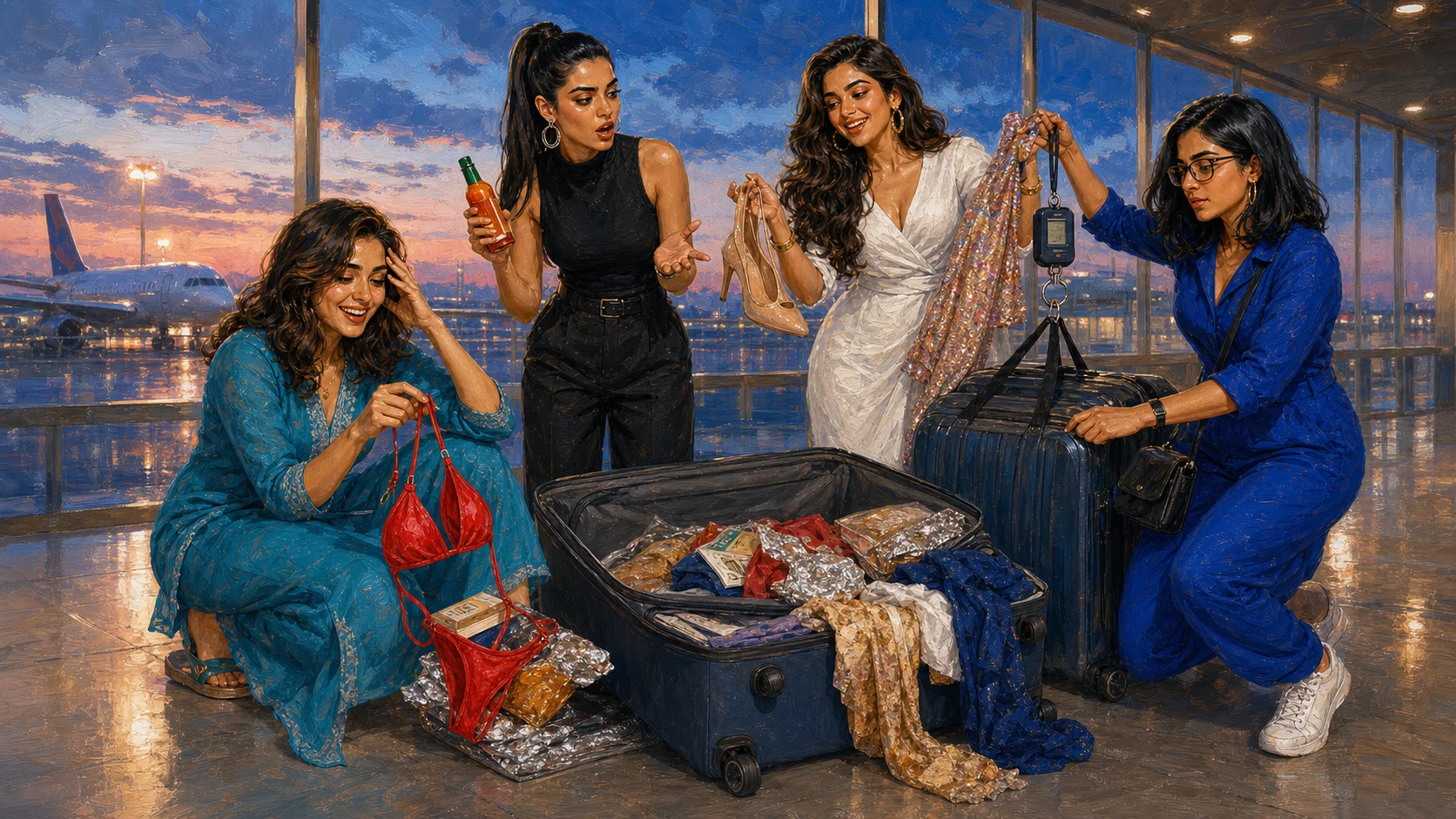
At the airport, under white lights that made everyone look pre-regretful, the scale confirmed Naina’s judgment. Seven kilos overweight.
“Remove items,” the airline employee said.
The four women opened Meher’s suitcase on the floor beside the check-in queue. Out came three pairs of heels, a hair dryer, a sequinned dress, two unopened bottles of skincare and an entire emotional-support wardrobe.
Families moved around them. A child pointed. Rhea held up a silver boot.
“For which part of Goa?” she asked.
“Night.”
“Which planet?”
Naina redistributed toiletries with military precision. Tanya opened her own cabin bag. The red bikini fell out between a novel and a packet of parathas.
Rhea picked it up by one strap.
“Evidence,” she announced.
Tanya snatched it back as her phone rang.
Papa.
She answered while forcing the bikini beneath a cardigan.
“Boarded?” Rajiv asked.
“Checking in.”
“Documents safe?”
“With Naina.”
“Taxi confirmed?”
“Yes.”
“Call after landing.”
“I will.”
There was a short pause.
“Have fun,” he said.
“We will.”
This, Tanya thought, was one promise she could make honestly.
They reduced the suitcase by wearing extra layers and carrying suspicious quantities of footwear. At security, Rhea was stopped for a bottle of hot sauce she claimed was medicinal. Meher objected to the lighting in the departure lounge. Naina counted boarding passes twice. Tanya bought coffee for everyone and accidentally used the school staff-room payment card she had saved in her phone.
By the time they reached the gate, they were tired, over-dressed and laughing too loudly.
Through the glass, the aircraft waited in the pale morning.
“Last chance to behave sensibly,” Naina said.
Rhea held out her hand. “Rejected.”
Meher placed hers on top. “Holiday rules apply after boarding.”
Tanya looked at the women who had known her before she became Miss Sachdeva, before employment and predictable dinners, before sensible became a room she did not know how to leave.
She put her hand over theirs.
“No one abandons anyone,” she said.
“No one judges anyone,” Meher added.
“No one bankrupts anyone,” Naina said.
Rhea grinned. “No one returns with an entirely clean record.”
The boarding announcement began.
They collected their bags and moved toward the gate in a noisy, uneven line. Tanya’s phone vibrated with a final school email. She looked at the sender, then switched the device to airplane mode without opening it.
For the first time in four years, Miss Sachdeva became unreachable.
Tanya smiled and boarded the plane.