The first thing Aalekh notices is the silence.
Not the polite, academic kind that settles over campus interview rooms when students are trying not to breathe too loudly. This is a different silence—thick, expensive, controlled. It belongs to glass walls and polished floors, to women who have learned how to occupy space without wasting it.
Varnika Beauty has sent its final-placement panel to the MBA campus in a convoy of black cars and sharp tailoring. Even before Aalekh sees the faces, he sees the effect they have on the room. The placement office has been scrubbed into submission for the day: fresh flowers in a white ceramic vase, water bottles lined like soldiers, a bowl of mints no one touches. Outside, the October sun burns over the college lawns. Inside, the air-conditioning is too cold and the stakes are too warm.
He is seated in the waiting row with nine other shortlisted candidates, all of them trying very hard to look like men who are not trying. Navy suits. White shirts. Rehearsed smiles. One boy keeps checking his tie in the dark reflection of the window; another flexes his jaw as if confidence can be manufactured by clenching. Aalekh does neither.
He sits back with his ankles crossed, one hand resting loosely on his knee, as though this room is only mildly interesting. He knows exactly how that reads. Careless. Composed. Slightly insolent. The kind of young man older people want to correct and younger people want to imitate.
He is twenty-three and already understands the architecture of attention.
Across the room, a woman in a charcoal saree speaks to the placement coordinator in a low, clipped voice. Nandita Menon, the sheet on the desk said. Team Lead, Brand Strategy. Thirty-six. Unmarried.
That last detail has no business being on a document, which is precisely why it stays in his mind.
She is not the loudest woman in the room, not by a long shot. But she has the kind of stillness that makes other people unconsciously lower their voices. Medium height. Lean. Hair pulled back so cleanly it looks almost severe. Her blouse is cream, her saree border a deep bottle green, and nothing about her outfit begs for attention. Yet she has it. Not the easy attention women like, but the harder kind—attention won by competence, by restraint, by the quiet refusal to apologise for existing.
Aalekh watches her once, then looks away before it becomes obvious. He is not here to stare. He is here to be chosen.
And Varnika Beauty, he has already decided, is a company built by women who choose carefully.
The door opens again.
A hush passes through the room like a hand.
Two more women enter, and the temperature changes, though the air-conditioning remains the same.
The first is in a rust-colored saree with a narrow gold border, her hair braided and pinned back with precision. Priya Khanna, marketing manager, according to the briefing notes he memorised on the cab ride. Married. Immaculate. The sort of woman who can make a deadline sound like a personal favor. The second is younger, in a black pantsuit cut so sharply it feels almost aggressive. She does not smile. She does not need to. Her presence brings order with it, as if the room itself has been reminded to stand straighter.
Shalini Rao.
CEO.
At thirty-nine, she is younger than half the placement team and colder than all of them combined.
The third figure does not enter with them.
She arrives later, almost unnoticed by everyone except Aalekh, who is absurdly aware of people who don’t need to announce themselves. The old woman in the ivory saree moves with the measured grace of someone for whom time has become a servant rather than a master. Vasudha Singhania—the founder, the name behind the empire, the woman whose face is printed in magazines beside words like visionary and legend and self-made in a country where those words are usually assigned to men.
She is not on the panel. She is not meant to be. But she stands at the edge of the room for a moment, speaking softly to Shalini, and every head inclines by a degree, whether its owner means to or not.
Aalekh feels it then: the shape of the company. Women at the top, women in the middle, women everywhere in between. Power stacked in elegant layers, not loud but absolute. A place where a man would not be expected to lead—only to adapt. To prove his usefulness. To be remembered if he performs well, forgotten if he does not.
He likes that.
He likes that far too much.
“Next candidate,” the coordinator announces.
Aalekh rises.
He does not hurry. He does not over-adjust his jacket. He walks in with the measured calm of a man who has already decided he belongs in the room and is simply waiting for everyone else to catch up.
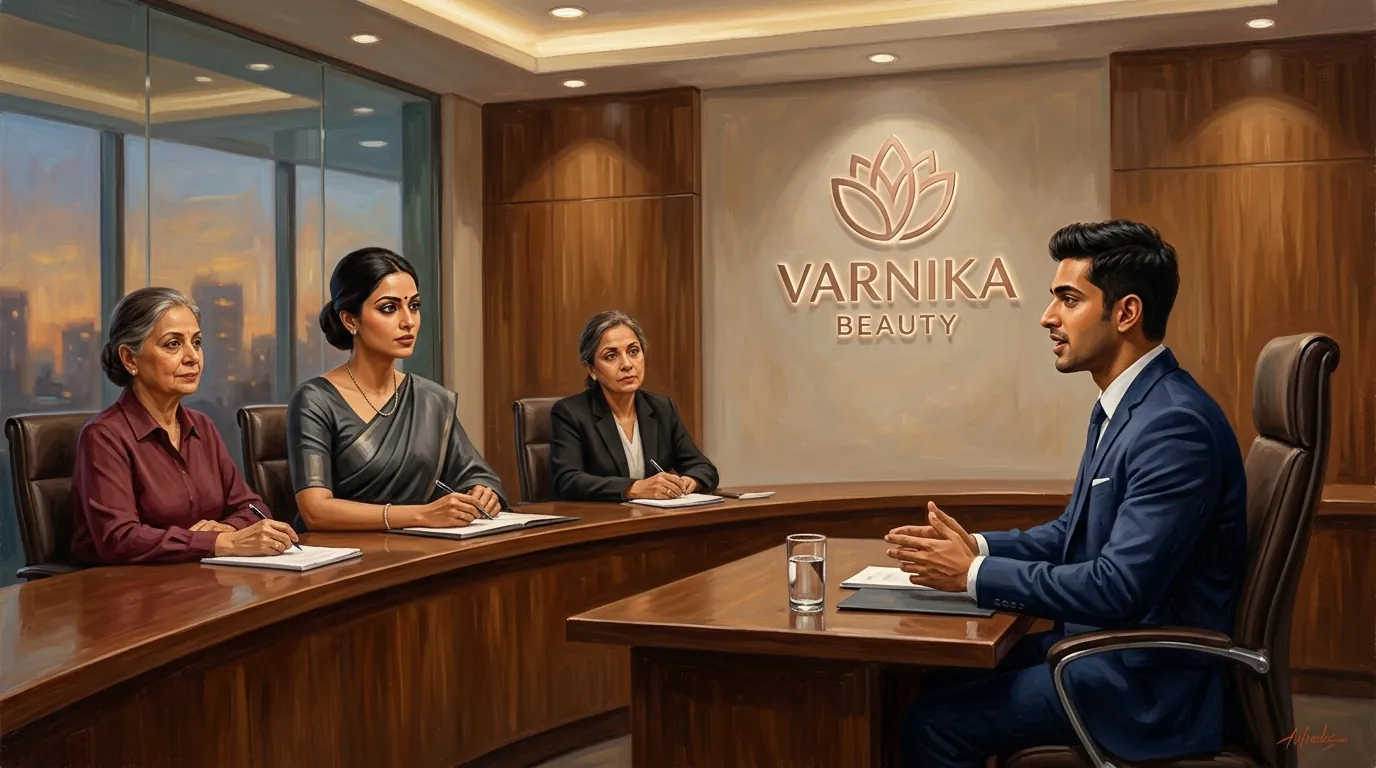
The interview panel is arranged in a long arc behind a polished table, each woman holding a folder, a pen, a different expression of scrutiny. There is a water glass in front of each of them, untouched. Behind them, Varnika’s logo gleams in soft metallic letters against a white wall. Confidence in a font.
Aalekh gives them the exact smile he has perfected for occasions like this—not too eager, not too defiant. Just enough warmth to suggest intelligence beneath the polish.
“Good morning,” he says.
“Good morning,” Priya replies, with the faintest hint of amusement. “Aalekh Srivastav?”
“Yes, ma’am.”
There is a pause at that. He has given her respect without servility. Smart.
Nandita glances at his resume. “You topped your batch in consumer behavior.”
“Yes.”
“Only ‘yes’?” Shalini says, one eyebrow lifting.
Aalekh turns to her with a look that is almost innocent. “If I say more, ma’am, it starts sounding like bragging.”
That earns the first real shift in the room. Not a smile, exactly. Something more useful. Interest.
Priya’s pen stops moving.
Nandita watches him with a stillness that feels like a blade held flat against skin. “Then let us avoid bragging,” she says. “Tell us why Varnika.”
There it is. The real question.
Aalekh folds his hands loosely behind his back before answering, as though he is speaking from a place of ease rather than calculation.
“Because Varnika doesn’t sell makeup,” he says. “It sells permission.”
No one interrupts. He can feel the room leaning, ever so slightly, forward.
He continues, voice even. “For a customer, the product is not only a lipstick or a serum. It’s a private agreement with herself. ‘Today I want to be seen.’ ‘Today I want to disappear beautifully.’ ‘Today I want to enter a room and not apologise for taking up space.’ Varnika understands that better than most brands. It doesn’t just market beauty. It markets agency.”
Priya’s expression changes first. She is married, yes, but not dead. Her eyes narrow with the pleasure of recognition.
Shalini says, “Interesting.”
Aalekh tilts his head. “It’s also smart. Indian women buy aspiration differently. We pretend the purchase is about shade matching or skin tone or the formula, but it’s often about the emotional aftertaste. The feeling that one has made a choice for oneself. Varnika’s campaigns understand that. They don’t shout. They don’t instruct. They seduce.”
The word hangs in the air a second too long.
He sees Nandita notice it. Of course she does.
“Seduce,” she repeats, voice controlled. “That’s an unusual word in a placement interview.”
Aalekh meets her gaze. “Not if the market is listening.”
There is a beat of silence. Then Priya, to his surprise, gives a small laugh.
“Fine,” she says. “Explain your last internship. You were in sales strategy, yes?”
For the next twenty minutes, they ask him about market segmentation, influencer fatigue, regional expansion, crisis response, and a campaign that had tanked in the north because the tagline sounded too much like moral instruction. Aalekh answers cleanly, quickly, never too much, never too little. He is good at this. Better than good. He can almost feel the panel recalibrating around him, each woman testing a different angle and finding, to her own irritation, that he has already considered it.
When Shalini asks how he would handle a product launch that failed to land with urban women but overperformed in tier-two cities, he offers a strategy involving micro-local narratives and differentiated messaging.
When Priya presses him on whether data should ever overrule instinct, he says, “Only when instinct is pretending to be vanity.”
That lands harder than he expects.
Priya looks at him over the rim of her spectacles, and for the first time her expression is not managerial. It is personal, almost involuntary, as if he has briefly reminded her of a younger self who still believed brilliance could be enough.
Nandita, however, remains difficult.
She watches him as though watching for a seam in expensive fabric. “You speak well,” she says. “That’s not the same as thinking well.”
Aalekh smiles, the corner of his mouth lifting with just enough irony to be dangerous. “No, ma’am. But thinking well without speaking well is just private suffering.”
That gets a flicker from her mouth—a near-smile, quickly buried.
He notices everything. He notices that her left hand is bare except for a slim watch. That the pen she holds is clicked between her fingers with unnecessary precision. That she has not once looked at him in the way young men usually expect to be looked at. She is not impressed by youth. Good. He has no use for women who confuse freshness with substance.
“Why should we take you?” Shalini asks, brisk as a blade.
Aalekh answers without hesitation. “Because I will learn faster than the others and stay calmer under pressure than most people older than me.”
“Confidence,” Shalini says.
“Accuracy,” he replies.
Her gaze holds his for one beat longer than is comfortable. “And if we say no?”
The room stills.
Aalekh lets the question settle before he answers. “Then I’ll be disappointed, ma’am. But I won’t be surprised.”
That brings the first real smile from the CEO. It is small, almost cruel, and all the more valuable for it.
“Why not surprised?”
“Because I know what I look like.”
It is a calculated line, but not a false one. He knows the effect of his face, his voice, the careful restraint of his clothes. He knows that beauty, when handled intelligently, can become a kind of leverage. He also knows that admitting awareness of it disarms people who expect vanity.
A tiny shift passes through Nandita’s eyes. She has seen that trick, or one like it, before. She is not fooled. But she is, perhaps, slightly offended by how well it works.
The interview continues.
At some point, Vasudha Singhania steps into the room and stands at the back, silent. No one announces her. No one needs to. The presence of the founder is enough to make even Shalini’s shoulders sharpen by a fraction. Aalekh feels the weight of it immediately. He does not turn. He keeps speaking to the panel, but he is aware of the old woman’s gaze like sunlight on the nape of his neck.
When the interview ends, Nandita says, “Thank you, Aalekh. Please wait outside.”
He nods. “Thank you for your time, ma’am.”
He leaves with the same controlled pace he entered with, but the instant the door closes behind him, the oxygen in his lungs seems to return all at once. He does not exhale fully. He knows better. The room has been deciding his future without him for the last half hour.
In the corridor, other candidates stare at him with open irritation.
Of course they do.
He is younger than most of them. Better dressed, perhaps. Certainly more relaxed. And he has just walked out of a women-led panel looking as though he might already be employed. That is enough to make men hostile and women curious, which, in his experience, is the ideal balance.
He moves toward the windows at the far end of the corridor, where the college courtyard lies bright and indifferent below. Students cross with backpacks and exam anxiety. Somewhere, a canteen vendor shouts over the noise of a generator. Normal life continues with insulting ease.
Behind him, the door opens.
He turns before he can stop himself.
Nandita steps out.
Up close, she is more dangerous than she was inside the room. Not because she is more beautiful—though she is, in a controlled, almost severe way—but because she has the air of a woman who has survived enough nonsense to recognise it instantly. She closes the door behind her and studies him without apology.
“You were very polished in there,” she says.
Aalekh gives the smallest shrug. “That’s generally considered a professional trait.”
“It can also be a shield.”
He smiles, slow and faint. “Only if someone is trying to attack me.”
Something in her expression tightens. He has not misstepped. He has, however, touched a nerve.
The corridor is emptying now. A few candidates pass, pretending not to notice them. The placement office’s frosted-glass windows catch the light and throw it back in clean white shards. Nandita folds her arms, and the movement draws his attention despite himself—the elegant line of her wrist, the watch, the slimness of her fingers, the composure of a woman who does not waste gestures.
“You know,” she says, “you answer like someone who has been coached to be liked.”
Aalekh meets her eyes. “And you speak like someone who is tired of being disappointed.”
The words are out before he can soften them. Not cruel. Worse—accurate.
For a second, she says nothing.
Then she takes one step closer.
Not enough to be called intimate. Enough to make his body understand the difference.
“You’re very young,” she says quietly.
“Yes, ma’am.”
“And very sure of yourself.”
“Yes, ma’am.”
A faint, almost invisible curve touches her mouth. “That’s the problem. People who are young and sure of themselves usually turn out to be reckless. Or lucky. Or both.”
Aalekh does not move. He can smell something clean and expensive on her—jasmine, perhaps, or sandalwood, something restrained enough to be remembered only when standing this close. His pulse does one stupid, traitorous thing. She notices, of course she notices. Her eyes drop to his throat for a fraction of a second and then return to his face, as if she has registered exactly how human he is.
“I’m neither, ma’am,” he says.
“Not yet.”
The way she says it is almost soft.
That is what makes it dangerous.
He should step back. He does not. He has never been good at retreat when curiosity is involved.
Nandita lowers her voice further. “You have a habit of looking at women as if they are already giving you something.”
Aalekh’s smile thins. “Do I?”
“Yes.”
“And is that a problem?”
“It depends,” she says. “On what you intend to take.”
For a moment, neither of them speaks. The corridor hums faintly with distant college noise, but around them the air feels unnaturally still. He sees it now with startling clarity: this woman is not merely suspicious. She is lonely in a way that has learned to wear authority. A woman who has built herself so carefully that no one is allowed to lean on her, and yet some part of her still stands in the doorway of wanting.
He should not know that from one look.
He does.
He lets a beat pass before answering. “What makes you think I intend to take anything?”
Her gaze does not waver. “Because men who have your kind of face always do.”
A laugh almost escapes him. Instead, he says, “That’s unfair.”
“Life is.”
There it is again—that dry, contained edge. The thing beneath the professional shell. She is not flirting. Not exactly. She is testing. Warning. Perhaps both. Yet the space between them is charged enough to feel like a secret neither has agreed to keep.
A phone vibrates somewhere inside the room behind her. She does not turn.
“I’ll tell you one thing,” she says. “Varnika does not reward charm alone.”
“I’d be insulted if it did.”
“Good. Be insulted less. Learn more.”
Then she moves to pass him.
He smells her perfume again as she comes close, a clean, expensive trace that disappears too quickly. He catches himself looking at the line of her jaw before he can stop. It is a mistake. A beautiful one.
She pauses beside him, not quite facing him, not quite leaving.
“You may get the offer,” she says. “Or you may not. Either way, don’t confuse attention with welcome.”
Aalekh looks down at her, and for the first time since he arrived on campus, he feels the faint, thrilling prickle of a woman who might actually be able to wound him.
“Yes, ma’am,” he says.
She tilts her head, as if deciding whether he is insolent or intelligent enough to be forgiven. “And one more thing.”
He waits.
“If you come to Varnika,” Nandita says, eyes steady on his, “do not assume the women here are lonely enough to be impressed by you.”
The corridor seems to narrow around the sentence.
Aalekh smiles then, but not in the easy way he does for interview panels. This one is slower, sharper, almost private. “I wouldn’t insult you by assuming that, ma’am.”
For the first time, her composure falters by a hair.
Not much. Just enough.
Then she turns and walks back into the room, leaving behind the faintest wake of perfume and warning.
Aalekh stands still for a moment after she disappears.
He should feel chastened. He feels, instead, awake.
By the time he returns to the waiting area, the other candidates have started to gather their belongings in the nervous, overdone way of men pretending not to be anxious. One of them mutters that Varnika’s panel is impossible. Another says the CEO looked like she could fire the whole batch with one glance. A third says the team lead with the green border saree is “strict as hell.” Aalekh nearly laughs.
Strict.
That is one word for it.
The result is announced forty minutes later.
Shortlist: Aalekh Srivastav.
A few others too, but his name lands like a match struck in a dark room. He keeps his face controlled as the coordinator reads it out, but inside, something hard and bright shifts into place. He has done it. Campus to empire. Student to recruit. From the crowd into the machine.
The shortlisted candidates are asked to wait for documentation and next-day onboarding details. Around him, some men clap too loudly, too falsely. One of them says “Congrats, bro” with the strained politeness of someone swallowing defeat. Aalekh nods, smiles, accepts it all.
He has learned that winning is easiest when you do not look hungry.
Yet hunger is exactly what he feels.
Not for the job. Not only for the job.
He looks once toward the interview room. The door is closed now. Through the frosted glass, he can’t see the women inside, but he can feel the company they make when together. Structured. Coloured by decision. A closed world with its own codes and appetites.
A woman passing by with files under her arm glances at him and then looks away too quickly. Another slows just enough to study his face, her expression unreadable. The whispers begin almost immediately, soft as silk sliding across skin.
He is handsome.
He answered too well.
Did you see how the CEO looked at him?
No, the team lead was the one.
He’s only twenty-three?
He doesn’t seem like the others.
Aalekh hears all of it and files it away with clinical calm. Gossip is a form of introduction. In a place like Varnika, it is also currency.
Hours later, when the campus office empties and the shortlisted students are told to leave, Aalekh finds himself in the corridor near the lift, waiting for the administrative staff to hand over his formal offer letter. Most of the panel has already departed. Priya’s car had come first. Shalini left without ceremony, black heels clicking once against the marble and then gone. Vasudha Singhania was escorted out by the dean as though the entire campus had become a smaller, humbler place. Nandita, he has not seen since the corridor.
He is disappointed by that fact in a way that irritates him.
Then, just as the lift doors part, she appears again at the far end of the corridor, carrying a slim file against her chest. Alone this time. No panel. No audience. Only the two of them and the white, echoing hush of the office wing.
She sees him. Stops.
The lift waits behind him, open and patient, but neither of them moves.
Nandita’s gaze drops briefly to the folder in his hand, then returns to his face. “Congratulations,” she says, and this time her voice is lighter, though not kinder.
Aalekh inclines his head. “Thank you, ma’am.”
A beat.
“Don’t let it go to your head.”
He almost says something clever. Instead he says, “That would depend on how often I’m allowed to disappoint you.”
The words slip out before he can fully dress them.
Her eyes narrow by a fraction. Not anger. Interest, sharpened.
“You’re bold,” she says.
“Only when I’m nervous.”
That earns him the smallest pause, as though she hadn’t expected honesty to arrive dressed like flirtation.
Then, very quietly, she says, “Good. Nervous men make better mistakes.”
The lift door begins to close behind him. He steps forward at the last second, presses the button, and watches her as the doors seal and reopen. She is still there when they part again, still holding the file, still composed. But now she looks at him as though she has taken his measure and found him more complicated than she wanted.
“Welcome to Varnika,” she says.
It is not warmth. It is not warning alone.
It is both.
Aalekh steps into the lift and turns just before the doors begin to shut again.
Nandita remains in the corridor, one hand resting lightly against the file, the other loose at her side, the picture of control. Yet the space between them feels occupied, not empty. Charged. Unfinished.
As the doors glide closed, he catches one last glimpse of her watching him—not with admiration, not with softness, but with the unnerving attention of a woman who has already decided he is either trouble or temptation.
Perhaps both.
The lift descends.
He looks at his reflection in the mirrored wall and sees what others will see: the neat shirt, the composed mouth, the face too calm to trust. But beneath that, something in him has shifted. The day has given him more than a job. It has given him a stage, a hierarchy, and a room full of women who believe they are the ones evaluating him.
Let them.
At the ground floor, the glass doors of Varnika Beauty open onto the city’s late-afternoon heat, and beyond them, the company’s headquarters rises in pale stone and tinted windows, all clean ambition and hidden rooms. Somewhere inside, women with power are already speaking his name.
Aalekh adjusts his cuff, steps into the sunlight, and smiles to himself as if the future has just leaned a little closer.