The message arrives at 8:14 p.m., after the building has begun to empty and the lights in the glass corridors have shifted from bright white to something more private, more severe.
**Come to Conference Room 7. Now. Shalini.**
No greeting. No explanation.
Aalekh reads it once, then again, standing near the lift lobby with his phone loose in his hand, the screen bleaching his fingers pale. Around him, Varnika Beauty is in its after-hours mode: the hush of closing laptops, the soft click of heels on polished stone, the faint perfume of exhausted women carrying power home with them like a second handbag.
He smiles to himself before he can stop it.
Not because the message amuses him. Because it confirms what he already knows.
When women like Shalini Rao stop being polite, the air changes.
He takes the service lift instead of the executive one. Less theatre. More control. The mirrored doors slide shut, and for a second he catches himself in the reflection: crisp white shirt, sleeves rolled once, no tie, hair neat but not overworked. The look of a man who belongs everywhere and nowhere. He has learned that this is how danger should dress—clean, reasonable, almost forgettable.
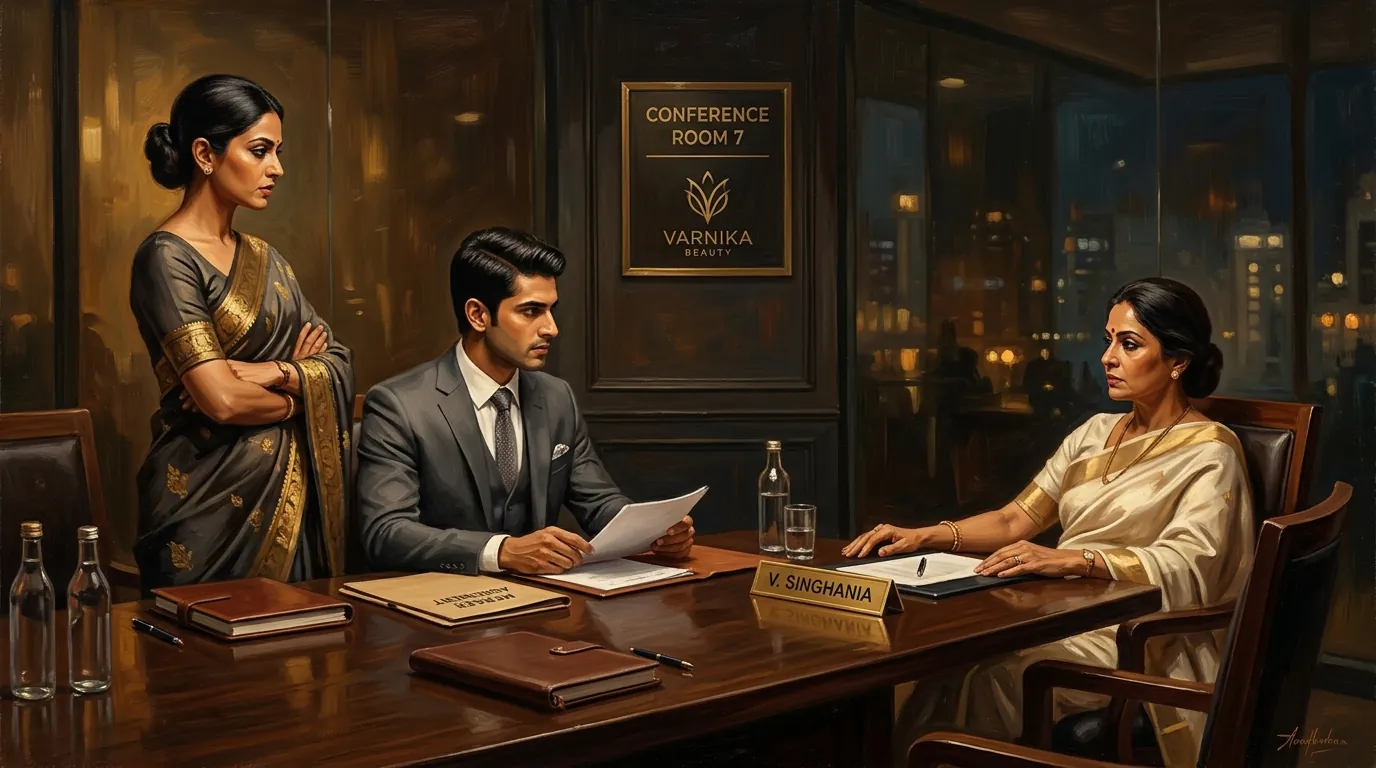
When the lift opens on the seventh floor, the corridor is dim except for the strip of amber lighting along the baseboards. Conference Room 7 sits at the far end, its glass walls blind from the inside. The frosted panels throw back only a pale blur of movement and shadow.
He pauses outside the door.
Then, because he has always preferred entering the room rather than being trapped by it, he knocks once and walks in.
Shalini Rao stands near the head of the table, one hand braced lightly on the polished wood, her posture straight enough to cut glass. She is in a charcoal saree with a narrow metallic border, the kind of garment that looks simple until it catches the light and becomes expensive. Her hair is pinned back with ruthless precision. Her face is calm in the way a blade is calm.
Vasudha Singhania sits at the far end, legs crossed, a tablet abandoned beside her untouched tea. She wears ivory silk and a string of pearls that seems almost ironic on her—too delicate a thing for a woman whose decisions have probably ended careers over breakfast. Her expression is unreadable, but her eyes are not. They are old power: measured, patient, and not in the mood for performance.
Between them, the room feels airless.
Aalekh closes the door behind him and lets the latch click softly into place.
“Ma’am,” he says, with enough deference to sound proper and enough ease to sound unafraid. “You called?”
Shalini doesn’t tell him to sit.
That, more than anything, tells him this is not a routine conversation.
“Sit down, Aalekh,” she says.
He does, choosing the chair opposite her instead of the one closer to Vasudha. Small things matter. Distances matter. He places his phone on the table face-down, then folds his hands loosely. His expression is attentive, almost mild.
Shalini looks at him for a long second, as if testing whether he will flinch.
He doesn’t.
At last she says, “How many versions of yourself are you carrying around this building?”
He gives the smallest of smiles. “Depends who’s asking.”
Vasudha’s mouth twitches once, not quite a smile.
Shalini doesn’t.
“Don’t be clever,” she says. “Not tonight.”
Aalekh lowers his gaze for a beat, as though chastened. It is an excellent imitation. He has spent months perfecting it.
Then he says, quietly, “I’m listening.”
Shalini slides a thin file across the table.
It stops in front of him with a soft whisper of paper on wood.
He doesn’t touch it immediately. He looks at it the way men look at evidence when they are hoping it might turn out to be rumor instead.
“Open it,” Shalini says.
He does.
Inside are printouts. Screenshots. Calendar invites. Hotel confirmations. WhatsApp excerpts with names redacted in black but context still bleeding through the gaps. Enough to be dangerous. Enough to ruin the tidy illusion of innocence. Enough to make a man’s stomach tighten if he had not already been preparing for this for days.
Aalekh turns one page, then another.
A message thread. Not his whole life, not even all his lies, but enough. A late-night note to Priya. A voice recording transcript sent to Nandita. A travel itinerary that should not have been shared. An internal note from a junior employee who saw too much and understood too little. There are timestamps. There are overlaps. There are patterns.
He shuts the file carefully and places both palms flat on it.
“Who prepared this?” he asks.
Shalini’s gaze does not move. “You’re asking the wrong question.”
He looks at her now, fully, letting his face sharpen. “Then what’s the right one?”
Vasudha leans back slightly in her chair, watching him as though he is a product line she is considering for discontinuation.
The silence stretches.
Then Shalini says, “How stupid do you think we are?”
Aalekh says nothing.
It is a mistake, and he knows it at once. Silence can be elegant in the right room. In this room, in this light, with these women, silence is blood in the water.
Shalini continues, each word clipped and precise. “You have been orbiting the leadership team like some charming little satellite. You made each of them think they were the center. You fed them whatever they wanted to hear. Admiration. Attention. Sympathy. Loyalty. And all the while you were collecting access.”
Her eyes narrow.
“Tell me I’m wrong.”
Aalekh looks down at the file again, as though the paper can rescue him.
“It wasn’t like that,” he says.
Vasudha gives a small, cool laugh. “That is always what men say when they are caught. It wasn’t like that. What, exactly, was it like?”
He lifts his eyes to her.
There are very few people in the world who can make a room feel smaller without raising their voice. Vasudha Singhania is one of them. She does not appear angry. That would be easier. She appears interested, and that is worse. Interest from a woman like her is never curiosity; it is assessment.
Aalekh says, “I never intended to—”
“—what?” Shalini cuts in. “Be obvious?”
The question lands cleanly.
He meets her stare and does not answer. Because any answer now would sound like confession, and confession in a room like this is not mercy. It is leverage.
Shalini takes one slow step closer to the table. The room catches the faint trace of her perfume—something cold and elegant, nothing that lingers too warmly. She places both hands on the table, framing the file between them.
“You know what the worst part is?” she says. “Not the lies. Not the flirting. Not the selective attention or the little private smiles you used like currency. The worst part is that you were good at your job. You were useful. You made people feel seen.”
Her mouth tightens.
“And then we discover that what you call being seen is just a cleaner form of manipulation.”
Aalekh’s jaw flexes once.
Vasudha finally speaks, her voice softer than Shalini’s and somehow more dangerous for it.
“Did you think we would never compare notes?”
He says nothing.
“Did you think,” she goes on, “that because we run a women-led company we would be too distracted, too sentimental, too proud of our own empathy to notice a pattern? That we would each believe ourselves to be the exception?”
Aalekh’s eyes flicker, almost imperceptibly, at that. Because it is too close to the truth.
Shalini notices. Of course she does.
Her expression hardens.
“There it is,” she says. “You heard the word exception and your face changed.”
He exhales slowly through his nose, then gives a brief, almost apologetic smile. “You’re both overestimating how theatrical this is.”
Vasudha tilts her head. “Are we?”
He leans back a fraction, just enough to reclaim a sliver of posture. “You’ve both built your careers on reading people. You know that every relationship in an organization has politics in it. Mine just happened to be… more visible.”
Shalini’s eyes flash. “More visible?”
“Yes,” he says, and his voice is smooth now, almost gentle. “I made mistakes. I got too personal in some conversations. I was careless with boundaries. But if you’re saying I engineered some elaborate conspiracy—”
“Don’t insult us,” she says.
And there it is again: the steel under silk.
He looks at her, then at Vasudha, and decides that honesty—partial, strategic honesty—may buy him time.
“I did what I thought was necessary,” he says.
Vasudha’s gaze settles on him like weight.
“For what?” she asks.
He holds her eyes. “To move here. To matter. To not be invisible.”
Shalini lets out a short, disbelieving breath. “So you used us.”
He doesn’t answer quickly enough.
That is answer enough.
The room goes still.
Outside, somewhere beyond the frosted glass, the building hums with the late-night life of a company too large to sleep. Elevators. Security radios. The distant murmur of someone laughing near the pantry. Ordinary sounds. Fragile sounds. As if the world is not collapsing in here.
Vasudha studies him for a long moment. Then, unexpectedly, she asks, “Which one of us did you think would save you?”
The question slices the air open.
Aalekh’s mouth parts slightly before he closes it again. For the first time that evening, something like real caution enters his face.
Shalini sees it. Her eyes narrow.
“You did think that,” she says. “You absolutely did.”
He says, very quietly, “I thought you would understand ambition.”
Vasudha’s expression does not change, but the temperature in the room drops.
“Ambition,” she repeats. “Do not confuse predation with ambition.”
He almost smiles at that—almost, because she is not wrong, and because being corrected by Vasudha Singhania carries a strange, humiliating intimacy. He has been scolded by senior women before. Not like this. Never like this, with such complete knowledge of the shape of him.
Shalini straightens and walks around the table until she stands behind his chair. He feels her there before he sees her in the glass reflection—a dark, elegant presence at his shoulder, close enough that he can sense her perfume and the heat of her body through the air, though she does not touch him.
Her voice comes low, near his ear.
“You have been playing a very long game for a boy who still thinks charm is a personality.”
He keeps his gaze ahead.
“Look at me,” she says.
He does.
Shalini’s face is composed, but her eyes are unmistakably furious now. Not loud fury. Controlled fury. The kind that has already decided its next move.
“Tell me,” she says, each word measured, “did you ever mean any of it?”
The question hangs there.
This is the question beneath all questions. Not about policy. Not about HR. Not about the board. Not even about scandal. Women like Shalini do not ask men like him whether they are guilty. They ask whether the lie had warmth in it. Whether the tenderness was counterfeit from the beginning. Whether they were foolish, or merely human.
Aalekh looks past her for a second, toward the glass wall, toward the darkened office beyond. In the reflection, he sees himself with two powerful women flanking him in a room that smells faintly of paper, tea, and expensive restraint.
He should lie. He is very good at lying.
But lying now would be too easy, and easy things are often traps.
So he says, carefully, “It was real enough.”
Shalini’s face goes still.
Vasudha’s eyes sharpen.
Aalekh continues, voice quiet and even. “For the moments they needed to be. For the conversations. For what people wanted to hear. Real isn’t always pure.”
Shalini’s laugh is brief and joyless. “How convenient for you.”
He gives the smallest shrug. “It’s the truth.”
“It is not the truth,” she says. “It is a refuge.”
Vasudha leans forward now, resting her forearms on the table. “Then let us ask the cleaner version. Did you care?”
Aalekh does not answer immediately.
Because this is the one question that can damage him from the inside.
He thinks of Nandita’s controlled silence, of Priya’s tired eyes when she forgot to armor herself, of the way Shalini looked at him once when he solved a crisis and made him feel—absurdly, dangerously—seen, and of Vasudha herself, who never once gave him the luxury of thinking he had fooled her entirely.
He thinks of the way each of them made him feel larger than his own age.
Wanted. Protected. Selected.
He thinks of how quickly desire can become dependence when one person has power and the other has hunger.
Then he says, “I cared about what it gave me.”
Shalini’s expression shifts—not into surprise, but into something colder. Final.
Vasudha sits back, as if he has just confirmed a calculation.
“Better,” she says softly. “At least now we are not pretending.”
Aalekh looks from one woman to the other and understands, with unpleasant clarity, that the room has already moved past the stage where he can charm his way out. There is no easy hand on the shoulder, no indulgent warning, no private protection from one woman against another. The alliance is complete enough to be dangerous.
Shalini reaches for a second folder from the table and flips it open.
“Here is where we are,” she says. “The internal review has begun. HR is aware. Legal has been briefed on enough to recommend suspension pending inquiry. If the board takes this to the media, it becomes a reputational event. If the media gets it first, it becomes a brand crisis. If one of the women you entangled decides to speak publicly, it becomes personal destruction.”
She looks directly at him.
“And if you think I am being dramatic, remember that our investors do not pay us to protect pretty boys with good diction.”
Aalekh’s mouth tightens.
Vasudha adds, almost conversationally, “We can end this quietly. Or we can let it become the kind of cautionary story that follows a man for the rest of his career.”
He sits very still.
Quietly. That word lands with almost obscene power. Quietly means extracted, managed, erased without spectacle. Quietly means mercy, but only of a corporate kind. No headlines. No public humiliation. Just a sealed file, a damaged reputation, and the long private consequence of being known.
“Why are you telling me this?” he asks.
Shalini’s eyes are hard. “Because I want you to understand the difference between being protected and being tolerated.”
The words strike deeper than they should.
Aalekh looks at her, and for a moment his expression loses its polish. Only for a moment. Enough for a crack, not enough for surrender.
Vasudha watches that crack with the interest of a woman who has seen empires rise and men collapse over less.
Then she says, “You have one chance to speak plainly. Was anyone here ever more than a rung on a ladder?”
The question is brutal in its simplicity.
Aalekh’s throat moves once.
He could say no. It would be believable enough, perhaps. He could say yes. It would be worse. He could say something artful and leave everyone angry. But the room has already taken his measure. There is no answer that restores him.
So he chooses the only answer that preserves a sliver of control.
“Different things were real to different people.”
Shalini stares at him for a long beat.
Then, in a voice so calm it is almost intimate, she says, “Get out.”
He does not move.
Vasudha says, without raising her voice, “Aalekh.”
It is not a command. It is more dangerous than a command. It is disappointment wearing silk.
He stands.
The chair slides back with a soft scrape that seems far too loud in the room. He keeps his face composed, but something inside him has shifted—an internal alignment, a recognition that the board he has been standing on is no longer steady.
Shalini doesn’t step aside as he comes around the table. He has to pass within arm’s length of her. Close enough to feel the edge of her perfume. Close enough to notice the pulse in her throat, quick and controlled, the smallest sign that she is still very much alive with anger.
He stops for the briefest instant.
“Shalini,” he says, not pleading, not yet.
She looks at him as if he is already a past tense problem.
He tries Vasudha’s name next, softer, almost respectful.
She holds his gaze and says, “You should have been more careful.”
Not kinder. Not crueler. Just true.
He nods once, because anything else would be performance, and perhaps for the first time in this building, performance is useless.
He reaches the door.
Behind him, Shalini says, “One more thing.”
He turns.
She stands with one hand on the back of the chair, the other resting lightly on the file. Her face is composed again, but the anger remains in the eyes, banked and bright.
“If you think this ends with us,” she says, “you are still underestimating women.”
Aalekh almost smiles at that. Almost.
Instead he inclines his head. “I never made that mistake.”
Vasudha’s laugh this time is faint, almost approving, and somehow that is the worst sound in the room.
He leaves before they can say anything else.
The corridor outside is too bright after the conference room’s controlled darkness. He stands there for a second, hand on the door handle, listening to the silence behind it as if it might still be speaking. It isn’t. The women inside are not discussing him anymore. They are deciding.
That is what women like Shalini and Vasudha do when the performance is over.
They decide.
Aalekh walks to the lift with measured steps, face smooth, shoulders relaxed, as though his body has not just been cut free from the structure that held it. The building reflects him in passing: a young man in a white shirt moving through a palace of glass and consequence, still handsome, still composed, still too calm for anyone who does not know how much calculation is hiding beneath the calm.
His phone vibrates in his pocket before the lift arrives.
A single new email notification.
From HR.
He doesn’t open it in the corridor.
Not yet.
He looks at the black mirror of the lift doors and sees his own reflection waiting back at him, eyes unreadable, mouth almost amused. Whatever happens next, he has time to choose the shape of his exit. Time to protect what can be protected. Time to decide which truth will be useful and which will be buried.
The lift chimes softly.
The doors begin to part.
And as the polished metal opens to his reflection and the darkened depth beyond, Aalekh’s phone lights up again in his hand—this time with a name that makes his mouth curve, just slightly, before he steps inside.