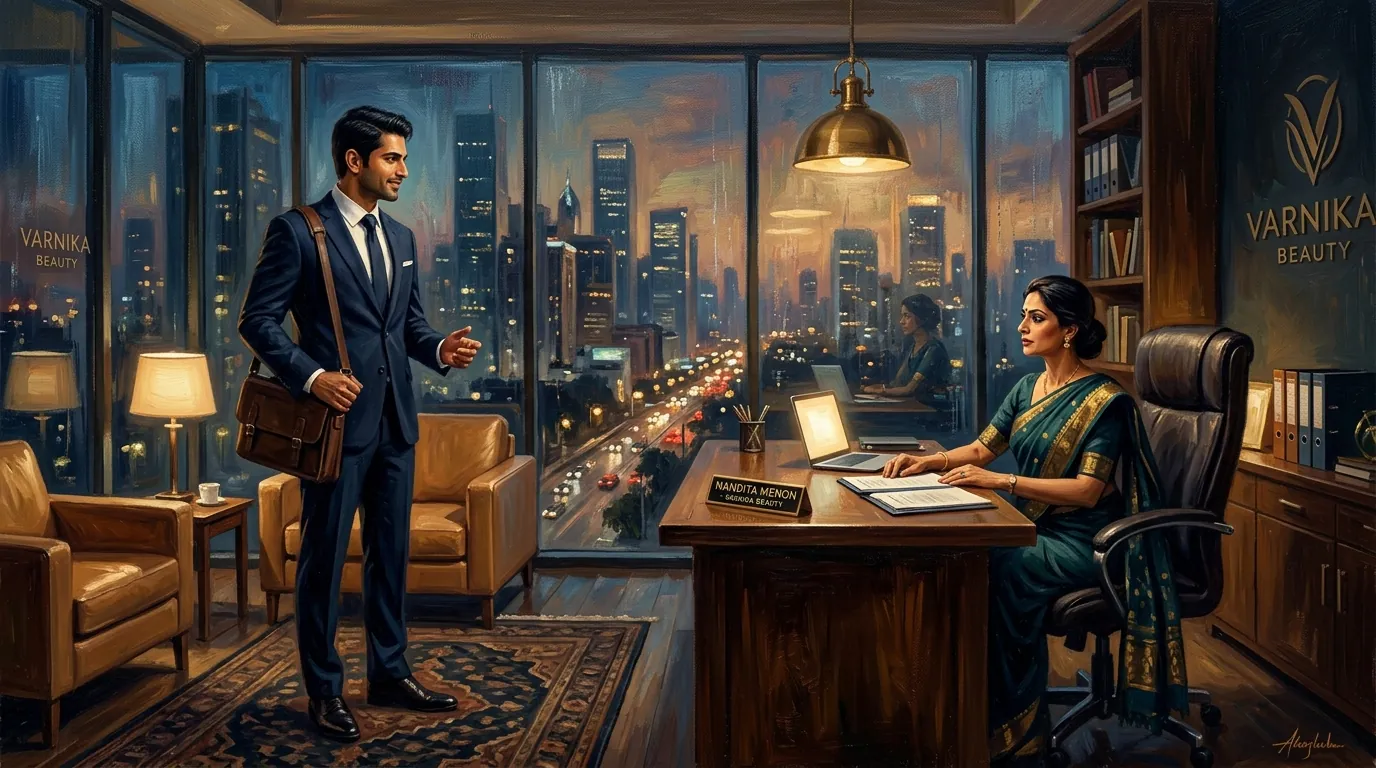
By six-thirty, Varnika Beauty starts to change its skin.
The workday version of the headquarters is all clean lines and efficient voices, a glass-and-marble organism fed by deadlines and ambient confidence. By evening, the offices empty out in layers. Perfume thins into air-conditioning. Heels fade from corridors. The bold red of the reception wall glows softer under the recessed lights, like lipstick after a long conversation. Somewhere in the distance, a housekeeping trolley rattles past a conference room.
Aalekh stays.
He is still in the same crisp shirt he wore through the pitch, sleeves rolled once, collar open at the throat just enough to suggest he has not yet decided whether he is done being useful. His tie is gone. His laptop bag hangs from one shoulder. He looks less like a fresher who belongs to the bottom of the hierarchy and more like a man who has already learned which rooms keep their doors unlocked after dark.
In the Strategy Pod, Nandita is the first to break the silence.
“Again,” she says, eyes on the screen, not on him. “Why did you shift the emotional hook to the last thirty seconds?”
Aalekh leans back slightly, one hand on the table edge. “Because people remember what arrives late. It feels earned.”
Priya, who has been reviewing his deck with the exhausted concentration of someone balancing six crises and one private life, glances up. “That’s a very dangerous sentence for a twenty-three-year-old to say in this company.”
He gives her the faintest smile. “I know.”
It is the kind of answer that could mean anything. That is part of his charm. Men like Aalekh do not survive by being transparent. They survive by making every woman in the room feel as if she is the only one clever enough to decode him.
Nandita clicks to the next slide. The room fills with the soft blue glare of the presentation. Product launch. Consumer insight. Market segmentation. Conversion funnel. Words that should be sterile, but in his mouth and on his deck they have a pulse.
He had rebuilt the campaign in forty-eight hours after the original agency version came in too loud, too desperate, too male. He had not said it that way, of course. He had said the copy lacked restraint, the visuals were trying too hard, the whole thing felt as though it was asking women for permission instead of offering them power.
That had made Nandita look at him for the first time with something close to respect.
Now, as he talks, the women at the table watch him in different ways.
Nandita watches for errors and finds none.
Priya watches the ease of his voice, the care with which he phrases each response, the way he never interrupts but still manages to guide the room toward what he wants.
And Vasudha Singhania, seated at the far end of the table with one hand resting lightly beside a closed notepad, watches the youngest person in the room as if he is a problem she has not yet decided to solve.
She has not spoken in twelve minutes.
That is usually when everyone else starts speaking more carefully.
Vasudha does not need to dominate a room. She has long ago learned that real power does not perform. It settles. It waits. It lets other people become nervous enough to reveal themselves.
Tonight she wears ivory silk without ornament, her hair pinned back with a severity that makes the planes of her face look sharper than they are. At fifty-four, she does not look softened by age. She looks refined by refusal. The refusal of sentiment. The refusal of clutter. The refusal to explain herself to anyone who does not deserve it.
Yet when Aalekh shifts the final recommendation into a cleaner pricing ladder and ties it to a distribution logic that saves the company nearly twelve percent in projected launch burn, something in her expression changes.
Not much. Just enough.
“Aalekh,” she says at last, voice calm, “whose idea was the regional staging?”
He does not hurry. That would look eager.
“It began as a rough thought from the team,” he says. “I tightened it after looking at the sell-through data from the previous quarter.”
Nandita’s eyes narrow a fraction. She knows he is being modest on purpose. Priya knows it too. Vasudha certainly knows it. But no one calls him out, because the room has already seen the effect: the deck lands. The numbers are better. The launch is safer. The language is more elegant. The campaign feels less like a shout and more like an invitation.
And invitations, at Varnika, are what women notice.
Vasudha closes the notepad. “Send me the revised budget before you leave.”
Aalekh nods once. “Yes, ma’am.”
She studies him a beat longer than necessary, as if weighing the cost of that exact obedience.
Then she stands. “Good work.”
Three syllables. No warmth. No praise. Yet the entire table straightens as though a hand has moved over their heads.
When she leaves, the room exhales.
Priya rubs at the bridge of her nose. “That’s the nearest thing to applause from her.”
Nandita is already gathering her papers. “Don’t let it go to your head.”
Aalekh smiles at the screen, where his final slide glows like a small victory. “I wouldn’t dream of it.”
But something in his face says otherwise.
He knows exactly what has happened here.
He has not merely saved a campaign. He has entered a private zone of usefulness. The kind that senior women remember. The kind that creates access. The kind that begins with work and ends with doors opening because someone upstairs has decided you are worth keeping nearby.
By the time the others leave, the floor has gone nearly silent.
Nandita goes first, as she always does, with her laptop tucked under one arm and the look of a woman who has already moved on to the next problem. Priya lingers a moment longer to send an email from her phone, then glances toward him with a tired half-smile that could mean gratitude, amusement, or the beginning of trouble. She is wearing a green saree that catches the light when she turns, and Aalekh notices the slight looseness in her voice, the way she says, “Good job today,” as if she is trying not to let it mean too much.
He gives her a polite nod. “You carried the room too, ma’am.”
Her expression softens in spite of herself.
Then she goes.
The executive floor settles into its after-hours hush.
Aalekh remains at the corner workstation, adjusting the budget sheet, cleaning up the last of the notes. He is in no hurry to leave. He has learned that the office changes its temperature after dark. People reveal themselves in these hours. The ones who stay late are either ambitious, lonely, or both. The difference between them is often only the quality of the silence.
At seven-fifteen, his phone vibrates.
Unknown internal extension.
He answers. “Aalekh.”
A pause. Then a voice, low and composed.
“Could you bring the revised deck to the founder’s suite?”
He straightens almost imperceptibly.
Vasudha’s secretary. Not Vasudha herself, but close enough to make the request feel deliberate.
“Yes, of course,” he says.
“Ten minutes.”
The line goes dead.
Aalekh looks once at the screen, then at the glass wall across the corridor, where the city has begun to darken into a field of lights. A faint smile touches his mouth and leaves just as quickly. He gathers the printed sheets, slips the laptop into his bag, and walks.
The founder’s suite sits on the top level of HQ, separated from the rest of the office by a discreet access door and a corridor lined with framed campaign photographs from Varnika’s history. Past launches. Awards. Magazine covers. The brand’s evolution displayed like a lineage. Women in high heels and sharper decisions. Lipsticks, serums, compacts, all turned into symbols of confidence and control.
He has only been up here twice before, both times in a group, both times while Vasudha was already moving on to another meeting. Tonight the corridor is empty.
The secretary opens the door with a brief nod and gestures him in.
Inside, the suite is quieter than the rest of the building. The lighting is warmer. The furniture is less corporate, more curated—camel-toned leather, low brass lamps, a long sideboard with crystal tumblers and a tray of untouched biscuits. Through the far glass wall, Mumbai is a dark, glittering spread.
Vasudha stands near the window, phone in hand, as if she has just finished a call she did not enjoy. When she turns, the expression on her face is neutral, but there is something in her eyes that is not.
“Leave the deck,” she says.
He does, placing it carefully on the table in front of her.
She does not pick it up immediately. Instead, she studies him the way she might study a new market entry—quietly, without waste. Her gaze passes over his face, the collar of his shirt, the watch on his wrist, the faint shadow at his jawline where the evening shave has already begun to lose its perfection.
“You stayed late,” she observes.
“There was still work.”
“Mm.” She walks to the sideboard, pours water into a glass, then changes her mind and instead reaches for the tea setup. “Do you drink tea?”
Aalekh blinks once. “Yes.”
The corner of her mouth moves, not quite a smile. “Good. So do I.”
She begins preparing it herself.
That, more than anything, unsettles him.
Women like Vasudha do not pour tea for juniors. They summon, they delegate, they watch. They do not perform domestic ease unless they intend it as a message. And messages from women like her are never accidental.
He remains standing where he is, posture relaxed enough to seem natural, alert enough to catch every shift in her movement. She measures the leaves. Pours water. Lets it steep. No rush. No hurry. The patience of someone who has spent decades making other people wait for her.
When she sets one cup in front of him, their fingers do not touch. They come close enough to make the distance feel intentional.
“Sit,” she says.
He does.
She takes the chair opposite him, crossing one leg over the other with slow, exact grace. The room feels suddenly smaller, though nothing has moved.
For a moment, neither speaks. The city hums behind the glass. Somewhere below, a lift dings. Somewhere farther away, a phone rings and is ignored.
Then Vasudha says, “Nandita respects your work.”
Aalekh lowers his eyes to the tea. “I’m glad.”
“Priya trusts your instincts more than she should admit.”
He lifts his gaze. “I’m flattered.”
“And Shalini,” she says, watching him carefully, “finds you useful.”
He does not smile. “Useful is not a bad thing.”
“No,” Vasudha says. “It is not.”
She sips her tea, and the silence after that sip is almost intimate.
Aalekh has spent enough time around powerful women to know that the most dangerous moment is not when they flirt. It is when they stop pretending the conversation is only about work.
Vasudha sets down the cup. “Tell me something, Aalekh.”
“Yes?”
“Do you know why I called you here?”
There are many possible answers. He chooses the one that gives her room to reveal herself.
“To discuss the launch.”
“That too.” Her eyes remain on his face. “But not only that.”
He waits.
Outside, traffic threads light through the city like a moving necklace.
Vasudha folds her hands. “You have a talent for making people feel seen.”
The sentence lands with subtle force. He keeps his expression composed.
“I try to understand the brief,” he says.
“Don’t reduce yourself.” Her voice is cool, but not unkind. “You know what you do.”
He lets a small silence form. Then: “And what do I do, ma’am?”
That finally earns him a look—sharp, approving, almost amused.
“You make women forget they are supposed to be guarded.”
The words sit between them, elegant and dangerous.
Aalekh does not answer immediately. He lets the moment breathe. A lesser man would deny, deflect, overplay innocence. He knows better than that. Denial looks cheap. Calm is more seductive.
“I think,” he says at last, “that women at Varnika are not easy to impress. So when they do trust someone, it usually means that person has earned it.”
Vasudha’s gaze narrows slightly, as if she is measuring the sophistication of the dodge.
“And have you earned it?” she asks.
The question is too direct to be casual.
Aalekh leans back a fraction, one hand resting over the arm of the chair. “I hope so.”
She studies him for a long beat, then looks away toward the window. From this height, the city appears like a field of unspoken things.
“When I built this company,” she says, and her voice changes—not softer, exactly, but more private, as if she has decided he deserves a smaller room inside her tone—“people thought I was driven. Or difficult. Or lonely.” A faint, dry smile touches her mouth. “Sometimes all three in the same week.”
Aalekh says nothing.
“I was called ambitious when the word was still meant to sound like an accusation,” she continues. “And cold, when I was simply tired of explaining myself.”
The tea in his cup has gone slightly cooler. He has not touched it. He is listening too carefully now, because the room has shifted from business to confession, and confession from a woman like Vasudha is rarer than a board-approved miracle.
She turns back to him.
“Men,” she says, “can be lonely in ways that are forgiven. Women are lonely in ways that become public property.”
He feels the weight of that sentence in his chest, though he does not show it.
For a moment, the founder is not the founder. She is simply a woman at the top of a building no one dares to question, speaking to a younger man who has the audacity to look at her without fear.
Aalekh’s voice, when it comes, is softer. “You don’t seem like someone who needs forgiveness.”
Vasudha looks at him for a long time. The room is quiet enough to hear the faint hum of the air conditioner.
“No,” she says finally. “I need control.”
And there it is. The real currency.
He lets the silence settle around that truth. Then, carefully, “Control is overrated when it keeps you from being understood.”
Her eyes flick to his face again.
That lands. He can tell.
A woman like Vasudha does not respond to cheap flattery. She responds to recognition. To the sensation of being accurately named without being diminished. It is a delicate thing, and he is very good at it.
She rises, takes two steps toward the glass wall, and folds one hand behind her back. “Do you know what I envy about your age, Aalekh?”
He watches her. “Tell me.”
“You still believe access is the same as belonging.”
The line is so precise it almost makes him smile.
He stands slowly, not because she asked him to, but because the room has already become a stage of sorts, and he knows when to move. “Isn’t it?”
Vasudha turns toward him. The expression on her face is unreadable, but her eyes are not. They hold the kind of attention that can feel like approval or warning depending on what a man has done to deserve it.
“No,” she says. “Access is just access. Belonging is something people give very reluctantly.”
Aalekh steps closer to the table, stopping at a respectful distance that is also, in its own way, intimate. “Then I’ll settle for access.”
Something in her gaze shifts at that. Not surprise. Interest.
“Most men your age would not know the difference,” she says.
“I’m not most men.”
“No,” she agrees. “You are not.”
The air has changed. It is not heavy. It is charged.
He can feel the exact shape of the moment: how close he is to being dismissed, or invited into something that will matter later. The distinction depends on her mood, her vanity, her loneliness, and perhaps the small, secret pleasure of finding a young man who does not look away when she looks directly at him.
Vasudha returns to the table and picks up the deck at last. She flips through a few pages, but it is obvious she has already reviewed enough to know the answer she wanted.
“Your pricing logic is good,” she says. “More than good. It gives us room.”
Aalekh remains still.
She looks up. “Do you know why that matters?”
“Because margin protects the launch.”
“Because margin protects me,” she corrects.
The candor is almost brutal.
He allows himself a slight, understanding nod. “Then I’m glad it works.”
Vasudha closes the folder. “You should be.”
There is a faint, deliberate pause.
Then she says, “Have tea with me again next week.”
It is not a request. It is not an order. It is worse than both, because it is an opening.
Aalekh meets her gaze without blinking. “Of course.”
Her mouth curves, barely. “Good.”
She reaches for the cup again, and for the first time since he entered the room, he notices the ring on her hand—the wedding band that appears more symbolic than affectionate, a circle worn because the world expects one, not because it still means anything. He notices also how she does not look at it. How she has long ago learned not to let a visible marriage interfere with private truths.
That, too, is a kind of power.
And perhaps that is why she fascinates him more than he wants to admit.
Not because she is older.
Not because she is the owner.
Not because the building itself bends around her name.
But because she is a woman who has survived being wanted and being disregarded in equal measure, and has turned both into authority.
He realizes, with a faint internal jolt, that she has been watching him watch her.
A dangerous smile, very small, touches the corner of her mouth.
“You are thinking too loudly,” she says.
Aalekh lets out a soft breath that almost becomes a laugh. “Sorry.”
“Don’t be.” She lifts her cup. “It is useful to know what a person notices.”
He knows better than to answer that. So he picks up his tea at last and takes one careful sip.
It is strong, slightly bitter, and perfect.
Vasudha sits across from him in the amber quiet of her suite, and for one suspended minute the entire company seems to narrow to the shape of that room: the founder, the younger man, the city beyond the glass, the unspoken current running between them like electricity hidden in silk.
Then her phone lights up on the table.
She glances at it, then at him. “That will be my husband,” she says, and there is no tenderness in the statement, only fact. “He calls at this hour when he wants to remember he is still relevant.”
Aalekh’s gaze remains steady. “Do you want to take it?”
Vasudha’s smile is faint and unreadable. “Not especially.”
She does not pick up the phone immediately.
Instead, she looks at him one last time as if filing him away somewhere private and useful. “Go home when you’re done,” she says. “And Aalekh?”
“Yes, ma’am?”
“Don’t confuse being noticed with being safe.”
He inclines his head. “I won’t.”
But even as he says it, the corner of his mouth suggests that he might already be thinking of exactly how far noticed can take him.
When he leaves the suite, the corridor feels colder.
The secretary is nowhere in sight. The access door closes behind him with a soft, final click that sounds less like dismissal than consent. He stands for a second beneath the framed history of Varnika Beauty, the founder’s private tea still warm in his body, the taste of attention sharper than caffeine.
Below him, the office lights glow in tiers across the darkening city.
His phone buzzes.
A message from Priya.
> Deck was excellent. Founder looked pleased. Good work.
Another, a minute later, from Nandita.
> The regional staging note is strong. Send the revised numbers before 9.
And then, after a pause he can almost feel, a third message from an unknown number that he recognizes instantly.
> Tea next week. 7:30. Don’t be late.
No signature. None needed.
Aalekh looks at the screen, the faintest smile returning to his face as he steps toward the lift.
Private access, he thinks.
The building is full of it.
And tonight, for the first time, he has a key.