By the time the Varnika convoy leaves Mumbai airport, the city has already begun to glitter like something expensive and slightly dangerous.
The trade fair is being held in Goregaon, in a convention center so polished it feels less like a venue and more like a promise. Outside, the roads are thick with honking taxis, delivery bikes, and men in shirtsleeves carrying roll-up stands and sample cases. Inside the executive SUV, the air-conditioning is cold enough to sharpen every thought.
Aalekh sits by the window in a charcoal shirt, sleeves rolled once at the forearms, one hand resting lightly over his phone. He looks calm in the way some knives look calm.
Across from him, Shalini Rao is already reading a file on her tablet, her face lit in hard blue. No jewelry except a watch. No softness anywhere. She has that particular stillness of a woman who does not need to raise her voice because the room has already learned to lower itself around her.
Priya Khanna is beside her, elegant in a cream saree that makes her look both older and younger than forty-two—older in the self-command, younger in the faint strain at the corner of her eyes. She has her laptop open, though she is not really reading it. Every few minutes, she glances at the route map on her phone, as if distance itself can be managed if she keeps checking it.
In the third car, Nandita is coming separately with the strategy team and the product display cases. The owner, Vasudha Singhania, has not traveled with the main group. She has flown in later, private jet, private schedule, private gravity.
“Two days,” Priya says, not looking up from the laptop. “That is all we need to not embarrass ourselves.”
Shalini’s mouth moves by a millimeter. “You make it sound like that is a rare outcome.”
Priya lets out a soft breath that is almost a laugh. “In corporate life, it often is.”
Aalekh turns his head just enough to give Priya his attention. “Ma’am, if embarrassment were a KPI, we would be top quartile.”
Shalini’s eyes lift, brief and assessing. “Do not get clever with me before lunch.”
“Then I’ll wait till dinner,” he says.
Priya’s gaze flicks to him, quick and involuntary. It is only a second, but he catches it. The smallest crack in an immaculate wall. He stores it away without changing expression.
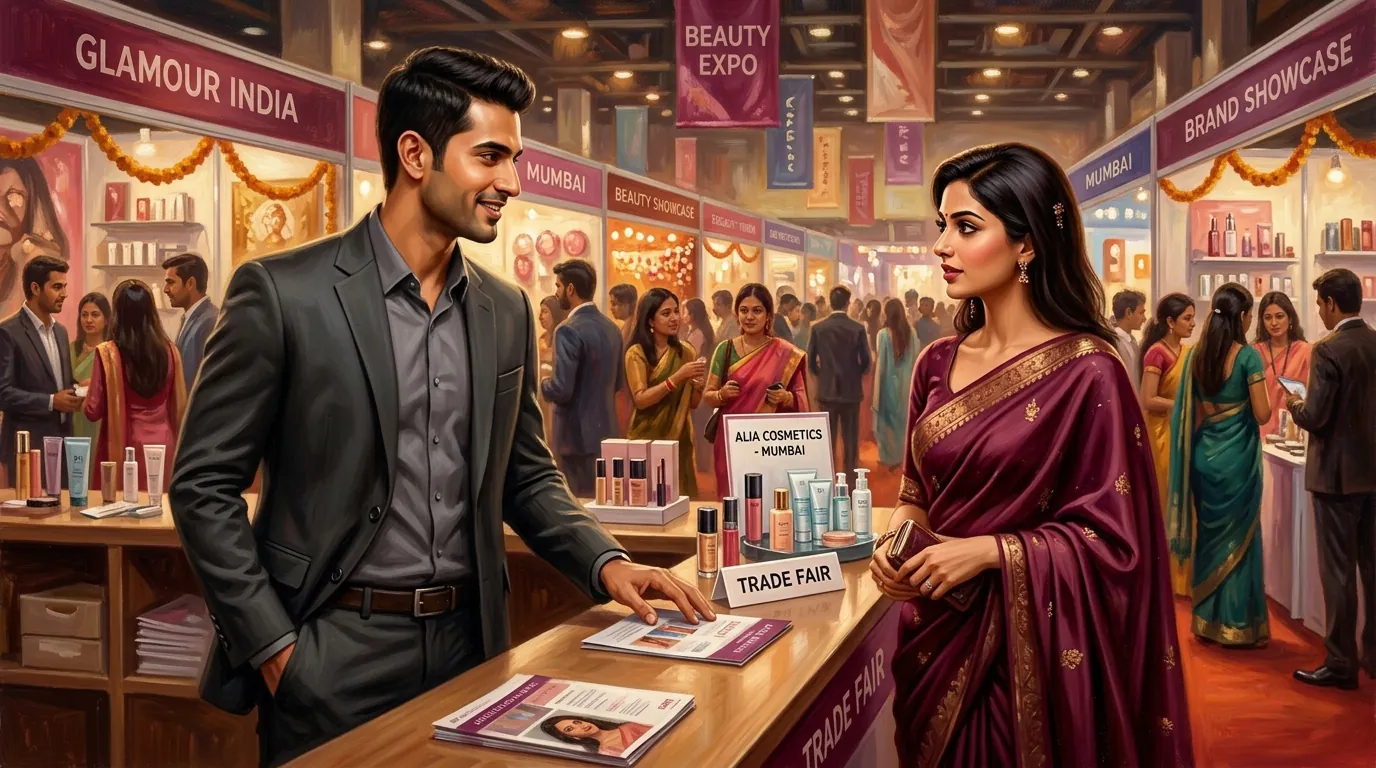
The fair has the usual theatre of scale: enormous banners, brand islands glowing under white lights, hostesses in identical smiles, rival cosmetic companies building temples out of acrylic and ambition. Varnika’s stall is on the main aisle, all matte rose panels and gold trim, with a central display of the new age-defying serum line. The brand language is aspirational, clean, female, decisive. Confidence in a bottle. Youth without apology. Power that smells faintly of iris and sandalwood.
Aalekh likes the way their brand looks from a distance. He likes even more the way it functions up close—every decision a negotiation, every visual a threat disguised as beauty.
By afternoon, the footfall is heavy enough to make the air warm despite the blasting AC. Buyers from multi-brand chains drift through with badges hanging from necks. Bloggers take videos. Competitors send polite spies in well-tailored kurtas. The Varnika team smiles until their cheeks go faintly stiff.
Aalekh moves through it all with the ease of someone who never seems to be searching for approval, only opportunity.
He is stationed near the consultation counter when the first serious buyer arrives from a premium retail chain in Pune. The man is skeptical, the way older buyers often are when they see a young executive without the hard edges they expect from sales leadership. Aalekh listens to him talk for nearly three minutes without interrupting once.
Then he says, “You’re not buying serum, sir. You’re buying margin with a story attached.”
The buyer pauses.
Aalekh continues gently, “Your customers already know what hydration is. What they want is a product that makes them feel they’ve made an intelligent choice. That’s where Varnika wins. It sits in the emotional center, not just the skincare shelf.”
The buyer’s expression shifts. Interest replaces caution. He asks about regional packaging, price bands, and introductory offers.
Within twenty minutes, the man is asking for a draft MoU.
Priya, watching from the side, does not smile—but her eyes soften in a way they do not with most people. Shalini notices, because Shalini notices everything.
“Good,” Shalini says when the buyer moves off. “You did not over-talk.”
Aalekh inclines his head. “You taught me, ma’am, that silence is sometimes a better pitch.”
She studies him a beat longer than necessary. “Do not make me regret teaching you anything.”
His smile is mild. “I never would.”
It is the sort of line that could mean nothing. In the Varnika universe, it means too much.
By five, the fair has settled into its second rhythm: the first rush of curiosity gone, replaced by the more serious work of conversion. Priya has been in meetings almost continuously since morning, coordinating with distributors, calming one regional head, adjusting a promo bundle with another, and answering calls from home with a voice so even it sounds professionally engineered.
Her husband has called twice. She has not taken either call in front of anyone.
Aalekh notices the way she steps away each time, phone held at her ear, her face arranged into the pleasant neutrality women use when they have learned that marriage is also a performance. When she returns, her lipstick is still intact, but something in her expression is fractionally more tired.
He knows better than to ask in the open. The fair has too many ears.
So he waits.
The evening reception begins in the hotel ballroom adjoining the convention center. Varnika has taken a private section near the terrace, all tall glass windows, white orchids, and low amber lighting. The city beyond the glass is a distant shimmer. Inside, the women from the leadership team look expensive in different ways.
Shalini in black, severe enough to cut with.
Priya in a deep wine saree, the color making her skin look warmer than it has any right to.
Nandita arrives late, hair pinned neatly, wearing a slate-blue suit that gives her the air of someone who could close a merger or dismantle a lie without changing her tone.
And then, a little after eight, Vasudha Singhania enters.
The room shifts. Not visibly, not in any crude way. But the air changes around her. She is not dressed to impress anyone. She is dressed to own the evening. An ivory silk sari, emerald studs, a pearl strand that sits at her collarbone like an inheritance. She greets people with a measured smile that never reaches the point of softness, and yet everyone leans in as if warmth might be found there if they are careful enough.
Aalekh sees her before she sees him.
That is always a dangerous sensation, being noticed by a woman who built an empire and never had to ask permission for any of it.
“Srivastav,” Vasudha says when she finally reaches the group. Her voice is low and controlled. “I’m told you have already made yourself useful.”
He bows his head slightly. “Only trying to justify airfare, ma’am.”
“Don’t be modest,” she says. “Modest men are usually hiding incompetence.”
Shalini’s expression does not change. Priya almost smiles. Nandita glances away, as if unwilling to give the moment more attention than it deserves.
Vasudha’s gaze moves over them all, taking inventory in a single sweep. Then she says, “We have a private dinner room at nine. I want the regional buyer shortlist by then. No drama. No heroics. Just numbers.”
She turns and is gone before anyone can respond.
Priya exhales once Vasudha is out of hearing range. “She says no drama as if she did not just arrive like a coronation.”
Aalekh, standing close enough to catch the subtle scent of Priya’s perfume—something floral and dry, elegant without sweetness—lets the corner of his mouth lift. “Some people don’t need to announce power. They just compress the room.”
Priya looks at him then, directly.
There is something in her face that is not quite hunger and not quite caution. More like the ache of being understood and the fear of being seen too clearly.
“Very poetic,” she says.
“Very true,” he answers.
Her gaze lingers half a second too long, then slips away.
By the time dinner ends, the official obligations have thinned into fragments. A few distributor heads remain to be entertained at the bar. Shalini has retreated into a private call. Nandita is in a breakout room reviewing lead sheets with the analytics team. Vasudha has disappeared upstairs to a suite meeting with legal and finance.
Priya stands near the hotel lobby, phone in hand, her shoulders held with the rigid elegance of a woman who has spent the entire day being competent for everyone except herself.
Aalekh emerges from the ballroom a minute later, jacket over one arm, tie loosened just enough to look intentional.
“Ma’am,” he says softly.
She turns.
The lobby is half-lit, all marble floors and gold lamps and the muted hum of a late-night property that has seen too many conversations it will never repeat. Outside the glass doors, Mumbai glows in broken lines of traffic and office towers.
Priya glances toward the lift bank, then back at him. “You should be with the others.”
“I was,” he says. “For most of the evening.”
That earns the faintest trace of dry amusement. “And now?”
“Now I was hoping to ask if you’d like tea. Or coffee. Or silence. Depending on which one is less insulting.”
It should sound flippant. It does not. His voice is quiet, and there is something almost careful in it.
Priya studies him. “You’re very good at making ordinary things sound like invitations.”
He gives a small shrug. “Maybe I’m just good at asking.”
The lobby feels suddenly smaller. A bellboy passes, then looks away at once, sensing something he has no business carrying.
Priya slips her phone into her clutch. “Tea,” she says. “But not in the restaurant. Too many people.”
Aalekh nods once, as if he had not hoped for anything else. “There’s a lounge near the mezzanine.”
She follows him without another word.
The mezzanine lounge is nearly empty. A single couple sits in one corner, speaking in low voices over untouched drinks. The rest of the room is shadow, muted brass, and the smell of bergamot. Aalekh orders tea. Priya asks for nothing, then changes her mind and asks for green tea with lemon.
When the waiter leaves, the silence that settles between them is not comfortable. It is charged, intimate in the worst possible way—meaning it asks for something neither of them can safely give.
Priya looks out at the city through the dark glass. “Do you know what I dislike about these trips?”
Aalekh leans back slightly in his chair. “The expense reports?”
She glances at him, and there it is again—that almost-smile, the one that seems to surprise her by existing. “The hotel version of everyone. People become more polished away from the office. More generous with compliments. More careless with boundaries.”
Aalekh’s gaze does not move from her face. “And which version do you dislike more?”
She is quiet for a beat. Then, “Both.”
He accepts that with a slight nod, though he does not stop looking at her. “You don’t seem like someone who is easy to fool.”
“No,” she says. “I’m not.”
The tea arrives. The waiter sets down the cups and vanishes.
Priya wraps both hands around the warm porcelain, though she does not drink yet. Her bangles shift softly at her wrist. It is a small sound, but in the silence it lands like intimacy.
Aalekh notices her fingers. The slight tension in them. The disciplined way she holds herself together.
“Your husband called you three times today,” he says, not as a challenge, just as a fact.
Priya’s eyes lift slowly.
He does not look apologetic. He looks attentive. That is more dangerous.
“You were paying attention,” she says.
“I always am.”
Her mouth tightens, not in annoyance. In something more fragile. “Yes. I’m beginning to notice.”
Aalekh lowers his eyes for a second, as if conceding the point. When he looks back up, his expression is stripped of its usual teasing ease.
“My mother used to say women get tired in places men never think to look,” he says. “Not because they’re weak. Because they’re carrying too much for too long.”
Priya is still. The room around them seems to recede.
He continues, voice quiet. “You don’t have to tell me anything. I just—” He stops, as if deciding whether to complete the sentence. Then he does, but softer. “You looked tired.”
It is not a grand confession. It is worse than that. It is precise.
Priya’s eyes move over his face with an expression so unreadable it is almost painful. “Everyone looks at me and sees efficient. Or competent. Or difficult.”
Aalekh says nothing.
She gives a tiny, humorless exhale. “No one says tired.”
Something in his jaw tightens for the briefest moment. “That seems like a mistake.”
The words hover between them.
Priya looks down at the tea cup. “My husband thinks if he stays calm enough, everything stays in place. The children need schedules. The house needs supervision. I need to be the one who handles what cannot be handled.” Her voice remains level, but the levelness is a kind of fracture. “Sometimes I think I am not married to a man. I’m married to a routine.”
The sentence lands with enough force to make him blink once.
He should not say anything personal. He knows that. He has built a career on knowing where not to step, and when to make his step look accidental.
Instead, he says, “That sounds lonely.”
Priya laughs once, very softly, but there is no amusement in it. “It is.”
The honesty between them is suddenly so clean it feels almost indecent.
Aalekh looks at her as if he has been granted access to a room no one else knows exists. His voice, when it comes, is lower. “Do you ever tell him?”
“Tell him what?”
“That you’re lonely.”
Priya stares into the tea as though an answer might be hidden there. “What would be the point?”
Outside, a car horn blares somewhere below, distant and impatient.
Aalekh sets his own untouched cup aside. “People hear what they’re prepared to hear,” he says. “Most of the time, not what we actually say.”
Priya’s gaze returns to him. “And what are you prepared to hear, Aalekh?”
He smiles then, but it is not the lazy, charming smile he uses in meetings. This one is quieter. More intimate. More dangerous because it seems almost honest.
“More than I should be,” he says.
For a moment neither of them moves. The lounge light catches in the line of her jaw, the curve of his mouth, the space between them that feels suddenly narrower than it is.
Priya’s phone vibrates on the table.
She looks at it. Does not pick it up.
It vibrates again.
She closes her eyes briefly, just once, as though collecting herself. When she opens them, the hardness is back in place, but thinner now. “I should answer that.”
Aalekh does not stop her. “Of course.”
She doesn’t move immediately. “You know,” she says, almost to herself, “it is strange. The more responsible you are, the less room people give you to be anything else.”
His gaze remains on her. “Maybe because responsibility makes people forget you’re human.”
Priya looks at him for a long second. Then she reaches for the phone, turns it over, and lets it go dark.
The gesture is tiny. It changes everything.
Aalekh’s phone buzzes in his pocket a moment later. He doesn’t check it.
“Your people will be looking for you,” Priya says.
“Let them.”
The corner of her mouth lifts, faintly. “Dangerous answer.”
“Only if I mean it.”
She studies him, and there is something almost helpless in the attention she gives him, as though she cannot decide whether he is a mistake or an escape.
At the same time, on the other side of the hotel, Shalini is standing near the glass wall of the executive corridor, speaking in clipped tones to someone on the phone. Nandita is still downstairs with the analytics team. Vasudha is in her suite. The fair is alive beneath them, and inside that single night, the lines between work and want are beginning to blur in ways nobody will admit tomorrow.
Priya finally takes a sip of tea. “You are very confident for someone so young.”
Aalekh’s expression remains easy. “Confidence is cheaper than therapy.”
That gets her. Not a full laugh, but something that loosens the stern line of her mouth.
He leans back, watching her with the same patient attention he gives buyers and bosses and anyone else who thinks they are interviewing him while he is learning them. “You should smile more often.”
Priya lifts a brow. “Is that advice from marketing or from a man?”
He tilts his head. “Would you trust the answer if I gave one?”
“No.”
“Then there’s your answer.”
She shakes her head once, almost unwillingly amused. It is the kind of expression that makes a woman look younger without making her look less powerful. Aalekh notices that too. He notices everything.
A silence settles again, softer this time. Less defensive. More exposed.
Priya sets her cup down. “What do you want from this company, Aalekh?”
The question is casual in tone and exact in its aim.
He does not answer immediately. He looks past her, toward the city, as if considering the skyline. Then he says, “To matter.”
It is not the whole truth, but it is close enough to make her pause.
“Most people want money,” she says.
“I want money too,” he replies. “But that’s not the interesting part.”
Her eyes narrow slightly. “And the interesting part?”
He turns back to her. “That I don’t like being ordinary.”
Priya watches him as if she has just seen the edge of a blade emerge from silk. “No,” she says quietly. “I don’t think you do.”
The words should be accusatory. In her voice they sound almost admiring.
Aalekh’s smile returns, just enough to be beautiful and not enough to be safe. “And what do you want, ma’am?”
Priya’s face stills. The answer, when it comes, is after a long pause.
“Peace,” she says.
There is no irony in it. That is what makes it devastating.
He looks at her with a kind of stillness that is rarer than charm. “That seems difficult in this building.”
“It is impossible in most buildings.”
The hotel corridor outside the lounge is empty now. Somewhere above them, a lift dings. The sound travels faintly through the floor.
Priya glances at the time and stands, smoothing her saree with one hand. “I should go.”
Aalekh rises too, polite and unhurried. The distance between them shrinks and then holds, neither of them crossing it.
At the doorway, she hesitates, just once.
He notices that too.
“You’ll be in the review meeting tomorrow?” she asks.
“Yes.”
“Good.” Her tone is steady again, managerial, controlled. But her eyes are not entirely steady when they meet his. “Do not make me defend you without reason.”
Aalekh inclines his head. “I’d never put you in that position.”
Priya’s gaze lingers on him a second longer than it should.
Then she leaves.
He stands in the lounge for a moment after she is gone, listening to the faint echo of her heels fade into the corridor. His reflection stares back at him in the glass: young, composed, unsentimental, almost too handsome under low light. A man with a clean shirt, a clean face, and dirty intentions dressed as professionalism.
His phone lights up at last.
A message from an unknown number.
*Need you in Suite 1408. Now. —V*
Aalekh’s expression doesn’t change, but something in his eyes sharpens.
He looks once toward the corridor Priya took, then down at the screen again.
Above him, the hotel is full of women who want different versions of him.
He puts the phone away, smooths his cuff, and starts toward the lift without looking back.