The first thing I knew was the noise.
Not the city noise I had lived on for years — the horn-blatter, the scooter cough, the chai-stall curse, the Blue Line shriek, the generator rattle during a power cut — but a smaller, meaner noise. A machine clicking with the patience of an unpaid bill. Air moving through plastic. A soft alarm that sounded offended by my refusal to cooperate.
Then I knew the light.
White, flat, merciless. Hospital light had no glamour in it, no mercy for cheekbones or bruises or the old tricks of looking expensive when you had nothing left but debt and nerve. It made everything honest in the ugliest possible way. The ceiling above me was a dead, clean rectangle. A fan turned somewhere I could not see. My mouth tasted like metal and cotton and something burnt. My body felt as if someone had taken it apart and put it back together with the wrong screws.
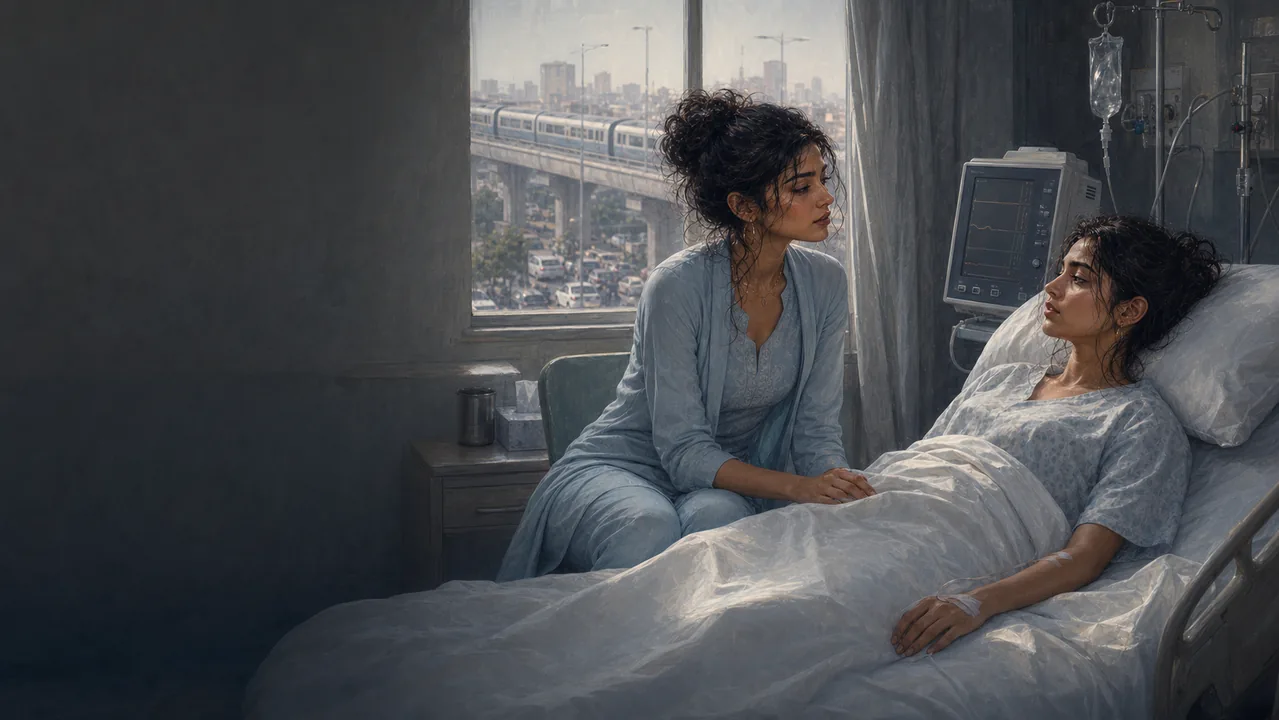
I tried to move and found I could not decide whether the pain was in my ribs, my shoulder, my jaw, or all of them at once. One eye opened easier than the other. The room swam into focus in pieces: a metal stand, a tube, a curtain pulled halfway, a chair where a woman sat with her elbows on her knees and her face in her hands. She lifted her head when she heard me breathe.
Sanjana.
Even now, even after all those years, I knew her by the way she held herself. Not stiff, not dramatic, not trying to be seen. Just there, solid as a wall, as if the room had arranged itself around her and accepted the inconvenience. Her hair was tied back badly. She looked tired in the way only women looked tired when they had been awake too long and had not been allowed the luxury of collapse. She wore a pale kurta and a cardigan too thin for the air-conditioning. She had probably come straight from work, or from the police station, or from wherever it was that honest people went when the world had gone feral.
She saw my eyes open and stood up at once.
“Don’t try to speak yet,” she said.
Her voice was low, steady. Still hers. Still the same voice that had once told me, in our first monsoon in Uttam Nagar, that I made too much noise when I laughed and too much noise when I was angry and probably too much noise when I was asleep too. It had irritated me then. It comforted me now in a way I did not have the strength to insult.
I wanted to ask her what had happened, though I already knew in the vague, broken way the body knows before the mind catches up. Khanna. His apartment. His hands. The argument. The look on his face when he understood that I was leaving. The sudden animal change in a man who had spent years pretending ownership was affection. The room turning sideways. Then black.
I remembered, too clearly, the sound of him saying my name as if it were something he had bought and found defective.
I swallowed and winced.
Sanjana reached for the water bottle and held the straw to my mouth. I drank too fast and coughed, and the pain shot through my chest like a warning shot. She let me stop without making a performance of it, which was one of the reasons I had always hated and loved her in equal measure. She never made mercy into theatre.
“Where is he?” I managed.
She looked at me for a moment before answering. “Not here.”
That was all. Not here could mean police custody, hospital lobby, a car outside, the country, hell. For a second I wanted the petty satisfaction of imagining Khanna afraid. Then I felt ashamed of even that. There was no dignity left in hating him. He had already taken enough.
The room was quiet except for the machine and the far-off squeak of a trolley in the corridor. A nurse passed once and looked in, then moved on. Outside the window, Delhi spread itself under a washed-out morning sky, and for a second I saw the city as it had always been: indifferent, busy, obscene, alive.
Sanjana sat back down. She folded her hands in her lap and waited for me to settle into the fact of being alive for the moment.
I looked at her properly then.
There were lines near her mouth now. A few more years in the eyes. The kind of face that had been made, not gifted. Not pretty in the easy, consumer way, but stronger than pretty. Life had rubbed some shine off her and left the structure. She had the same calm eyes, though. The same expression of someone who could stand in a queue for an hour, miss a bus, get cheated by a landlord, and still not feel entitled to burn down the world because of it. I had once mistaken that for weakness. I had called it all the names a girl with lipstick and ambition and too much blood in her mouth called things she could not afford to respect.
Now I could barely lift my head, and she was the one sitting there.
“How long?” I asked.
“Three days,” she said. “You were unconscious.”
Three days. That meant my phone had died, my face had swollen, and half the city had probably already decided the version of my story it preferred. In Delhi, a woman’s injury was always public before it was personal. People loved the smell of a fallen girl more than the sight of a successful one.
I shut my eyes for a second and the old life came back in fragments, as if some editor inside my skull were cutting between reels.
Mainpuri first. Dust hanging over the road. My father’s voice in the courtyard, measured and political even at home, as if every sentence had to survive an election. The men arriving and leaving with files, scarves, incense, and opinions. My brother on his phone, half protector, half threat, always with the tone of someone who loved me and wanted to own me in equal measure. I had grown up around power without ever believing in innocence. That was my first education. You learned early that morality was what the weak called restraint when they could not win.
Then Delhi. The first time I stepped out at Uttam Nagar and felt the air hit me like a wet rag. The lanes narrow with scooters and water puddles and men pretending not to stare. The PG with its pink peeling paint and the smell of frying onions. Bua Devi at the gate, squinting at me as if I were a parcel delivered with a missing label. The room small enough to make a lie sound intimate. The bed, the cupboard, the cracked mirror. My own reflection looking back at me with the arrogance of a girl who thought she had come to conquer a city that chewed women and called it commerce.
I had been so sure then. That certainty now looked less like confidence and more like a fever.
Sanjana had arrived fifteen days later with two suitcases, a cheap umbrella, and that infuriating habit of apologizing to furniture when she bumped into it. Dehradun had shaped her differently from Mainpuri. Not softer, exactly. More patient. Hills instead of plains. Cantonment discipline instead of political noise. She carried herself as if she expected the world to be rude but not fatal. I had mocked her for it on the second day, maybe the third, when she asked if we could pay the electricity bill on time and I laughed and said, “You sound like someone’s obedient daughter.”
She had looked at me and said, “And you sound like someone who thinks volume is the same as strength.”
I had hated her for that line. I had also remembered it.
Now, with a tube in my arm and my ribs burning when I breathed, I thought: yes. She had been right. Even then.
The city outside the window had changed while I was lying there between consciousness and whatever came next. Delhi always changed its clothes too quickly. One season it wore dust, another it wore rain, another it wore a thin mask of wellness and another it wore grief like a cheap shawl. But the bones were the same. Metro pillars stained with advertisements. Chai stalls under flyovers. Men in offices pretending not to be hungry. Women carrying bags that weighed more than their pay. The same lane in Uttam Nagar where the waterlogged road reflected broken neon after a monsoon shower. The same shared bathroom queue where we had once stood with buckets and wet hair and argued over whether dignity was a luxury or a discipline.
I had once thought I was smarter because I moved faster.
That was what my life had been, really. Speed with lipstick.
I had learned how to read a room before I learned how to respect it. I knew which photographer wanted to be admired, which producer wanted to feel young, which show organizer wanted the girl who made him feel powerful and then grateful. I knew how to tilt my head, when to laugh, when to let silence do the work, when to make a man believe he had invented desire all by himself. I called it strategy because strategy sounded cleaner than hunger.
Khanna had been the biggest of them, which was exactly why I had gone to him.
R.K. Khanna. Wealth with a belly and a temper. The kind of man who never had to raise his voice in public because the room had already learned to lower itself around him. He had liked me because I was beautiful and rude and not obviously grateful. Men like him did not want worship; they wanted resistance they could pay to overcome. He had bought dinners, bags, a driver sometimes, a room with too much polished wood and too little air. I had told myself I was using him. That was the joke I used to tell myself when I was trying on expensive things in his bathroom mirror.
I was not stupid. I knew what I was doing. I knew it was transactional. I knew Delhi was full of women and men pretending that sex was the only currency that mattered when in fact it was just the easiest one to shame. I knew I was bartering access. The ugly part was that it worked. It worked often enough to make me feel vindicated.
Rohit had given me my first serious portfolio after a night that began with a dinner I could not afford and ended with his hand on my thigh and my smile arranged like a lockpick. Vikram had put me in front of an ad-film lens because I had said the right thing in a corridor and then the wrong thing in his car, which turned out to be exactly what he wanted. Arjun had promised a ramp slot and a bigger show if I kept “being nice,” which in his language meant remaining available, decorative, and grateful.
I had played them all. I had won enough to believe winning was the same as arriving.
And each time I won, something in me shrank a little and called it discipline.
Sanjana had watched all this with the expression of someone witnessing a fire through a window. She never judged me in the simple way people like to imagine moral people judge. She judged the cost. That was what I did not understand until much later. She was never saying desire was evil or money was dirty or ambition was shameful. She was saying that the bill always came due somewhere else, and usually on the bodies of people who had not agreed to pay it.
I had mocked her for working retail, for giving auditions and then waiting, for taking calls from Sunita Mehta and writing down instructions in her notebook as if discipline were a religion. Sunita, with her sharp eyes and her dry voice, had been the first person in that industry to look at Sanjana and see reliability instead of hunger. She did not flatter. She did not promise miracles. She gave Sanjana a small reel job, then a casting, then another. It was humiliating work, the honest kind. Waiting in corridors. Being told to come back. Being told no by assistants barely older than teenagers with sunglasses on their heads and power in their pockets. Sanjana endured all of it with that same infuriating calm.
I had once laughed and called her weak.
Weak. As if patience were a defect and not an instrument.
My phone buzzed on the side table, and the sound dragged me back to the room. Sanjana reached for it before I could. She glanced at the screen and made a face.
“Monika,” she said.
I almost laughed, and it hurt.
“Of course it is.”
She handed me the phone. My fingers trembled. The text preview was enough to make me know the tone before I opened it.
You should know I told you both this would happen. Men like him don’t just ‘lose control,’ they are enabled by the whole rotten structure. Also, if either of you has started crying over patriarchal violence now, spare me. You girls loved the system when it paid you.
I stared at the screen.
Even in my condition, Monika could still sound like an argument wearing lipstick. I saw her face immediately — sharp cheekbones, aggressive eyeliner, the kind of confidence that came from being certain the world was intellectually beneath you. She had a real point in her somewhere, usually buried under ten layers of accusation and one layer of self-righteousness. She was not wrong that the system fed on all of us. She was not wrong that men like Khanna were not isolated monsters but polished symptoms. She was not wrong that women got blamed for the violence done to them while institutions called it procedure. On paper, she was often right.
But Monika never knew when to stop being right and start being human.
I typed with difficulty: Save the lecture for someone who asked for it.
Three dots appeared. Disappeared. Reappeared.
Then: Typical. When women tell the truth, the sluts start crying about tone.
Sanjana saw my face and reached for the phone. “Let me see.”
I handed it to her. She read the exchange once, then snorted softly.
“She still thinks abuse is an argument,” she said.
I gave a breath that was almost a laugh. “It is her entire personality.”
Sanjana typed something, handed the phone back, and I read it.
Tone aside, you were right about the violence. But you are still not right about everything.
A minute later came Monika’s reply, all fury and no grammar. A paragraph of insult, then another. Coward. Compromised. Class traitor. Patriarchy’s pet. Sellout. I could almost hear her voice climbing the ceiling.
Sanjana took the phone from me again after I started coughing from the effort of reading.
“What did you send?” I asked.
“Nothing worth memorizing,” she said.
That, too, was Sanjana. She never needed the last word. She needed the truthful one.
I lay back and let my eyes drift to the window. The city was visible in slices between the water stain on the glass and the edge of the curtain. A moving line of traffic. A flyover. A distant block of buildings. Somewhere, a metro train crossed like an artery under skin. It struck me then, with the strange cruelty of late clarity, that I had spent years treating Delhi like a stage and it had always treated me like a temporary resident.
I remembered the first monsoon after Sanjana arrived. The lane outside the PG had flooded ankle-deep. Men had rolled up their trousers and cursed. The chai stall owner had lifted his gas cylinder onto two bricks and kept pouring tea as if the weather were a small administrative issue. Bua Devi had stood at the gate with a steel bowl on her hip, watching us as we ran between puddles.
“You girls will catch fever,” she had said. “Or a man. Both are expensive.”
Sanjana had laughed into her sleeve. I had rolled my eyes and said Bua was dramatic.
Bua had looked at me and said, “No, child. I am practical.”
She was practical about everything. Rent. Gossip. The men who came to the lane pretending to be electricians and the ones who came pretending to be cousins and the ones who came with proper shoes and bad intentions. She knew when a girl had started dressing for a man. She knew when a girl had started crying into her pillow. She knew when one of us was lying about where she had been. She never asked the questions she already knew the answers to. That was her version of mercy.
She had once told me, as she adjusted the hem of her sari on the stairs, “A girl can do anything in this city if she remembers where she came from.”
I had answered, “I remember.”
What I meant was: I remember enough to use it.
That was another lie. Not the sort that sounds dramatic in retrospect. The ordinary sort. The kind that let you wake up in a stranger’s bed and believe you had not become what you feared.
The men had changed my life in ways that were always smaller than they sounded from outside. Khanna gave me money and a car and a room and then, eventually, rules. Rohit gave me photographs that made me look like the version of myself I had invented in my head. Vikram gave me visibility and the bored contempt of someone who thought every woman in a lobby was available if the lighting was right. Arjun gave me access to the ramp and then tried to punish me when I stopped being convenient. Kabir gave me love.
Kabir had been the worst and the best of them because he had not been useful in the way the others were. He had been an actor with too much hope and too little work, the kind of man who still believed every woman he loved was a potential home. He used to bring me aloo parathas wrapped in foil when I was shooting late. He would wait outside studios in the heat, pretending he was there for an audition. He liked my face, yes, but more than that he liked the idea of being chosen by someone difficult. I had taken his devotion and used it like a spare key. I had let him drive me places, carry things, listen to me complain, hold me when I was bored. I had kissed him when I needed softness and pushed him away when softness became inconvenient.
He had once asked me, very quietly, “Do you ever love anyone back?”
I had laughed and said, “Love is for people with free time.”
He had not laughed. That was the last time he looked at me with uncomplicated hope.
I thought of him now and felt, not guilt exactly, but something like the outline of it. A bruise on the soul. Kabir had loved me in the way some men love women they cannot afford: with a faithfulness that becomes a wound. I had used that wound to keep myself warm.
Sanjana knew all of this. She knew because she saw more than I wanted her to see, and because she never pretended not to. That was the burden of loving me. She had never made a religion out of my cleverness. She had always seen the panic under it.
I turned my head toward her. “Did anyone call my father?”
Her mouth tightened a little. “Your brother did. I spoke to him.”
Of course he had. Rahul Yadav would have heard the news and immediately turned it into family business, reputation management, a rescue mission with a moral vocabulary. He had always loved me in the suffocating way men in my family loved women: with possession disguised as concern. He wanted to protect me from scandal, which was another way of saying he wanted to protect the story men told about us. He would not care that Khanna had nearly killed me except as a headline risk.
“What did you tell him?” I asked.
“That you were alive.”
“And?”
“That if he came here making noise, I would throw him out.”
I smiled despite myself, then regretted it because my split lip complained. “You?”
“Yes,” she said. “Me.”
I believed her. That was the thing. Sanjana had never been loud, but she had a steadiness that made even my brother’s type of masculinity look like cheap theatre. She was the sort of woman who could stand at a hospital door and make a man reconsider his entitlement simply by looking at him without fear.
I closed my eyes and the old arguments returned, the ones we had conducted over tea, over rent, over men, over choices.
“You are too proud,” I had told her once when she refused a shortcut that would have got her a casting if she had only agreed to “be nice” to a producer’s friend.
“And you are too fast,” she had said.
“Fast gets there first.”
“Sometimes,” she had said, “it gets there broken.”
I had called her weak so many times. Weak for waiting. Weak for refusing easy money. Weak for taking a bus to an audition in the rain. Weak for letting Sunita correct her posture. Weak for calling her mother before every major decision. Weak for believing a woman could build something without lying her way through the foundations.
Now, lying in a hospital bed with my body refusing to feel whole, I could see how much strength it had taken to be that kind of weak.
The irony was almost obscene.
The door opened and a doctor came in with a nurse. They checked the monitor, spoke to Sanjana in the low brisk language of people who had already decided to be practical in the face of uncertainty. I caught words here and there: swelling, observation, internal, critical. None of it sounded like a future. The doctor glanced at me, asked if I knew where I was. I nodded. He shone a light in my eye. Everything hurt. He left after giving instructions I could not be bothered to remember.
When the door closed again, the silence felt larger.
Sanjana tucked the blanket around my legs with the kind of careful touch one used on a child or a wounded animal. I hated how much I needed that care. I hated less that she gave it without making me pay for it.
I said, after a while, “You should have left me.”
She looked at me sharply. “Don’t start.”
“No, I mean it.”
“I know what you mean.”
“You should have let the police deal with it, or Rahul, or whoever. I have made enough trouble for you.”
Sanjana sat back. “You think I came here for your manners?”
I wanted to smile, but it turned into something else. “Why did you come?”
She was quiet for a moment. Then: “Because you called me.”
I remembered that call in fragments. My hand shaking. Blood on the side of my mouth. The taste of fear, which is different from pain. Her voice when she answered. Me trying to sound arrogant and failing. Her saying, “Tell me where you are.” Me saying, “I think he’s going to kill me.” Her saying, without drama, “I’m coming.”
That was all.
No lecture. No questions. No moral victory. Just coming.
I had once thought love was the thing men extracted from women. Money, sex, status, compliance. A bargain with lipstick. But the love that had stayed with me, the only one that had not rotted into possession or use, was this one: a woman showing up in the middle of the night because you had finally run out of lies.
The memory of our room in Uttam Nagar hit me so hard I had to shut my eyes.
The tinny fan. The cracked switchboard. My suitcase always half-open because I did not know how to settle. Sanjana’s neat stack of folded clothes. The bucket in the corner. The smell of damp cement after rain. We had fought there, laughed there, eaten Maggi there, applied for jobs there, counted money there, cried there when we thought the other was asleep. That room had been small enough to force honesty on us whether we wanted it or not. I had treated it like a waiting room on the way to better things. It had been the first place in Delhi that asked me who I was when nobody was looking.
The answer, at the time, was: someone who would do anything to leave.
Now I understood that leaving was not the same as becoming.
The phone buzzed again The phone buzzed again, then fell silent against the blanket as if it too had exhausted itself with me.
I did not open my eyes right away. Hospital light had a way of finding the skin even through closed lids, a white pressure, not illumination. Something hissed beside me. Something clicked on and off in a patient rhythm that made time feel less like a line and more like an animal trapped in a cage, turning in place.
When I finally looked, the room came into focus in pieces. The ceiling first, its tiles stained in the corners. Then the metal rail of the bed. Then the stand with the clear bags hanging like dead promises. Then Sanjana, sitting in the chair beside me with her back straight and her hands folded in her lap as if she had come to a temple and not to a ward where people came apart quietly.
I remember thinking, absurdly, that she had not changed. Not in the ways that mattered. Not in the ways that money could reach. Her hair was tied back. There was no dramatic collapse in her face, no puffy sympathy, no performative grief. She looked tired, yes, and frightened in the deep way people are frightened when they have already been frightened for hours and have nowhere left to put it. But she was steady. She was there. She had probably been there for longer than I could account for.
“You’re awake,” she said.
Her voice was low, controlled. The sort of voice that did not ask for permission from the world.
I tried to answer and found that my mouth had the taste of metal and cotton. My throat hurt. My side hurt. Everything hurt in layers, like a badly built city.
“How bad?” I asked.
She looked at me for a second before answering, and I saw then that her silence was not cruelty. It was mercy. She had learned the small discipline of not lying to me and not frightening me more than the truth required.
“Bad enough that the doctor said you need to rest,” she said. “Bad enough that the nurse told me to stop asking questions.”
I gave a faint laugh that turned immediately into a wince. “That sounds like me. Asking questions.”
“Only when you already knew the answer.”
There it was. Her sharpened tenderness. The blade wrapped in cloth.
The memory returned all at once, not as a story but as a body blow: Khanna’s hand, heavy with drink and entitlement, the room spinning, the flash of anger in his face when I had told him I was done playing the grateful girl. Not the first time a man had thought his money made him a weather system. Not the first time I had mistaken proximity to power for safety. But this time there had been blood. This time the floor had come up hard. This time there was a crack somewhere in me that the hospital had not yet named.
I had believed, for too long, that danger was something cinematic, something that happened in alleys or headlines, to other women with less practice at smiling through it. But violence in Delhi was often domestic in this way: private, upholstered, rich. It came in cars with tinted windows. It came with imported whiskey and a hand on the waist that tightened when you tried to leave. It came with a man saying, You owe me, as if the sentence were a law of nature.
Khanna.
Even now the name made something in me recoil.
“Did he come?” I asked.
Sanjana’s face changed only by a degree. “No.”
“Did he call?”
“Not here.”
“Good.”
She watched me, and I knew she was deciding whether to say the next thing. She had always been like that—careful not because she was timid, but because she understood the cost of words.
“Arnav sent the documents to the reporter,” she said at last.
I stared at her.
Even in the hospital hush, even with my body falling through itself, the words landed with force. Arnav. His awkward carefulness. His refusal to be impressed by wealth. His habit of looking like he was apologizing to the room by existing in it. The files he had gathered, the screenshots, the numbers, the names buried in invoices and shell companies and those glossy, sanitized little empires men built out of other people’s fear.
“Did he?” I said.
“He did.”
“And?”
“And it is moving.”
I closed my eyes. Not because I was overwhelmed exactly, but because some part of me had been waiting so long for the world to do anything at all that it almost felt fictional now to hear that it had begun.
Outside the room, the hospital kept its own dull life. A trolley rattled past. Someone coughed with the deep misery of a body that had given up bargaining. A nurse called for a file. Somewhere down the corridor a television murmured without conviction. Delhi, reduced to its stripped-down version: waiting, wheeling, swallowing pain because no one had the leisure to stop.
“Khanna’s people?” I asked.
Sanjana’s mouth thinned. “They are calling everyone. Threatening. Denying. The usual theatre.”
“The usual theatre,” I repeated softly.
Yes. That was it. The whole city’s favorite genre. Men with expensive watches and soft voices. Women made to feel lucky and then made to feel stupid. Deals made in air-conditioned rooms, then denied in daylight. Every lie dressed as inevitability.
I had spent so long believing I was smarter than all of it.
Not wiser. Smarter. There was a difference, and I had confused it for years.
I was smart in the way a rat is smart in a kitchen. Fast. Alert. Able to smell danger before it arrived. Able to choose the narrow gap, the weak hinge, the path of least resistance. I knew how to change outfits, accents, loyalties, addresses. I knew how to read a room and make it want me. I knew how to borrow confidence from men and spend it like cash. I knew how to stand under studio lights and look as if I had always belonged there, as if the camera itself had discovered me in some fortunate act of grace.
But speed is not depth. Glitter is not a foundation. And lipstick, however red, does not make a lie into a life.
I had called it survival. I had called it ambition. I had called it reinvention.
Sometimes it had been all three.
Mostly it had been fear with a manicure.
The admission did not arrive as a moral lesson. It arrived as exhaustion. A body at the end does not have the luxury of performance. It stops pretending even before it dies. That was the great cruelty and the great relief of illness: it made every story tell on itself.
I saw Mainpuri then, not as a backdrop but as a pressure. The narrow lanes. The dust that rose from the road and settled on the skin. The women in salwar suits standing at thresholds, gossiping, measuring one another with the precision of people who had too little privacy and too much memory. The men with their confidence borrowed from age and ownership. The school building with its cracked paint. The smell of wet earth after the first rain of the season, when everything seemed briefly possible and then, by afternoon, disappointingly itself again.
I had I had wanted to outrun all of that. Not merely leave Mainpuri, but erase the version of myself that had been formed there: obedient when it suited me, hungry when it did not, forever translating my own life into something more palatable to strangers. I had wanted the clean violence of reinvention. A new name in a better city. Better clothes. Better men. Better mirrors. I had wanted the sort of freedom that looked, from a distance, like triumph.
Instead I had built a life that required constant defending.
Even now, in the hospital bed, with my body reduced to its thinnest argument, I could see the tally without effort. The victories I had chased had not made me larger. They had made me exposed. They had cost me safety, because every room I entered had to be won. They had cost me dignity, because I had learned too many ways to bend without calling it bending. They had cost me peace, because there is no rest inside a life built on the fear of being ordinary.
Sanjana had known that before I did.
That thought came to me with the clarity of a blade laid gently on a palm. She had taken the slower road, the stubborn road, the one that looked from the outside like hesitation and, from the inside, felt like principle. She had not rushed to become legible to men who would have consumed her and called it admiration. She had not traded her voice for entry. She had not mistaken being chosen for being valued. And because of that, she remained herself. Unembellished, perhaps. Unforgiven by some. But intact.
I had mistaken motion for progress. I had mistaken attention for power.
The window beside my bed held a pale rectangle of evening. The city beyond it was already turning on its lights, one by one, as if some invisible hand were testing the switchboards of the world. I could see a line of traffic moving in slow, stubborn pulses. A scooter. A bus. An ambulance with its siren off. The ordinary machinery of survival. People going home. People going nowhere. People carrying their private humiliations and private hopes through the darkening streets as though the night might absolve them.
My phone buzzed on the sheet.
For a moment I did not reach for it. I had grown tired of the language of interruption. But it buzzed again, insistent and familiar, and I knew before I looked whose name would be on the screen.
Monika.
Of course it was Monika.
The message was long and jagged, all caps in places, as if volume could supply what coherence did not. She had heard, she said, that I was “playing the tragic queen again,” that I had “managed to make even dying about my face,” that I was probably “expecting sympathy from people I used and discarded.” Then came the familiar inventory of her contempt: I was false, I was cheap, I was a parasite, I had always thought I was above her and above everyone else, and now look where all that ambition had landed me.
There had been a time when such words would have entered me like hooks.
Now they hovered at the surface and fell away.
She was noise. Ugly noise, yes. Familiar noise. But noise all the same. The kind that came from a person who needed an audience so badly she would insult the dead if it bought her one second more of relevance. I could almost hear her voice behind the screen, bright with grievance, as though cruelty were a personality and not a wound that had learned to speak.
She sent another message before I could even set the phone down.
You think you were better than Sanjana, she wrote. You think anyone ever believed you were better.
I laughed then, softly enough that the sound surprised me. Not because it was funny. Because it was true, and the truth had finally lost its power to injure.
No, I thought. I had not been better. I had been quicker. Louder. More willing to take what glimmered. More willing to confuse appetite with fate. Monika had mistaken that for superiority, just as I had once mistaken her bitterness for strength. We had all been wrong in our own special ways.
The phone lit again, but I did not look.
I turned my head toward the window. The sky had gone the color of old steel. Somewhere below, someone was honking in irritation, then honking again, because even in grief the city insisted on itself. I had spent so many years believing I was at war with that insistence, when in fact I had only been fighting my own reflection in it. The city had not promised me anything. It had only offered scale. I had been the one who mistook scale for meaning.
Sanjana would have understood that without drama. That was what had always made me furious, and what now made me ashamed. She had possessed the rare and infuriating gift of being difficult to corrupt. She could be hurt, certainly. She could be stubborn, and proud, and maddeningly silent. But she did not let hurt make her vulgar. She did not let disappointment turn her into a costume. She did not require the world to worship her in order to remain decent to herself.
I had spent years calling her cautious. I saw now that caution was only what recklessness called wisdom when it was too late.
My chest hurt. Or maybe the thought of all I had squandered did. The distinction had become academic.
I closed my eyes and let the room gather itself around me: the smell of antiseptic, the low murmur beyond the curtain, the soft mechanical attention of a machine that had no opinion of my life. I thought of all the versions of myself I had performed and abandoned. The girl who wanted out. The woman who wanted more. The one who wanted to be adored, envied, untouchable. Each had seemed, for a while, like a necessary betrayal of the last.
And beneath them all, there had been the plain fact of me: frightened, vain, ambitious, lonely, and still capable of being loved if I had not spent so much time insisting on being admired instead.
That was the tragedy, if there was one. Not that I had failed to become extraordinary. It was that I had been offered ordinary goodness and had treated it like an insult.
Sanjana had not been the lesser life because it moved slowly. She had been the stronger one because it did not require her to break herself in order to continue. She had chosen a harder kind of endurance, and it had left her intact. I had chosen speed, and speed had hollowed me out.
Monika sent one last message. I did not open it. I did not need to. I knew the shape of it already: accusation dressed as concern, envy dressed as contempt, the old hunger for an ending that would humiliate me enough to make her feel briefly safe.
Let it come, I thought, and let it pass.
Outside, the city kept glowing into night. Cars traced thin red lines through the dark. A distant tower blinked. Somewhere a dog barked once and then was silent. Life continued without permission, without apology, without asking whether I was ready to be done with my own lies.
I was done.
Not forgiven. Not