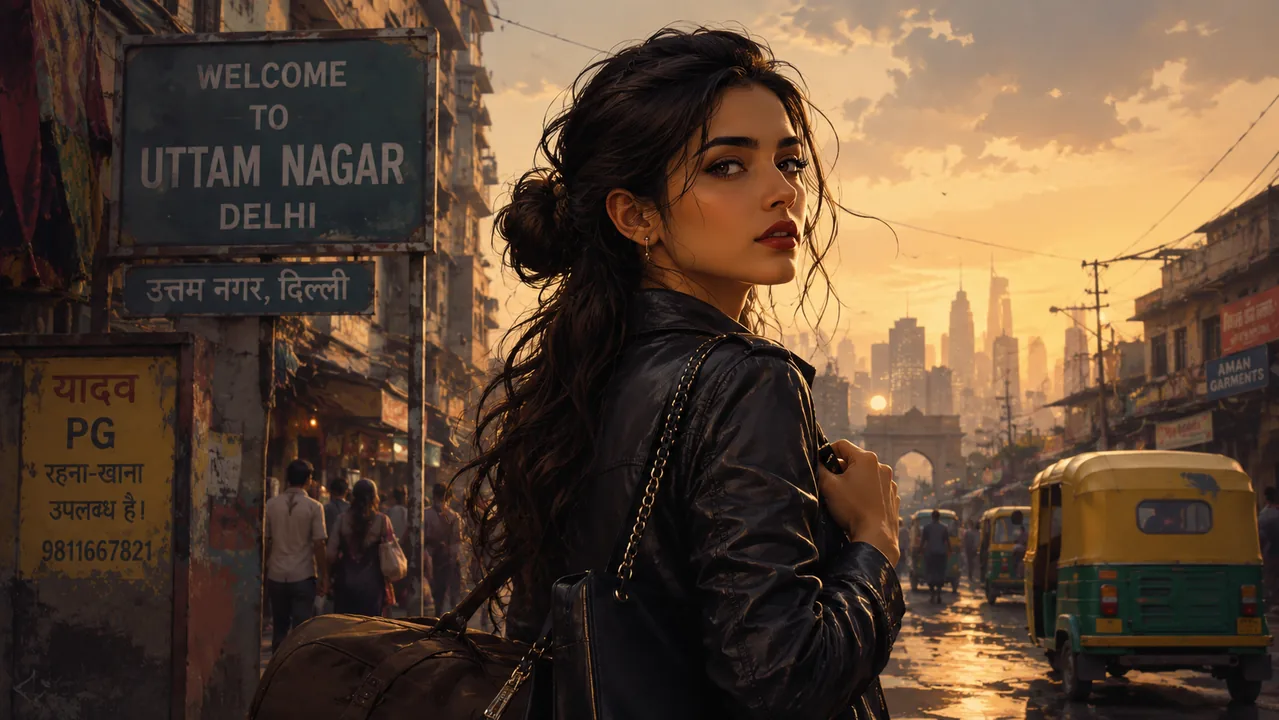
I arrived in Delhi with one suitcase, a garment bag, and the kind of face that made people look twice and then look away as if they had been caught doing something improper.
That was not vanity, exactly. Vanity was too simple a word for what I had. I had preparation. I had calibration. I had spent years being told by relatives in Mainpuri that I was too tall, too sharp-featured, too restless, too much of everything that a girl was supposed to keep hidden so that a husband could later discover it in private and call it charm. I had been educated by nuns, which meant I could write a clean sentence and lie in grammatically correct English. I had been raised in a house where politics sat at the table like another hungry uncle, where my father’s name could open doors and also close throats, where my brother’s temper was considered protective right up until it became inconvenient. I had learned early that power was never innocent. It only became respectable after the men who used it had put on a white shirt and spoken about service.
I was not going to Delhi to serve anyone.
I was going there to be seen.
The train from Mainpuri had been full of masks, elbow grease, half-eaten food, and the stale anxiety that hung over the country after the second wave had passed through it like a bad fever. People sat apart when they could, which was not very often, and every cough made strangers glance up with the expression of people who had recently decided to become religious. I sat by the window and watched the flat land slide away. The fields looked tired. The stations looked like they had been waiting for a better decade. I kept my chin up and my legs crossed and my sunglasses on, though it was not quite the kind of day for sunglasses. I liked the effect anyway. A girl in dark glasses on a train looked either expensive or dangerous. I was not yet either one, but I intended to become both.
My suitcase contained the practical fiction of a new life: jeans, black trousers, two fitted tops, one white shirt, one pair of heels with a sensible heel and a dangerous toe, three dresses, a stack of underclothes that cost more than they should have, and a small bottle of perfume my cousin had brought from abroad and pretended not to notice when I took it. In the garment bag were the clothes that mattered more. They were not expensive, but they knew their job. They clung where they should, floated where they could, and made the body underneath look like it had been designed with intention. I had packed as if I were already important. It is useful, in life, to arrive dressed for the version of yourself that other people have not yet agreed to.
At the station, men carried their own boredom like luggage. Porters shouted. A tea vendor moved through the platform with a metal tray and the dangerous confidence of a man who knew every person there was too exhausted to bargain properly. The air was wet and metallic, with that faint smell of old rain, diesel, and sweat that belonged to Indian railways and nowhere else. A child cried because it had been separated from its mother by approximately three feet. A woman in a faded blue sari stared at my face with frank curiosity and then at my shoes with open suspicion.
I gave her a look that said, yes, I knew they were better than yours, and yes, that was the point.
She looked away first.
Delhi was not my first city, but it was my first intention.
I had seen it before on family visits, in the back seat of an SUV with tinted windows, driven from one party office to another, one relative’s house to another, one function to another, where men in crisp shirts had shaken my father’s hand with the same expression they used for money and weather. In those visits, Delhi had seemed less like a city than a machine for converting ambition into humiliation. Everyone was pretending to be larger than they were. Everyone was taking notes. Everyone wanted something. I had liked it already for that honesty.
Now I came into it alone.
By the time I reached the blue-line metro, the afternoon had thickened into the sort of heat that made the inside of a mask feel like a punishment invented by a spiteful god. The platforms were crowded but not cheerful. People stood with the stiff attention of those who had survived something and were not yet ready to call themselves lucky. The announcements crackled overhead. A guard shouted at someone for standing too close to the yellow line. A couple argued in low voices near the pillar. A boy with an engineering college backpack stared at me with the shameless concentration of the unemployed.
I stared back until he became suddenly interested in his phone.
That was one of my small gifts: I understood timing. I knew when to return a look and when to let one die. I knew when to smile and when to make a man nervous. Men liked to imagine that women were either coy or crude. In reality, many of us were just students of atmosphere. We watched. We adjusted. We learned which face made a clerk cooperative, which voice made a driver respectful, which silence made a liar overconfident. I had been doing it since I was thirteen and my father’s office had become full of men who said one thing and meant another. Politics taught a girl more about men than any college did.
The metro arrived with its usual shriek and the doors opened to a blast of cold air that felt almost indecent after the platform heat. I stepped in with my suitcase between my feet and my garment bag slung over my shoulder like a weapon. The carriage was full of masked faces and tired eyes and the strange intimacy of strangers who had all accepted that they might be delayed, cheated, or infected, but preferably not all three. A woman held a sleeping child against her chest. Two office workers shared a bottle of water. A young man in a pressed shirt watched the route map as if memorizing it could make him more successful than the city intended him to be.
I did not belong to any of them. That was the point.
At Dwarka Mor, I got down and took an auto because the last stretch to Uttam Nagar was a matter of lanes and dust and small humiliations. The auto driver had a moustache that looked permanently offended and a radio tuned to a station playing songs that sounded as if they had been written in a hurry by people being paid by the syllable. He overcharged me by a little and I paid him without argument because I was not yet in the mood to educate Delhi on my principles. One learns, if one is wise, when to save one’s temper for a better audience.
The lanes of Uttam Nagar were narrow in the way cheap places always are, as if the buildings had been made to stand shoulder to shoulder out of fear of being left out. Damp walls bore old rain marks and newer posters. The smell changed every few metres: frying samosas, cheap incense, sewage trapped under concrete, detergent, hot oil, wet gravel, and the faint sourness of rooms that had no proper sunlight. A boy in shorts ran past me carrying a packet of groceries over his head like an offering. Two women stood on a balcony below a rusting water tank and discussed somebody’s daughter with the solemn precision of military intelligence.
The whole area looked temporary and overpopulated, which meant it was perfect for people who did not yet have the luxury of permanence.
I judged it immediately and then, because I was not stupid, I judged its usefulness.
Rent would be low. No one here would care who my father was. No one here would know my brother’s temper, my uncle’s alliances, the exact shape of our family’s small-town reputation. In Mainpuri, everyone knew everyone else’s grief and pretended it was social knowledge. In Delhi, at least in places like this, people had too many of their own problems to waste time on mine. That anonymity felt like a clean shirt after a long journey.
The PG stood at the end of a lane so narrow that two scooters had to negotiate like diplomats. It was a three-storey building with pale, peeling paint and a balcony crowded with clothes drying in the afternoon heat. A steel nameplate near the gate announced the landlady’s surname in letters that had once been gold. I rang the bell and waited.
The woman who opened the door was built like a fort and dressed like she meant to survive any siege. Her hair was oiled flat and tied back. Her dupatta was pinned so tightly it looked less like fabric than policy. She took one look at me and lifted her brows in a way that suggested she had already begun forming an opinion and would not be bullied out of it by my cheekbones.
“Yes?” she said.
I smiled. “I am here for the room.”
She looked me over, not in a vulgar way but in the efficient manner of someone inspecting a shipment. “Name?”
I told her.
“From where?”
“Mainpuri.”
“Alone?”
“Yes.”
That earned me a longer look. I could almost see her mind arranging me into categories. Pretty girls alone were either trouble or profit, sometimes both. Her face said she did not trust me. Her eyes said she knew I knew that. I liked her immediately. Suspicion was at least a form of attention.
She stepped aside. “Come in. Shoes off.”
The corridor smelled of disinfectant and old cooking. Somewhere upstairs a pressure cooker hissed with the fury of a minor explosion. A television played a news channel at low volume. There were framed pictures of gods near the staircase, each with a threadbare garland and a coating of dust that suggested devotion was present in theory. The walls were damp in patches, the kind that bloomed after rain and never fully disappeared. At the landing, a young woman carrying a bucket glanced at me, then at my suitcase, then at my face, and decided I was either rich or doomed.
Both, I thought, if I was unlucky. But luck had always been overrated by people who had not bothered to train themselves.
The landlady took me to the office room on the ground floor, which was really just a table, two plastic chairs, a register, and a steel cupboard that held the administrative soul of the building. A small deity sat in one corner beside a bottle of sanitizer. There was a ceiling fan overhead making a sound like a helicopter that had given up on life.
She asked for my ID. She asked for my father’s number. She asked if I was employed. She asked if I had any habits. The question landed with the weight of accusation.
“What kind of habits?” I asked.
Her mouth tightened. “You know.”
I smiled, showing her exactly enough teeth to be polite and exactly enough menace to discourage further intimacy. “I read. I sleep. I pay rent on time. If you mean cigarettes or men, I am selective about both.”
That made her stare at me. Then, unexpectedly, one corner of her mouth moved.
“Big talk,” she said.
“Delhi rewards it.”
She snorted and wrote something in the register. “Advance for one month. Deposit. No guests after eight. No loud noise. No cooking in rooms. Shared bathroom. Lights go off at night if the electricity fails. And if you bring trouble here, I will throw you out myself.”
I nodded as if she had merely informed me of the weather.
She took the cash I handed her and counted it twice. Her fingers were quick and dry. “You got money from home?”
“Enough.”
“Pretty girls with money from home usually become arrogant.”
I leaned against the counter. “And landladies with rules usually become bored. We all have our burdens.”
She laughed then, a short, unwilling sound. “Your room is on the second floor. Number seven. You’ll share with another girl. She hasn’t come yet.”
“Another girl?” I asked, though I already knew. PGs in Delhi loved the mathematics of inconvenience.
“Room is half-empty till she arrives. You can keep your things.”
I thanked her with the sort of polished courtesy that convents had refined in me to a dangerous degree. She gave me the key, a key that was too old for the lock and too small for the confidence with which she handed it over.
“Bua,” she said at the end, as if I had not earned it but might as well be warned. “Shanti Devi.”
I nodded. “Nisha.”
“Pretty name.”
“Useful face,” I said.
She looked at me for a second longer than necessary. “Be careful with that face. Delhi likes to take what it can from girls who think they are holding the knife.”
I laughed because I preferred to laugh at warnings than at myself. “Delhi can try.”
But her words stayed with me as I climbed the stairs.
The room was exactly as I expected and therefore worse. Two narrow beds stood parallel with a steel almirah between them like a border. The paint on the walls had begun peeling in long, curled strips, revealing older layers underneath, each one a little more tired than the one above it. One ceiling fan turned with a rattling complaint. The window had iron bars and a view of a lane where boys were arguing over a scooter and a vendor was ladling tea from a dented kettle. On the sill sat a cracked cup filled with ash. The bathroom was down the corridor, shared, and smelled faintly of bleach and the despair of strangers.
And yet.
And yet the room had a kind of fierce practicality. It was not pretty, but it was survivable. The bedframes were sturdy. The cupboard door shut. The curtain over the window had only one tear. There was a plug point near the bed, which in Delhi counted as a blessing. It was the sort of place where a girl could disappear long enough to become someone else.
I set down my suitcase and stood in the middle of the room with my hands on my hips.
Temporary, I told myself.
That was the first lie and the first truth of the city. Everything in Delhi claimed to be temporary right up until it became your life.
I unpacked slowly because I liked the ritual of arrangement. I hung my clothes in the cupboard with the same care people used for offerings. I placed my perfume, my comb, my makeup, my phone charger, and the small mirror I had carried from Mainpuri on the table near the bed. I smoothed the bedspread with the palm of my hand. I opened the window, then shut it again because the lane noise was immediate and rude. I adjusted the chain on the door. I checked the lock twice. Then I sat on the bed and looked at my reflection in the cracked mirror.
The crack ran diagonally across my face, splitting me into two versions: one whole, one slightly distorted. I preferred the whole one, but the other had its uses. It made my jaw look harder. It made my eyes look more expensive. It made me look like a woman who had been through some things and had not, regrettably for her enemies, been diminished by them.
I touched up my lipstick out of habit. Red, but not too red. Never too red. Red on a girl like me had to look chosen, not desperate.
My phone rang before I had finished.
Father.
I let it ring once more just because I could. Then I answered. “Yes?”
His voice came through with the crackle of distance and authority, the peculiar sound men make when they believe the world should pause to hear them correctly. “Have you reached?”
“I am not dead,” I said.
“Don’t be clever.”
“I am in Delhi, not a monastery.”
There was a pause. He was not used to being answered lightly. In Mainpuri, my father was an opposition man with a reputation large enough to make people lower their voices when they spoke near him. He had the posture of a man who expected loyalty and the nerves of a man who never quite trusted that he had earned it. Even over the phone I could hear the tension under his control.
“Your brother called me,” he said. “He says the city is full of predators.”
“It is also full of cameras,” I said. “I plan to meet the right ones.”
“That is not what I mean.”
“I know what you mean.”
He exhaled, impatient. “Listen to me carefully. Delhi eats girls alive if they wander around like they know everything.”
That irritated me in a familiar way. Fathers always liked to pretend their warnings were love and not ownership. “I am not wandering.”
“You are alone.”
“I am capable.”
“Capable girls make mistakes.”
“Then it is lucky I am not one of those girls.”
Silence again. I could hear papers rustling at his end, the faint murmur of men in a room, perhaps his office, perhaps a meeting. Politics never left him. Even when he called his daughter, he sounded like a man interrupted between battles.
“You will keep your head down until you settle,” he said at last. “No foolishness. No late-night nonsense. No people coming and going. Your name matters.”
“My name matters to me,” I said.
“And to us.”
That was the trouble. Family names in towns like mine were never really yours. They were a shared liability. They were a public asset. They were inherited, defended, weaponized, and occasionally used to shame girls into behaving as if their bodies were municipal property.
I listened until he finished his lecture about caution, reputation, and the city’s moral bankruptcy. Then I said all the right things. Yes, I would be careful. Yes, I had money. Yes, I knew how to take care of myself. No, I would not be stupid. I had learned long ago that men, even fathers, liked agreement more than obedience because agreement allowed them to imagine they were still in charge.
When I hung up, I stared at the phone for a second.
The call had done what such calls always did: it reminded me that I had a history, a surname, a family that would love me best at a distance. But it also sharpened my appetite. My father thought Delhi could eat girls alive. He was right. What he did not understand was that some girls came hungry.
I pulled on a fresh kurti and went back downstairs to ask about the bathroom timing. There was already a queue forming near the corridor: two women with plastic buckets, one schoolgirl with a damp braid, and a young bride with kohl smudged at the corners of her eyes as if marriage had happened to her in a hurry and she still had not recovered. They looked at me with the mild hostility reserved for women who appeared self-possessed in public. I stood there, perfectly straight, and waited my turn.
The bathroom door was ajar. Inside, the tile was cracked, the tap leaked, and the bucket under it had a chip missing from the rim. The mirror above the sink was clouded and stained, but it still reflected enough for a girl to know whether she was winning or merely surviving. I washed my face, tied my hair back, and studied myself under the unforgiving light.
Convent education had given me many things: English that sounded cleaner than my thoughts, manners that could be deployed like a switchblade, and the ability to assess a room in under ten seconds. Mainpuri had given me the rest: appetite, suspicion, and a family that taught me how power moved in circles. Delhi had not given me anything yet. It was too busy watching.
Back in the room, I opened my suitcase again and laid out my clothes more carefully. I had brought too many black things. That was a habit of mine. Black made a woman look either wealthy or serious, and serious women were often mistaken for expensive ones. I liked blouses that showed the line of the collarbone without begging for attention. I liked trousers that made my legs look longer than they already were. I liked dresses that caused a man to speak to me with caution and then with hope. Clothes were not decoration. They were strategy. Anyone who said otherwise had either never needed strategy or had been born with enough money to confuse luxury with identity.
I sat cross-legged on the bed and scrolled through my contacts. There were a few people in Delhi already, the kind of contacts girls collected the way other girls collected bangles: a cousin’s friend, a senior from some beauty pageant workshop, a photographer who had once said I had “presence,” a producer’s assistant who had liked my profile picture and then, after I had ignored him for three weeks, had liked it again as if persistence were a form of prayer. None of them mattered yet. They would. In Delhi, things only became real after enough people had pretended to want them.
A message came from my brother.
Call home when you have settled. Don’t roam around alone after dark. Father is already worried. Remember who you are.
I stared at the screen and almost laughed.
Remember who you are. As if I had been in danger of forgetting.
I typed back: I arrived safely. I know exactly who I am.
That was not entirely true, but it sounded good.
Evening came early, as it often did in the city when the sky was clouded with heat and residue from somewhere else. The lane outside turned a shade darker, the shops lowered their shutters, the samosa stall near the corner lit its stove, and the smell of frying oil crawled through the open window with all the subtlety of gossip. Somewhere a generator coughed to life. The electricity had flickered once already, and now the fan was moving with a kind of tired persistence, as if it had accepted that no one would replace it and had decided to continue out of spite.
I went out to buy water and came back with a packet of biscuits and a bruised tomato, because apparently even I could not be trusted with a simple errand when left alone in a new city.
The room looked smaller when I came back into it, as if the walls had leaned in to inspect my purchase. I set the water down by the bed, the biscuits beside it, and bit into one of them standing up, because sitting felt too much like surrender. The biscuit tasted of sugar and dust. Not terrible. Not good. Very Delhi, I thought: something dry enough to choke you and cheap enough to keep you coming back.
Outside, the lane kept up its ugly little theatre. A scooter barked past. A woman shouted at a child. Someone’s television was turned up so loud I could hear the laugh track through the wall, bright and stupid, like the city was mocking itself. The fan above me kept circling, pushing warm air around the room in patient, useless loops. I lay down fully clothed, one arm over my eyes, and listened to the building settle.
I had told no one the truth, which was that I was not just here to work. I was here to become visible. That was the real hunger. Not safety, not comfort, not even independence, though I would have taken those too. I wanted the kind of life that made people shut up when they heard your name. I wanted to be the sort of woman my brother would mention carefully, with pride and irritation mixed together. I wanted my father to hear of me from other mouths. I wanted my mother, if she thought of me at all, to think of me as someone who had escaped the shape of our house.
In the dark, my room held no promises. It was a rented box in Uttam Nagar with a peeling patch near the switchboard and a window that looked onto another wall, close enough to touch if I leaned out and ruined my life. But I lay there feeling, with the certainty of the young and the desperate, that this was temporary. The mattress was temporary. The chipped bowl on the shelf was temporary. The smell of damp paint and frying oil and the neighbour’s detergent was temporary. I would stay a little while, work, save, sharpen myself into someone unavoidable, and then leave all this behind in one elegant motion.
I even gave myself a deadline, because hope is more manageable when it has a date. Within months, I told myself. Not years. Months. By then I would have money in my account, a better room, a better voice, a life that did not require explanation. I would not be the girl who had arrived with one suitcase and a face too full of expectation. I would be someone Delhi had to make room for.
The fan clicked, slowed, and then resumed its tired spin. The power must have dipped again, because the bulb gave a small shiver of light. I stared at the ceiling until the plaster blurred into a pale country of cracks and shadows. Somewhere in the building a door slammed, and then there was silence so complete it felt staged.
I lay awake that night certain this room was temporary, unaware the real test would arrive in fifteen days and look nothing like me.