By the time Delhi had learned my face, I had learned its moods.
That was the thing about the city: it did not stay impressed for long. A month ago, a girl from Mainpuri with a convent accent and a pair of legs that made men forget their own names had been a novelty in Uttam Nagar. By late 2022, I was just another woman in a rental room with a borrowed ceiling fan, a suitcase that never fully unpacked, and a phone that never stopped vibrating like a bad conscience.
The monsoon had gone late that year, which made everyone in West Delhi more disagreeable than usual. The lanes around the PG stank of wet cement, frying oil, and the open drains that the rain never quite cleaned, only rearranged. The metro passed overhead with its metallic groan, and the autos honked at nothing in particular, as if the drivers had married their horns and were now committed to them for life. In the evenings, when the power cut arrived like an old enemy, the whole building would exhale in irritation. The landlady, Bua Devi, would bang her steel spoon against the railing and announce, to nobody and everybody, that if people wanted light they should have been born with their own generators.
She was a fat, sharp-eyed woman with a waistline built out of suspicion. She knew exactly how much rent each girl delayed, who brought men in through the back stairwell, who cried in the bathroom after midnight, and who pretended to study while texting some idiot with a car. She knew my life before I admitted it to myself. The first time she saw me step out in a black bodycon dress and heels high enough to be a legal offence, she looked me up and down and said, “You are either going very far or very wrong.”
I smiled and told her I always went far.
She snorted. “That is what the wrong girls say.”
She was not wrong, the old witch. But women like her had a habit of calling prophecy when they meant gossip.
Khanna had started as generosity and was now settling into surveillance. That was the natural order of rich men. They bought you with the softness of a velvet box and then expected you to live inside it forever, as if gratitude were a lease agreement. At first he had liked my silence. He had liked the way I listened, the way I laughed at the right time, the way I did not ask for things like a beggar with lipstick. Men like him were always startled by a woman who understood transaction without making it feel cheap. They liked to believe they were rescuing you, which was good for their ego and even better for your bank account.
Then the questions began.
Where was I?
Who was I with?
Why had I not answered on the first ring?
What had I worn to the studio?
Why had I taken so long to come back?
He asked them with the face of a man who thought he was being loving. That was the funniest kind of violence. It arrived in a silk shirt and Italian shoes, with the voice of concern and the smell of expensive aftershave. If a poor man had spoken to me like that, I would have slapped him and called the police. But a rich man made the same demand with better lighting, and suddenly it was a relationship.
I had been seeing him for nearly a year by then. In that time, I had learned the geography of his moods, the slope of his silence, the exact angle of his jealousy. He liked me best when I was available but not eager, glamorous but not too public, grateful but not needy. He wanted the fantasy of a woman who had chosen him, not the inconvenience of a woman who had a life.
And I, in my arrogance, had thought I could manage him the way I managed everyone else.
That was my first real mistake. Not that I used him. Men with money had used women and called it ambition since the beginning of the world. My mistake was believing that control could be shared equally in a room where one person owned the walls.
The studio that week was in Lajpat Nagar, one of those converted spaces where fashion people pretended poverty for aesthetic purposes. The floor was dusty, the lights too white, and the air was thick with hairspray and desperation. Models drifted around in various stages of undress, all long limbs and hollow cheekbones, each one trying not to look like she was trying. The makeup artists moved like surgeons. The photographers spoke in tones of bored intimacy, as if they were all sleeping with the same secret.
I had gone there because Arjun Verma had promised me a larger placement.
Arjun was one of those men who wore black kurtas to appear creative and old leather shoes to appear established. He was a choreographer and show organizer, which meant he controlled access to runways the way a priest controlled miracles: selectively, and with a lot of emotional theatre. I had met him at a pre-show dinner where he had looked at me like I was a resource he had not yet learned to monetize. Men in that circle always thought they were choosing women, when really they were choosing which ego to feed.
He had texted me the night before.
Come early. There may be something better for you.
There may be something better was the most dangerous sentence in Delhi. It made girls lose sleep, dignity, and sometimes rent money.
I arrived early, in a cream co-ord set and my hair pulled into a knot that made my neck look longer than it already was. I knew how to enter a room. That was a gift, not vanity. A woman who knew how to walk in and be noticed without begging for attention could save herself years of irritation.
Arjun found me near the tea station and smiled that greasy professional smile men used when they wanted to seem like benefactors instead of gatekeepers.
“You look good,” he said.
“I know.”
He laughed, because men love confidence as long as it costs them nothing.
He told me there had been a last-minute reshuffle. A brand wanted “a fresher face” for one segment, and he thought I could fit the mood better than the girl they had originally shortlisted. I had heard this kind of language before. Fresh face, new energy, youthful edge. In fashion, euphemisms were how men kept their hands clean while moving women around like furniture.
I let him talk. He liked that. Most men did. They mistook patience for weakness and silence for gratitude. By the time he had finished his little speech, I had understood that he was not giving me an opportunity. He was offering me a gamble.
“What do you want?” I asked.
He smiled more slowly. “You know what I want.”
Yes, I did. The same thing all of them wanted: a woman who would make them feel chosen, superior, and slightly ashamed of themselves in the best possible way.
I leaned in, close enough to make him feel his own pulse. “Then don’t waste my time pretending you’re doing charity.”
His eyes moved over my face with the lazy confidence of a man who believed every woman eventually came around to the idea of him. He told me to wait. He would see what he could do.
The thing about men like Arjun was that they loved access more than talent. Talent was too honest. Access came with leverage, and leverage was where their real affection lived.
I waited. For three hours I waited among girls who had not slept, assistants who had not eaten, and stylists who had already decided who mattered. The studio smelled of burnt coffee, foundation, and the metallic heat of lights. Everyone there had a soft smile and a hard ambition. It was a lovely, rotten little ecosystem.
Then the model they had been holding back arrived with a senior manager and a face like a saint in a shampoo ad. She was one of those girls who looked as if she had never had to ask for anything in her life, which, in our industry, was often the most suspicious thing about a person. She had a small, expensive handbag and the kind of body that made women resent her and men speak in lowered voices.
Arjun saw her, changed expression, and drifted toward her like a loyal dog.
I watched it happen in real time. The reshuffle was not for me. It had never been for me. I had been used as a bargaining chip in a room where everyone spoke in favours.
By the time the assistant came to tell me my segment had been cut, I was already angry enough to be elegant about it.
I thanked him. I even smiled.
That was the part of me men misunderstood. I could be furious without becoming ugly. Ugly people lost control. I preferred timing.
I walked out with my chin up and my stomach hollowed by humiliation. Outside, the air was wet and stagnant. A fly sat on my wrist like it had paid rent. I lit a cigarette, though I had not planned to smoke, and watched the traffic choke itself on the road. Somewhere nearby, a vendor was frying something in oil old enough to vote. The smell made me think of home, which was irritating because home was the last place I wanted to think about when I was being professionally disrespected.
My phone buzzed.
Rahul.
My brother never called unless the world was either on fire or about to be. He had inherited our father’s appetite for drama and our mother’s ability to sound calm while threatening violence.
I answered. “What?”
“You are in Delhi,” he said, which was not a greeting so much as a charge sheet.
“I know where I am.”
“Then stop acting like you don’t know who else knows.”
I leaned against the studio wall and closed my eyes. “Say what you mean.”
He did not like being told to hurry, but he knew me well enough to know I would hang up if he performed too much. “Your name came up in the wrong conversation. There are people asking questions.”
“About what?”
“About you.”
I laughed, because what else was there to do? “That narrows it down beautifully.”
“You think this is funny?”
“No. I think you are dramatic.”
There was a pause. Then his voice dropped. “Father said you should be careful.”
That stopped me for half a second, which was the closest I ever came to reverence. My father did not ask. He issued weather warnings. He had spent his life in opposition, which meant he was always one mistake away from being either a martyr or a headline. In Mainpuri, men like him survived by understanding that reputation was not a decoration. It was the wall that kept the wolves out and the voters in.
“What did he hear?” I asked.
“Enough.”
“From whom?”
“From people who don’t like us.”
I exhaled smoke through my nose and looked at the studio gate, where a boy in cheap sneakers was arguing with security. “And what exactly am I supposed to do with this information?”
“Stop being careless.”
I almost told him that if he had spent one week in Delhi he would understand that carelessness was not my style. But then I remembered that the city had made me harder, not wiser, and I swallowed the remark.
Rahul continued, “You are not a child anymore, Nisha. Whatever you do there comes back here. Do you understand?”
Of course I understood. That was the curse of being a politically exposed girl from a small town. Even your freedom carried a family signature.
“I’ll handle it,” I said.
“You always say that.”
“And I always do.”
He made a sound that was half irritation, half worry, and cut the call.
I stood for a moment with the phone in my hand, feeling an odd irritation that had nothing to do with him. The city had a way of making every private choice public eventually. Delhi was like that aunt who never paid your bills but always knew your business.
When I got back to the PG, the building was already in one of its evening moods. Girls were cooking in the shared kitchen, the corridor smelled of turmeric, damp towels, and cheap room freshener, and someone had left a pair of wet sandals outside the bathroom like a warning. Bua Devi was sitting on a plastic chair by the entrance, counting rent envelopes with the concentration of a banker and the warmth of a tax officer.
She looked up as I passed. “You are late.”
“I had work.”
She sniffed. “Work or men?”
“Both. I am efficient.”
That got a reluctant smile out of her. She liked me in the way older women liked dangerous girls: with suspicion, admiration, and a faint hope that we would not end up on television for the wrong reason.
Upstairs, in our room, Sanjana was not yet home. She had spent the afternoon at an audition in Noida and then gone for an evening shift at a retail store in a mall near Dwarka. She had arrived in Delhi fifteen days after me, carrying one suitcase, two salwar suits, and the kind of patience that made me want to shake her and hug her in the same breath.
I had mocked her at the beginning, naturally. I had mocked her for her job, her slow pace, her refusal to accept money from men who offered it with sticky palms and fake smiles. I had called her weak, idealistic, provincial in the wrong direction. But Sanjana had the particular stubbornness of a woman who had been raised to believe that dignity was not a mood. It was an inheritance.
The room itself was as glamorous as a prison cell and twice as humid. Two beds, one shared wardrobe with a broken lock, a mirror spotted with age, and a ceiling fan that made a heroic but inadequate effort against the heat. Our clothes lived in suitcases because the cupboard had been claimed by a dead student long before we arrived, according to Bua Devi, who told that story with such relish you would think the dead girl had offended her personally.
I kicked off my heels, checked my face in the mirror, and saw that I looked exactly like a woman who had been underestimated by a studio full of idiots.
A knock came at the door.
Monika Kevat entered without waiting for permission, because Monika believed boundaries were a bourgeois conspiracy. She was from a college in South Delhi, or claimed to be, and wore activism the way some women wore perfume: aggressively, with no awareness of dosage. Her hair was always either wildly artistic or deliberately unkempt, depending on the audience. She had a tote bag printed with slogans, a voice capable of waking the dead, and a talent for turning every conversation into a seminar.
“I heard the industry people were being misogynistic again,” she announced, dropping onto Sanjana’s bed with the confidence of a woman who had never paid for a mattress in her life.
I was too tired to fight, which meant I was dangerous. “How disappointing for them. I assumed they did better after lunch.”
Monika ignored that. “You girls keep treating these things as individual incidents. That is the problem. You need collective resistance.”
I took off one earring and looked at her. “You need to stop talking like a poster.”
Her eyes narrowed. “That is exactly the kind of internalized patriarchal attitude—”
“Stop right there,” I said. “If a man wanted to screw me over, I would at least know who he was. Your type hides behind theory and then acts shocked when women are still getting fucked.”
Monika sat upright, offended in the abstract way only the doctrinaire could manage. “So your answer is to sleep your way up?”
“My answer is to not lie about the game,” I said. “I don’t need your ideology to understand power. I use it better than you do.”
Sanjana came in just then, damp from the rain, carrying a plastic bag with a steel tiffin inside. She took one look at our faces and sighed.
“What now?” she asked.
“Your friend here thinks feminism is a costume,” Monika snapped.
Sanjana put the bag down and removed her sandals carefully. “No. She thinks your feminism is a costume.”
Monika stared at her.
Sanjana went on, mild as milk and just as dangerous when cornered. “There is a difference. You say things that may be true in theory, but you speak as if every woman has the same options. That is not politics. That is a lecture with good vocabulary.”
Monika’s mouth tightened. “And what would you know about politics?”
Sanjana’s eyes flicked toward me, amused. “I know enough to see that in our culture, women are still respected in a lot of ways you refuse to acknowledge. Families protect daughters. Men stand aside on roads. Homes feed daughters first when there is less food. It is not perfect, but it is not nothing.”
Monika gave a sound of disgust. “That is sentimental nonsense.”
“And your tone is why people stop listening to you,” I said. “You talk about women, then abuse them when they disagree. Typical feminist and leftist behaviour, really. Abuse when you cannot answer.”
Monika’s face reddened. “You two are impossible.”
“Correct,” I said. “Now go and organise your revolution somewhere else.”
She left in a storm of offended dignity and had the grace to slam the door hard enough to make the mirror shake.
Sanjana looked at me. “You should stop provoking her.”
“I should stop breathing too, probably. It agitates someone.”
She smiled, but her eyes were tired. She had circles under them from work and travel and the persistent burden of trying to be good in a city that rewarded compromise. I did not say it out loud, but that kind of life looked exhausting to me. Still, there was something in her steadiness that annoyed me because it was useful. A person with principles was a nuisance in the short term and an asset in the long run. Men liked girls like her when they wanted to feel clean. Women liked her when they wanted proof that decency had not been entirely cancelled.
She sat on her bed and opened the tiffin. “I brought roti and potato curry. Eat before you become impossible.”
“You make me sound like a disease.”
“You are a habit,” she said.
I laughed despite myself and sat down with her. Outside, the rain had started in earnest, hitting the tin awning below our window with the impatience of a thousand small fists. The electricity went off two minutes later, because of course it did. In the dark, the room smelled of wet concrete and turmeric and the faint floral scent of the cheap powder Sanjana used. Someone in the corridor began to argue with somebody’s boyfriend on speakerphone. Another girl was crying softly in the bathroom. Delhi had no shame about its suffering. It displayed it in public like a shop window.
Sanjana ate with the calm concentration of a woman who had learned not to waste food or time. I watched her for a moment and thought, not for the first time, that she was too plain for the life she wanted. Then I felt ashamed of the thought, which only made me keep it.
“What happened?” she asked.
I told her about the studio. Not everything. Just enough. I did not mention the full humiliation, because humiliation is a private disease and I had no intention of making it communal.
She listened without interrupting. That was another thing about her. She did not perform concern. She absorbed.
When I finished, she said, “You cannot keep letting men move you around like this.”
I arched an eyebrow. “And what would you suggest? A candle march?”
She ignored the insult. “I mean it. First they offer help, then they ask for obedience. It is always the same.”
“Yes,” I said. “And yet here I am, still alive and better dressed than most of them.”
She gave me a look. “Alive is not the same as safe.”
I wanted to laugh at that because it sounded like something a school teacher would say to a child crossing the road. But the truth of it landed somewhere inconvenient in my chest, where I kept my real fears and my best lies.
Before I could answer, my phone rang again. Khanna.
I looked at the screen and felt the tiniest flicker of annoyance. He hated unanswered calls the way some men hated women with opinions. I let it ring once, then picked up.
“Where are you?” he asked.
“In my room.”
“With whom?”
“With my roommate.”
Silence. Then: “You should have told me you were going out.”
“I did tell you I had work.”
“That is not what I asked.”
I glanced at Sanjana, who was watching me with the alertness of someone who had already understood the shape of the conversation. She had always been smarter than she looked, which was one reason I preferred her. Weak women annoyed me. Hidden strength was more interesting.
“I am tired,” I said. “Can we not do this now?”
“What did you do after the studio?”
I stared at the wall. The rain was louder now, drumming against the window grill. Somewhere downstairs, Bua Devi shouted at a girl who had left her wet dupatta hanging in the corridor.
“I came home,” I said.
“Directly?”
“Yes.”
“You are lying.”
I smiled, but there was no humour in it. “You always sound so disappointed when I have a life outside you.”
He did not laugh. “Where were you for the last two hours?”
“At the PG.”
“With your roommate?”
“Yes.”
“Why did you not answer earlier?”
I closed my eyes. The room had become too small for my patience.
“I was on the phone with my brother,” I said.
“What brother?”
Now that was interesting. He knew I had one, of course. He had simply not cared enough to remember. Men like Khanna remembered what threatened them and forgot what did not.
“My brother,” I repeated. “He exists.”
“And what did he want?”
I looked at Sanjana then, because by then I was beginning to understand the shape of this thing and did not like it. She had gone still, the way animals did before a storm.
“He wanted to warn me about family matters,” I said.
Khanna’s voice sharpened. “What family matters?”
I stood up and walked toward the window, as if movement could create distance. The rain had turned the lane outside into a silver mess. A boy was pushing a cart through the water, his feet disappearing with each step. The city looked washed and dirty at the same time, which was its truest face.
“Nothing you need to worry about,” I said.
There was a pause. Then he said, very softly, “Why are you speaking to me like this?”
“Like what?”
“As if I am a stranger.”
I almost told him that strangers were easier. But I had not yet become stupid enough to say the quiet part aloud.
“Because I am in a bad mood,” I said.
He laughed once, without amusement. “You are always in a bad mood when you are hiding something.”
Sanjana looked away, giving me privacy even in a room built out of thin walls and worse loyalties.
I told myself I had the upper hand because I could still make him wait, still make him wonder, still make him come to me if I wanted. That was my religion for years: if a man desired you enough, he would keep paying for the privilege of uncertainty. I had built a whole philosophy out of that belief. It made me feel clever. It made me feel spared.
But by then his calls had changed texture. The sweetness had gone. What remained was pressure. A hand on the back of the neck. A voice pretending to ask while already deciding.
After I hung up, Sanjana said quietly, “He sounds angry.”
“He sounds rich,” I said.
“That is not the same thing.”
“No. It is worse.”
She did not argue. She just put the tiffin aside and began folding the cloth napkin with unnecessary care. That irritated me more than if she had lectured. Sanjana had a talent for making her worry look like housekeeping.
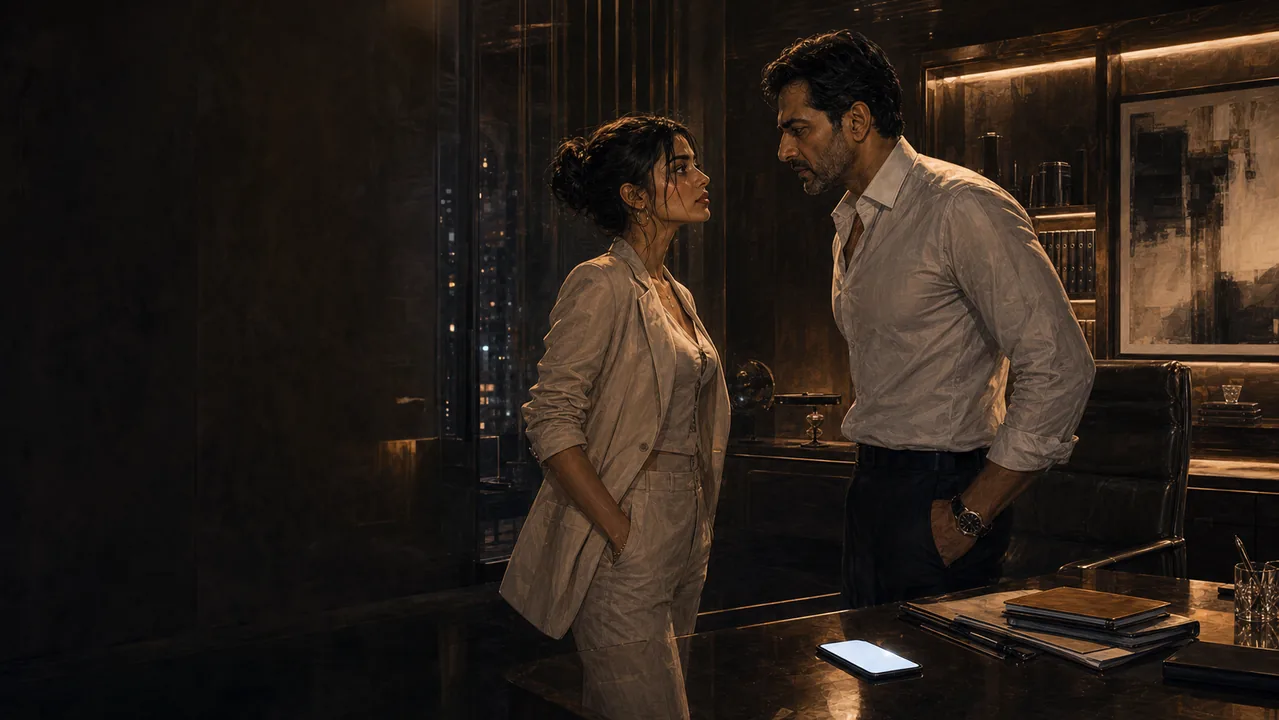
A few days later, after a morning of auditions and a disastrous hour in traffic near Rajouri Garden, I found found myself in Khanna’s office, standing near the window with my handbag clutched too tightly in both hands while he asked the same question for the third time.
“Where have you been?” he said, and then, as if I were slow, “I asked you where you have been.”
He did not raise his voice. He never needed to. His politeness had the sheen of polished stone: smooth enough to touch, hard enough to bruise. The office smelled of cigarette ash, aftershave, and the cold metal of the air conditioner. Outside, the city had gone orange with evening, the kind of Delhi dusk that made every building look briefly forgiven.
I said, “I told you. Auditions.”
He tilted his head, studying me the way men like him studied art and horses and women they intended to buy. “Which auditions?”
“For a commercial.”
“For what commercial?”
I stared at him. “I did not memorize the product.”
He smiled, but only with one corner of his mouth. “You are being difficult today.”
“I am being tired.”
“You are being evasive.”
I let out a small laugh, because if I did not laugh I might have said something unforgivable. Something honest. “You keep asking questions as if you are my husband.”
His eyes sharpened at once, and I saw the small, dangerous flare of pleasure in that. He liked being reminded that he occupied territory he had not formally claimed. Men like Khanna always preferred conquest to ceremony. Ceremony meant witnesses. Witnesses meant accountability.
“I am not your husband,” he said.
“No,” I said. “You are worse. A husband at least has to behave as if he is embarrassed.”
That earned me a longer look, the kind that searched for weakness and found, if not weakness, then at least nerves. He sat back in his chair and tapped the ash into a crystal tray. He had changed his cufflinks that day; they caught the light each time he moved his hand. Everything about him was curated to suggest effortlessness. Even his temper was expensive.
“Do not speak to me like this in my office,” he said.
“In your office?” I repeated. “Is that what this is?”
He did not answer. He did not need to. The room itself answered for him: the heavy desk, the leather chairs, the framed degrees on the wall, the line of files arranged by someone who knew he preferred obedience to elegance. In that room, he was not merely a man. He was a system.
I had learned that systems were most dangerous when they pretended to be personal.
He stood and came around the desk slowly, not in anger exactly, but with the calm of someone who believed anger was beneath him and therefore more alarming when it arrived. He stopped in front of me and looked down at my face.
“Do you think I enjoy asking you three times?” he asked. “Do you think I do not know when you are lying?”
I did not look away. “Then why ask?”
His gaze held mine. “Because I want to hear what story you choose.”
There it was: the cruelty disguised as intimacy. The warning wrapped in velvet. He was not merely jealous. He was testing the shape of my obedience, checking whether it still fit.
I felt something in me go very still.
For a long time I had mistaken that stillness for strength. I had thought it meant I was composed, hard to shake, a woman who could survive anything if she kept her face arranged correctly. But now I recognized it for what it was: the body’s way of stepping back from a ledge.
He reached out and touched the side of my wrist, just there, where the pulse betrayed the whole performance.
“Tell me the truth,” he said softly.
I almost laughed again. Truth, from a man like Khanna, was not a moral request. It was a demand for compliance. The truth he wanted was not information. It was submission dressed up as confession.
And then I understood, with a clarity that was almost vulgar in its simplicity, that his jealousy was never about love. It was about inventory. About knowing what belonged to him, where it had gone, and whether it had the audacity to move without permission.
When Khanna asked where she had been for the third time in one evening, Nisha understood that a rich man’s jealousy was just ownership with better packaging.