By the summer of 2022, Delhi had learned to sweat again.
That sounds poetic only if you have never lived through the kind of heat that turned the walls of a shared room into wet breathing skin, the kind that made the corridor outside our PG smell like damp cement, frying oil, and somebody’s cheap body spray failing in real time. In Uttam Nagar, the monsoon did not arrive like a blessing. It arrived like a leak in the sky, then stayed to make everyone miserable. The lanes filled with brown water and plastic cups, the drains muttered, the autos splashed past like they had personal grudges, and the metro station kept spitting out masked faces with the dead-eyed patience of commuters who had accepted that life was mostly standing in queues.
Our landlord, Bua Devi, said the weather exposed character.
She said it while banging on our door with two fingers and a steel tumbler in her hand, demanding rent in the tone of a woman asking for a kidney. She wore cotton saris with borders faded from a decade of washing and had the kind of face that made you trust her and fear her at the same time. She knew everything. Who had gone out at midnight, who had returned with wet hair, who had started talking to whom on the terrace, who had hidden an extra girl in a room meant for two. She kept the PG running on a mixture of authority, boredom, and pure surveillance.
“Character comes out when the weather turns bad,” she told Sanjana one afternoon, staring at the black sky gathering over the lanes. “And when the electricity goes.”
The lights had gone three times already that week. Each time the room had turned into a hot cave, and the ceiling fan had come to a halt with a slow, offended cough. Then the building would fill with the sound of people swearing in different registers, the clatter of buckets in the bathroom, somebody’s phone torch beam cutting through the corridor like a knife.
I had started to like those blackouts in a twisted way. They made everybody equal for a few minutes. The girl who wore fake pearls to her interview and the boy who pretended to be a poet on the terrace both became damp, irritated bodies in the dark. Delhi loved hierarchy too much to let equality survive long, of course. The generator would kick in, if Bua Devi felt generous or somebody had bribed the electrician, and the old world would return with its fans, its half-light, its grumbling.
By then Sanjana and I had settled into the rhythm of each other’s breathing in the room. She was still maddeningly clean in her habits, folding her clothes with the sort of care that made me suspect her of secretly owning more than one future. I had stopped mocking her in front of her face because it had become too easy and therefore boring. I still thought her choices were weak, of course. I thought that every time she chose a cheaper meal, every time she said no to a man with a car, every time she stayed up making notes for some casting list while I was already halfway into a better life. But she had this irritating habit of becoming more herself under pressure, while I only became sharper.
“Your room looks like a crime scene,” Monika announced the first time she came up to our floor and pushed open the door without knocking.
Monika Kevat had the confidence of a woman who had been arguing since birth and had never once considered that silence might also be a form of intelligence. She wore oversized T-shirts with feminist slogans on them, though the slogans were usually so ironic that I suspected she bought them for the rage they caused in others rather than for the words themselves. She had a loud laugh, heavy silver earrings, and the kind of face that looked permanently prepared to say, I told you so.
She had attached herself to our lives the way damp attached itself to Delhi’s walls.
We had met her at a small café near the metro station where a group of women from some left-leaning student collective had been handing out leaflets about workplace harassment, unpaid labour, and bodily autonomy. Monika had been at the center of the circle, one hand on her hip, explaining to anyone foolish enough to listen that women were not free just because they had more consumer choices. Then she had looked at me, looked properly, and said, “You are what patriarchy looks like when it is wearing lipstick.”
I had laughed in her face.
Sanjana had not.
That was how I knew Sanjana was more dangerous than she appeared. I could always tell when she was offended. She simply became quieter, which made people underestimate the damage.
Monika had also, to my surprise, become a regular nuisance in our orbit because she was useful in a perverse way. She knew people. She knew where the protests were, which casting agents were “all talk,” which art-house people were secretly sleazy, which publications were hiring interns and which editors liked to be flattered. She also liked us, in her own abrasive way, because we did not flatter her back.
At the café that afternoon, she had planted herself opposite me with a glass of lemon soda and begun the same sermon she always began.
“You girls keep calling everything choice,” she said. “But choice is a luxury term. Most women are choosing between different forms of exploitation. That does not make them empowered. It makes the system efficient.”
I had leaned back in my chair and crossed one leg over the other. My black top clung to my body just enough to make the man at the neighboring table keep pretending not to stare. Delhi men had the self-control of hungry dogs.
“And your solution is what?” I asked Monika. “To sit in a circle and say words like ‘system’ until the system feels ashamed?”
Sanjana had looked into her tea and smiled with that maddening softness of hers, as if she were about to stroke a stray animal or slap someone with a flower.
“My solution is not to be stupid about the world,” Monika snapped.
“No one said you were stupid,” I said. “Just loud.”
She gave me a glare sharp enough to cut metal. “You think because you use men you are smarter than women who are used.”
“I think,” I said, “that I don’t need a feminist label to know how power works. Men want beauty, attention, obedience, fantasy. Give them the fantasy, keep the leverage, and take the money. That is not ideology. That is business.”
Monika let out a short, disgusted laugh. “You are calling prostitution business now?”
I smiled at her. “I am calling your moral panic lazy.”
Sanjana finally looked up. “And I think,” she said, in that calm voice that could make a room go still, “that you keep forgetting women are already respected in our homes in ways your politics never acknowledges. Food is served first to the daughter in many houses. The mother protects the girl. The family bends around her safety. Not every culture needs to be explained by imported anger.”
Monika blinked at her. “Imported anger?”
“Yes,” Sanjana said. “Sometimes your feminism sounds like it was delivered in a box with instructions.”
I nearly choked on my soda. Monika’s face went red.
“My feminism,” she said, each word pressed flat with fury, “is about women not getting crushed by men like you two are busy polishing the boots of.”
I laughed then, properly, because she had finally stopped pretending to be above the mud.
“There it is,” I said. “Typical feminist and leftist thing. No argument left, so abuse starts.”
Monika stood up so fast her chair screeched on the floor. “You are both ridiculous little sellouts,” she said. “One of you is a whore with better grammar and the other is a sentimental idiot pretending virtue is a career.”
Sanjana’s face hardened, but she remained composed. “And there it is again,” she said. “Abuse when you cannot answer.”
Monika pointed at both of us like a prosecutor who had lost the case and was now threatening the witnesses. “Enjoy your compromise. Enjoy your patriarchy. It will eat you alive.”
Then she stormed out, nearly colliding with a waiter carrying a tray of tea glasses.
We sat there for a moment in the stale café air, the fan above us rattling like an old ceiling trying to remember if it was still useful.
Then Sanjana laughed. It was a small laugh, but real.
“She is exhausting,” she said.
“She is right about one thing,” I said. “The industry does consume women. It just pays better when you hand yourself over prettily.”
Sanjana looked at me sideways. “That is not a compliment.”
“It wasn’t meant to be.”
We both smiled then, because the world was ridiculous and because Monika’s rage had a kind of pathetic theater to it. Still, her words stayed with me longer than I admitted. Not because she was right in the moral sense. I was never so sentimental as that. But because she had named something ugly and obvious: the industry was a machine, and women were the material. I had simply decided I would be a piece of the machine that moved.
The problem, as it turned out, was that machines also had parts that broke.
Kabir Anand entered my life through a side door and a bad joke.
He was the kind of struggling actor Delhi produced in batches: long-limbed, underfed, dramatic in a way that had not yet earned money, with a face that looked slightly too earnest for its own survival. He was introduced to me by a stylist friend of Rohit’s at a shoot in a studio in Okhla, where the air conditioner was making a noise like a dying animal and the makeup artist had already sworn three times before noon.
Kabir had been sent to help carry clothes and fetch coffee because, apparently, this was what “starting out” meant in the city: being useful enough to remain visible.
He had looked at me once, just once, and then had the foolishness to smile as if the room had improved.
“You are Nisha Yadav,” he said.
I raised an eyebrow. “And you are observant.”
He grinned. “I saw your last shoot in an online portfolio.”
“Did you like it?”
“I thought you looked like trouble.”
“Good,” I said. “Trouble is more memorable than beauty.”
He had laughed, actually laughed, and that was the first thing I liked about him. Not the fact that he admired me, because men admired me in clusters and trampled each other doing it. Not the fact that he was handsome in a scruffy, underreharsed way. It was that he seemed to know his own disadvantages and had not yet turned bitter enough to weaponize them.
Later, when the photographer was screaming at a junior for losing a clip-on earring and the model in the next chair was asking for another round of contour because she had seen herself in the mirror and disliked reality, Kabir came up to me with a paper cup of tea.
“I thought you might want this,” he said.
I looked at the cup, then at him. “Do I look like someone who drinks tea?”
“No,” he said. “You look like someone who pretends not to need anything.”
That was a dangerous thing to say to me, because I had spent years building a face that made need look like a vulgar habit.
I took the tea. “You have a death wish.”
“Not really,” he said. “I just thought you might not bite.”
“I bite when bored.”
He smiled again, that stupid, open smile. “Then I’ll try not to bore you.”
He was useful from the beginning. He knew which auto drivers would overcharge less if you spoke with enough authority. He knew which cafés near the metro station let people sit for hours on one chai. He knew little corners of the city where you could get a decent coffee, a cheap sandwich, a quiet phone charge, a place to wait out an hour without looking desperate. He had one of those male bodies that looked capable even when the bank balance was not. He also had the irritating decency to never act as if helping me was a transaction.
That made him both safer and more dangerous than the men who paid.
It started with small things. A ride back from a late audition near South Extension when the metro was crowded and my feet hurt from standing in heels for six hours. A packet of chips when I was too hungry to behave. A call to say he had heard of a casting and thought I should know. A message after midnight asking whether I had eaten. I answered selectively, because I was not an idiot. I knew when to make a man wait. I knew when to reward effort with a little warmth so he would keep producing it. Men were very simple creatures once you removed their ego from the room.
Kabir, however, was not simple in the usual way. That was the trouble. He did not only want my body. He wanted my attention in the soft, loyal, domestic sense. He wanted to be the man who saw me between jobs, between men, between versions of myself. He wanted to be useful enough to be kept.
I found that strangely comforting.
Not because I loved him. I did not, not then. Love was a word people used when they wanted to legalize their foolishness. I liked him because he looked at me as if I was a person and not merely a set of angles and eyelashes. That was rare enough to feel like charity.
And charity, once accepted too often, becomes a habit.
By August, I had begun to look like money.
That was the cheapest way to describe it, but accurate. My clothes had improved. My skin had that particular glow women got when they were sleeping in better rooms, eating better food, and not worrying every hour whether next month’s rent would exist. Khanna’s money had done its work. Rohit had given me my first usable portfolio because I had made him believe I was flirtation mixed with ambition, the most irresistible combination in Delhi. Vikram, the ad-film producer, had promised a campaign casting after I had laughed at his very bad joke and let my fingers brush his wrist in the dark of a bar where everyone was performing sophistication for each other. Arjun Verma, the choreographer, had been all charm and timing until I had learned that timing was also a weapon.
None of them gave me anything for free. That was the great lie women told themselves in this city: that they were being “helped” by men. No. They were being purchased in installments, and the receipt was always written in invisible ink.
Still, I was winning. Which mattered.
Fashion week access had come through one of Arjun’s assistant coordinators, a tall woman who smoked too many cigarettes and had the expression of someone who had seen enough backstage hysteria to stop believing in human dignity. She had liked me because I could stand in heels without looking like a baby deer and because I did not fawn over her. I knew when to say thank you and when to shut up. That is a useful talent in Delhi. People mistake silence for respect and then hand you opportunities as if they invented you.
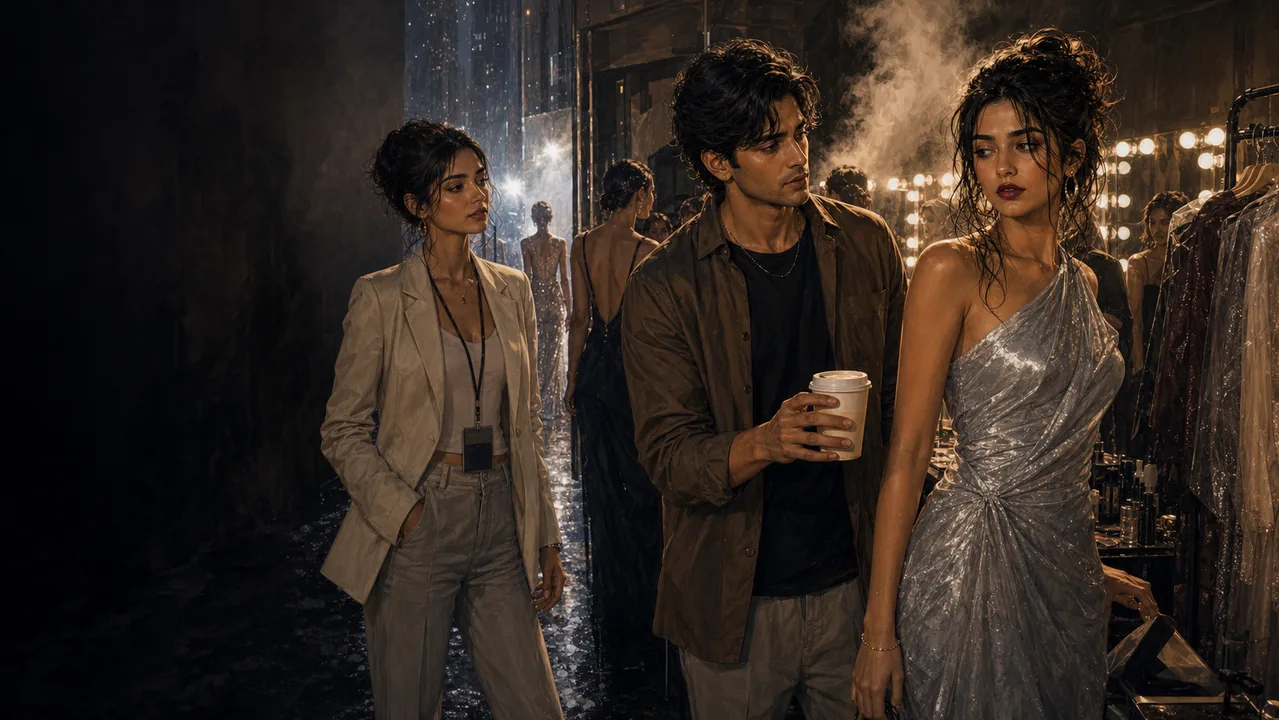
The first time I walked into a proper backstage area, with racks of clothes lined like disciplined soldiers and makeup artists moving fast with sponges and powders, I felt a tiny electric thrill run through me. Not joy. Joy is too clean a word. It was more like possession. I belonged there. Or rather, I could belong there if I kept lying with confidence.
The air was thick with hairspray, perfume, sweat, fabric steam, and ambition. Girls stood in half-finished dresses, nipples taped, faces half-made, all of us pretending not to see each other as competition while measuring each other like livestock. Men with lanyards spoke in clipped tones, saying names too quickly, as if time itself had become expensive.
I caught my reflection in a mirror between two hanging gowns and almost liked what I saw.
Almost.
Kabir was there too, because he had somehow found a reason to be near the venue, carrying a bag for one of the assistant producers. He looked absurdly pleased to see me, which should have annoyed me more than it did.
“You made it,” he said.
“Obviously.”
He laughed. “You always speak like you’ve just won an argument with the world.”
“Because I usually have.”
“You look beautiful.”
I rolled my eyes. “That is not useful information.”
“It is if I mean it.”
There it was again, that open, unguarded thing. Men like Khanna and Vikram and Rohit used flattery as a tool. Kabir used it as an instinct. I was not sure which was more dangerous.
Sanjana found me backstage later, wearing a simple cream kurta and jeans, her hair tied back, a press card hanging from a string around her neck because she had started freelancing for small online pieces and event coverage. She had been taking pictures for a local fashion blog, writing captions, interviewing stylists, doing whatever could be done without selling the soul in one clean transaction.
She looked tired. She always looked tired when she had worked hard, which somehow made her more beautiful to me than all the polished girls swanning around the venue. There was something almost insulting in how little she cared about appearing expensive.
“You look like a peacock that has eaten a diamond,” she said when she saw me.
I smiled. “And you look like somebody’s ideal of a struggling saint.”
“Better than looking like somebody’s bill.”
I laughed. “You are still miserable.”
“No,” she said, adjusting the strap of her bag. “I am employed.”
That was Sanjana’s arrogance: she never sounded impressed by the fact that she survived. She treated survival like a task, not a miracle. I found it irritating because it made my own victories look theatrical.
We stood at the edge of the backstage corridor while the show runners shouted at people and the first models were being lined up. I could feel the city pressing in beyond the venue walls: traffic at a standstill, the smell of rain on dust, the metro rumbling somewhere underground like a mechanical beast, the endless churn of Delhi moving itself from one class to another and pretending the movement was democratic.
“You still think my way is weak?” I asked Sanjana.
She glanced at me. “I think your way is fast.”
“Same thing.”
“No,” she said. “Fast and strong are not the same thing. You keep confusing velocity with power.”
That annoyed me enough to laugh. “You sound like a motivational poster for suffering.”
“And you sound like somebody who thinks every door should open because she is pretty.”
“It usually does.”
“Yes,” she said, with an infuriating softness, “and then what?”
I had no answer I liked.
Kabir appeared a moment later with two paper cups of coffee and handed one to me without being asked. He nodded politely to Sanjana, who accepted her cup with a little smile.
“This one is yours?” he asked her.
She snorted. “I am not his anything.”
Kabir looked briefly embarrassed, then recovered. “I meant the coffee.”
“Still no,” Sanjana said.
I nearly laughed out loud. He turned to me, slightly wounded but trying to hide it, and I had the absurd impulse to touch his arm and reassure him. Not because I owed him reassurance, but because his desire was so obvious that it made me feel powerful in a way money never quite did. Money could buy clothes and rooms and access. Being wanted for no immediate return was a different currency.
It also, I would learn later, had a cost.
At the time I was not interested in costs. I was interested in momentum.
That night, after the show, I sat in the back of a cab with my makeup still half on and my hair smelling of lacquer, while Delhi slid past the windows in wet reflections. The driver had his radio on low, some call-in program where people complained about roads, politicians, and rising prices with the weary intimacy of citizens who knew nobody was listening. We crawled past a tea stall where men stood shoulder to shoulder under a plastic sheet, smoking, arguing, and watching the rain hit the road in silver needles. A child splashed barefoot through a puddle. Somewhere a pressure cooker hissed from an open window. The city was never one thing. It was always a thousand half-finished lives happening at once.
Kabir called.
I let it ring twice before answering. That was the correct amount of delay. Enough to suggest I had other options. Too much delay and a man started imagining betrayal.
“Did you get home?” he asked.
“I was in a cab.”
“Good. I wanted to know if you were okay.”
“I am always okay.”
He laughed softly. “That is not true.”
I looked out at the rain-dark road. “You sound very certain for a struggling actor.”
“I am not certain. I am just saying what I mean.”
That was the problem with him. Men like Khanna hid behind money. Men like Rohit hid behind wit. Men like Vikram hid behind professionalism. Kabir hid behind nothing. He simply spoke. It made him seem cleaner than he was, which was unfair because nobody in Delhi stayed clean for long. But he had not yet learned the city’s favorite trick: how to perform indifference while wanting everything.
“Are you free tomorrow?” he asked.
“No.”
“Not even for coffee?”
I smiled despite myself. “You are persistent.”
“I am unemployed. Persistence is all I have.”
That was almost charming enough to be dangerous.
We met anyway, of course. In Delhi, all refusals were provisional. Tomorrow was just another word for maybe.
He took me to a café near the metro station, one of those places with exposed brick walls, too much Edison lighting, and menus written as if the owner had discovered irony and wanted to punish the public for it. The crowd was a mix of students, freelancers, and people pretending to write novels on laptops. The air smelled of roasted coffee, damp clothes, and expensive insecurity.
Kabir talked about auditions that went nowhere, about directors who asked him to “look more dangerous,” about roommates who stole shampoo, about how one casting assistant had told him he had “face value” but not “market value,” as if he were a fruit from a bad orchard.
I listened with half an ear and full attention to the room, because that is how I survived people: I took their stories, measured what they needed from me, and stored the weak points for later. Kabir needed encouragement. He also needed to believe I was impressed by his resilience.
“So what do you want?” I asked him.
He shrugged. “To work. To be seen. To not be forty and still carrying bags for people who scream at me.”
“That is ambitious.”
“It has to be.”
“You don’t sound bitter enough for this city.”
He smiled. “I am trying to stay better than it.”
I laughed at that, because it was the sort of stupidly earnest line that would have sounded fake from anyone else. From him it sounded almost painful.
My phone buzzed. Khanna. I glanced at the screen and felt the familiar tightening in my chest, not fear exactly, but the body’s recognition of a man who had begun to treat access like ownership.
Kabir noticed. “You can take it.”
“It’s nothing.”
He did not ask who. That was one of his better qualities. Or maybe his worst. Men who ask too many questions become tedious. Men who ask none become either saints or fools. Kabir, for the moment, was still useful enough to be neither.
I answered, put on my softest voice, and listened as Khanna asked whether I was free later, whether I had eaten, whether I had thought about what he had said the previous week, whether I had remembered that people like me did better when they remained grateful.
People like me.
He said it as if class and beauty and debt were all one category.
I murmured the right things. I had become excellent at murmurings. The phone call ended with an invitation dressed up as a command. I put phone down and smiled without warmth.
Kabir had been watching me with the patience of a man pretending not to watch. “Bad news?” he asked.
“Routine news.”
“Then it was bad.”
I could have lied better than that, but I was tired of the performance for one minute more. I rested my head back against the chair and closed my eyes briefly. The café was noisy in the way Delhi was noisy, as if the city believed silence was a luxury reserved for funerals and wealth.
“What does he want?” Kabir asked.
I opened my eyes. “A dinner. A conversation. Gratitude.”
He gave a small, almost amused breath through his nose. “Always gratitude.”
“People with money like gratitude the way poor people like rain.”
“That sounds like something you would say only after three drinks.”
“I have not had any drinks.”
“Then you are more dangerous than usual.”
I looked at him. He was smiling, but his eyes were not. He had that careful expression some men wore when they were trying not to reveal how much they were listening. I had known too many men who listened only to prepare a counteroffer. Kabir listened as if he wanted to understand the shape of a wound without pressing it.
“I should go,” I said.
He glanced toward the street beyond the glass. “Do you want company?”
The question was casual enough to be innocent, but nothing in Delhi was truly innocent. Company meant escort, witness, shield, excuse. Company meant someone standing beside you so that the world had to imagine there was a reason.
I said, “Why?”
He shrugged. “Because you look as if you are about to go back into a room you do not like.”
“That is an accurate description of my life.”
“Then let me be a temporary hallway.”
It was such an odd sentence that I laughed again, this time despite myself. I stood, gathered my bag, and found that he had already reached for the bill. I should have objected. I did not. I noticed that too.
Outside, the air had that damp metallic feel that came before rain. The road was a bright confusion of horns, scooters, private cars, and people moving with the resignation of those who had long since accepted that the city would never make room for them. Kabir walked on the side nearest traffic without thinking about it, a small habit that revealed more than any speech could have.
“You always do that,” I said.
“Do what?”
“Take the dangerous side.”
He glanced at me. “Someone has to be impractical.”
That made me look at him more closely than I intended. He was not handsome in any polished, complete way; he was too severe for that, with a face that seemed assembled by necessity rather than admiration. But there was an intelligence in him that gave the whole thing a dangerous coherence. The sort of man who might be dismissed by the careless and remembered by the cautious.
We walked in silence for a while. My phone stayed in my hand like an accusation. I could feel the shape of the evening waiting for me: the questions, the dinner, the subtle tightening of rooms around me until I could no longer tell whether I was a guest or a possession.
Kabir said, “You do not have to answer if you do not want to.”
I knew he meant the phone, but the sentence landed elsewhere. I laughed once, quietly. “That sounds like a revolutionary principle.”
“It is not. It is just basic decency.”
“Then it is rare.”
He looked ahead. “Yes.”
I turned my face away before he could see that the simplicity of his answer had unsettled me. Men like Khanna made everything complicated on purpose. Men like Kabir made things simpler in a way that was almost more unnerving, because simplicity made room for honesty, and honesty was a door I had learned not to open too quickly.
At the corner, he stopped. My building was only a short walk from there, but I had not told him that. He had noticed on his own. Of course he had.
“This is you,” he said.
I nodded. “This is me.”
He did not move immediately. “Will he be there?”
“No.”
It was a lie, but not a strong one. Khanna might not physically be there yet, but his expectations were. His voice was already in the room.
Kabir studied me for a moment, then said, “If you change your mind about dinner—”
“I won’t.”
“You did not let me finish.”
“I know what you were going to say.”
“And?”
“And I know enough not to accept invitations from men who can read my mood from twenty feet away.”
That made him smile properly, briefly. “That sounds unfair.”
“It is. I live in unfairness. I have become expert at it.”
He held my gaze. “Be careful with him.”
I almost asked whether he meant Khanna or with men in general, with wanting, with myself. But the traffic surged, a bus groaning around the turn, and the moment passed into the street noise.
I said, “You too.”
For the first time, his expression shifted into something I could not name at once. Not pleasure exactly. Not relief. Something quieter, and therefore more dangerous. “I will,” he said.
He turned to go, then looked back once, as if checking whether I had remained where I was. I stood under the weak streetlight and watched him cross into the stream of bodies and vehicles, swallowed and released by the city like everyone else.
Only then did I realize that Kabir had looked at me as if I were salvation, and for the first time I wondered whether being wanted was beginning to feel like being trapped.