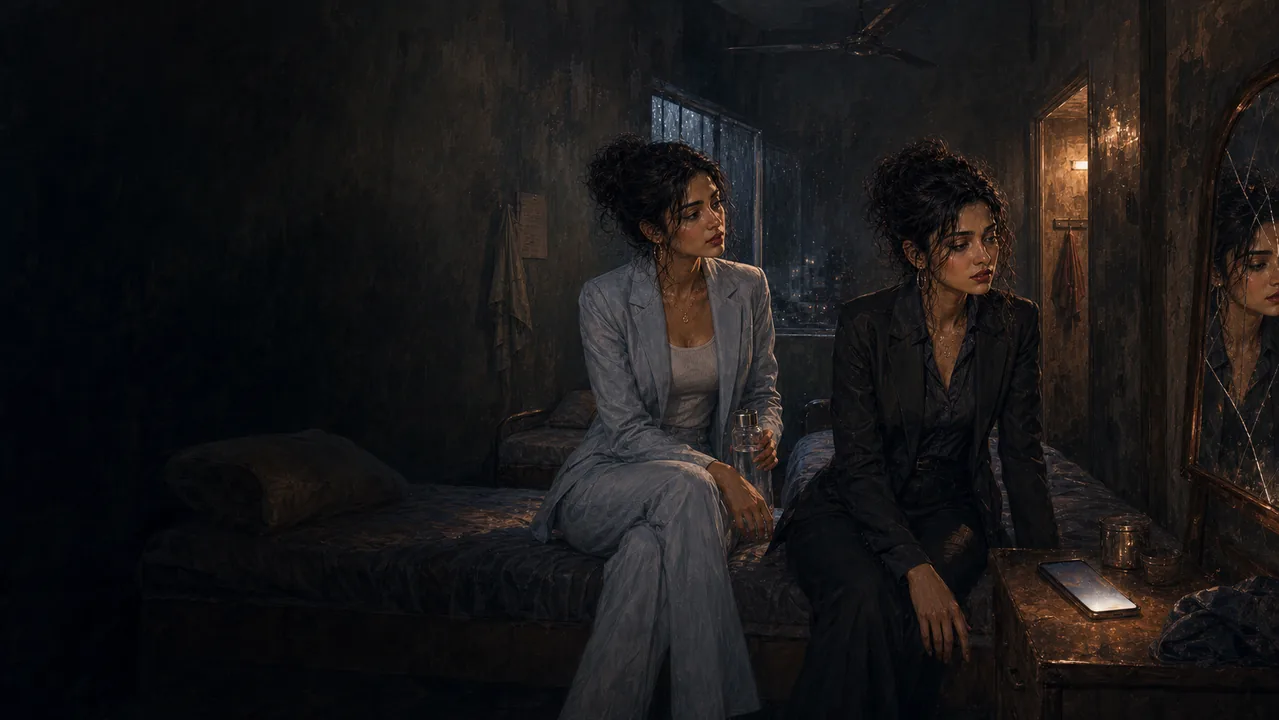
Khanna started calling me at odd hours, which was how I knew he had moved from indulgence into ownership.
A man who loved you called when he felt like it. A man who paid for you called when he wanted to remind you that he still could. Khanna was doing something uglier than either. He called when the city was loud, when the power had gone, when the fan in my room had slowed to a sulk and the walls were sweating through their damp skin. He called when I was half-asleep and angry and therefore less likely to sound elegant. He called when I was in a cab and could not immediately throw the phone into a gutter. He called when I was with people so I would have to smile like a woman under glass.
He had always liked to know where I was. Earlier he had disguised it as concern, which is how rich men dressed up surveillance when they still believed themselves romantic. Now he stopped bothering. If I did not answer, there would be ten missed calls in a row and then a message that was not really a message, just a sentence with no punctuation and the stink of command in it.
Where are you.
Who is with you.
Call me now.
It was never phrased like an order. That would have been vulgar. Khanna liked his cruelty polished. He liked it in a silk tie. He liked to make a woman feel she had chosen the cage because he had put flowers in it.
I told myself I was managing him. I told myself that because I had to keep my self-respect somewhere, and if it could not live in the facts then it had to live in the story. I had learned that early in Delhi. Story was architecture. Story was the only thing that made a room look larger.
But the truth, which I only admitted in pieces, was that he had begun to tighten around me like a fist closing very slowly. Not dramatic. Not immediate. A little more control over the driver. A little less notice before he appeared. A little irritation when I said I was busy. A little silence after I said I would not come. Men did not usually become monstrous at once. They became repetitive.
The city, meanwhile, went on being itself, which was one of the more offensive things about it. Uttam Nagar still smelled of frying oil and wet concrete and the cheap incense Bua Devi burned in front of the little brass god on her shelf, as if smoke could bribe the monsoon into better manners. The lane outside the PG still flooded in the first hard rain, turning into a brown ribbon of slush and plastic wrappers and one dead slipper no one ever claimed. The metro still coughed people in and out in the mornings with the tired authority of a machine that knew it was carrying the entire middle class on its back. The auto drivers still shouted from the corner. The boys at the chai stall still argued about cricket, prices, women, and the government, in that order, as if history had been reduced to a betting game.
Inside the PG, nothing changed except the gossip.
Bua Devi had a talent for making gossip sound like public service. She sat on her plastic chair in the corridor, a steel tumbler of tea in one hand and her phone in the other, supervising the girls the way a prison warden might supervise flowerpots. She knew who had come home late, who had lied about work, who had worn lipstick to a grocery run, who had been picked up in a car with tinted windows. She missed very little and forgave less.
When I came down one evening in a black dress and oversized sunglasses, she looked me over in a single sweep and said, “You look tired.”
I did not like being told that by a woman whose entire face seemed made of verdicts.
“I am busy,” I said.
She snorted. “Busy girls in Delhi are always tired. Busy with what, only they know.”
I would have laughed if I had been in the mood to be generous. Instead I said, “You should write a book.”
She lifted her eyebrows. “And who will read it? Girls like you do not read truth. They only read invoices.”
That was the problem with Bua Devi. She was often right in a way that irritated the vanity out of you. I hated that in people. It made them hard to dismiss.
My old contacts were no help. Rohit had stopped replying to my texts with the old eagerness and had replaced it with a professional politeness so cold it might have been carved from ice. He still wanted me in front of his camera sometimes, but now it was in the way a man wanted a familiar object he could rearrange for his pleasure without paying full price for it. The last time I went to his studio, he had looked at me with the distracted consideration of someone deciding whether his ex-girlfriend could still be used in a campaign.
“You’ve changed,” he said, as if that were my crime.
“Have I?” I had asked, smiling.
He had shrugged. “You know. There is a… look. People notice.”
That was Delhi code for used. Not beautiful. Not unavailable. Not expensive enough to be worth the trouble. A woman could be a lot of things in this city and still be forgiven if she looked like an asset. Once she looked like a story people already knew, her market value dropped faster than monsoon water through a broken drain.
Vikram was no better. He had started including me in dinners again, but only if there were others present, and only if there was a possibility that his friends would see me and think he had excellent taste. He liked to place a hand on my back in public, the gesture of a man who wanted to be seen owning a painting. In private, he had become lazy. Men were always lazier once they believed they had already won.
Arjun, the choreographer, was the worst kind of coward because he was a cheerful one. He still smiled when he saw me. He still spoke to me as if we were on perfectly normal terms. But the last time I asked him for a slot in a show, he had given me a helpless little shrug and said the roster was full.
“Full of what?” I had asked.
He had laughed, not meeting my eyes. “Don’t do that. You know how it is.”
I did know how it was. He had found a younger model with a cleaner reputation and a better family name and had decided that I belonged to the category of temporary pleasure, no longer useful for public ambition. Men were like that. They wanted a woman to be available and respectable at the same time, which was a contradiction they never had to solve themselves.
I should have been angry. I was angry. But anger was expensive, and I had begun to feel the budget.
Then there was the scandal, or the almost-scandal, which in Delhi was enough to make everyone act as if they had seen a body.
It started with a video clip, half-lit and badly cropped, circulating through the industry circles like a dirty joke. A senior stylist had been filmed shouting at a junior assistant during a late-night fitting. Then came the thread of messages, screenshots, old complaints, whispered names. Nothing that would have mattered in a city with a conscience. In Delhi, where morality was mostly a service industry, it mattered enough to make men nervous. Everyone suddenly wanted to be seen washing their hands. Everyone suddenly remembered boundaries. The same men who had once flirted with scandal as a badge of sophistication now spoke in grave tones about professionalism and respect.
The worst part was not the scandal itself. It was the way it changed the air around women like me. The men who had once been hungry became cautious. The ones who had once been generous became suspicious. The ones who had once promised opportunity began to speak in the language of risk.
A woman could survive being desired. She could even survive being envied. But being considered inconvenient was the beginning of social death.
That week I had a stress-related collapse of the sort that sounds melodramatic until it happens to you. I had not slept properly in days. Khanna had been calling more often. I had been drinking too much coffee and not enough water and living on cigarettes and the fiction of control. I went for a fitting in South Extension, stood too long under hot lights while a tailor pinned a hem, and suddenly the room tilted. Not dramatically. Not in a cinema way. More like the floor had remembered it was not obliged to be steady for me.
I sat down on the nearest chair, which happened to belong to a very annoyed makeup artist.
Someone said my face had gone white. Someone else asked if I had eaten. Men always asked that question as if a woman’s body were a machine and lunch the only possible maintenance issue. I said I was fine, because that is what women say when they are trying not to become a topic.
But on the ride back I felt the panic arriving in my chest in small, stupid waves. By the time I reached the clinic near the market, I was furious at myself for needing one. Needing anything was humiliating. It made you legible.
The clinic smelled of antiseptic, old air-conditioning, and the despair of people who had come there expecting quick fixes. A television in the corner was playing some afternoon serial with the sound off. A child in a plastic chair was swinging his legs and coughing. A woman in a faded dupatta was arguing with the receptionist about the price of a test. Delhi’s class system was never hidden in places like that. It sat in the waiting room and pretended to be sick with everyone else.
The doctor was a woman with careful eyes and a face that had learned not to show surprise. She asked me questions in a flat professional voice. Sleep? Food? Stress? Periods? Sex? I answered enough to seem cooperative and withheld enough to preserve dignity, though by then I had begun to suspect dignity was just a decorative word for poverty.
“Your body is under strain,” she said at last. “You need rest.”
I laughed, because the alternative was to scream. “Rest is not really part of my current career plan.”
She looked at me as if she had heard that sentence from a hundred girls before me. “Then your current career plan is stupid.”
I liked her instantly for that.
She gave me medicines that tasted like chalk and made me sleepy in a mean, condescending way. I took them anyway. The body, when it starts complaining, becomes a very expensive employee. You may despise it, but you still have to pay it.
When I came out of the clinic, the sky had darkened in that Delhi way where afternoon suddenly looks like an unpaid bill. The monsoon had not fully left the city; it just kept forgetting to go. A damp wind moved through the market. The roads were slick. A man selling roasted corn had wrapped plastic over his cart. An auto driver with one broken mirror shouted at two women arguing over fare. Somewhere nearby, a generator coughed into life after a power cut, and the whole lane smelled briefly of diesel and defeat.
I called Sanjana because I had no one else I trusted enough to be practical with me.
That was not a sentence I would have written in a diary. It sounded too much like truth.
She answered on the second ring, which told me she was not in class or on set or in one of those long, disciplined silences she wore like a clean cotton shirt.
“What happened?” she asked immediately.
“I need a ride,” I said.
A pause. “Are you okay?”
“I said I need a ride, not a lecture.”
“I know. Where are you?”
I gave her the clinic name.
“Sit there. I’m coming.”
She said it the way she said everything difficult: with almost no drama, which made the kindness more irritating. Sanjana had that effect on people. She made decency look like a practical habit instead of a performance.
She arrived forty minutes later in a shared auto, her hair tied back, a mask on, a tote bag slung over one shoulder, looking as if she had come from a life that contained errands rather than emergencies. She was still not beautiful in the way men in Delhi usually meant it. She was something worse, and much more durable: clear. Clean-faced. Straight-backed. Annoyingly unadorned. The sort of girl you underestimated at your own peril.
“You look like shit,” she said, taking one look at me.
“That is your greeting?”
“It is my honest assessment.”
I wanted to tell her to go to hell, but the medicine had made me soft around the edges. Besides, she was already paying for the auto, which made abuse feel tacky.
She bought me water and a packet of biscuits from the pharmacy next door. We sat on the clinic steps while the sky threatened rain and the traffic snarled around us like a bad thought.
“You should have told me earlier,” she said.
“And give you the pleasure of saying I told you so?”
“I do not say that.”
“You do. You just make it sound moral.”
She smiled a little, then looked at me in that quiet, searching way of hers which always made me feel as if I had been caught with my hand in a drawer I had no business opening. “Are you in trouble with him?”
I did not ask which him. There was only one.
“No,” I said too fast.
She did not believe me. Of course she didn’t. Sanjana had one flaw, if you could call it that: she believed in the existence of consequences with religious seriousness.
I took a drink of water and said, “He is being annoying.”
“That is not an answer.”
“It is the only one you are getting.”
She studied me, then looked away. “You can stay at my place tonight if you want.”
The offer annoyed me more than it should have. It implied need. It implied dependence. It implied that she could be generous without losing anything, which was the kind of moral superiority I found difficult to forgive.
“I have a room,” I said.
“You have a room with a man who is making you nervous.”
“I said he is annoying.”
“And I said you can stay with me.”
There it was: the stubbornness she used like a shield. It was very hard to hate someone who would rather inconvenience herself than watch you make a mess of your life.
I shook my head. “I can manage.”
“Of course you can,” she said, and there was no sarcasm in it, which made it worse.
We went back to Uttam Nagar in a shared auto because the metro had become crowded after the rain, and because autos in Delhi are the universe’s way of punishing people for having no money and too much pride. The roads were full of puddles reflecting broken neon signs, and every pothole sent a small hard jolt through my spine. Sanjana sat beside me in silence, one hand keeping the tote bag close, the other holding the plastic water bottle. Her face was calm, but I could tell she was thinking. She always thought before she spoke. It was one of her most infuriating qualities.
By the time we reached the lane, the evening had turned the walls into wet cement. The PG building looked even more tired than usual, its yellow paint peeling in strips, the iron gate half-open, the corridor light flickering. A smell of frying pakoras drifted from the tea stall at the corner. Someone upstairs was playing a sad song too loudly. Two girls in the opposite building stood on their balcony gossiping in the rain, their voices carrying through the humid air like small knives.
Bua Devi spotted us from her chair and raised one eyebrow. “Two girls, one auto. Either you are very good friends or very bad at budgeting.”
“Both,” I said.
She looked at me with the long, assessing stare she used when she wanted to make a point without wasting breath. “Delhi is a city that eats girls in installments. First the rent. Then the men. Then the body. Then the shame. Then it writes poetry about their resilience.”
Sanjana gave a small, tired laugh. I rolled my eyes.
“You are in a mood,” I said.
“I am always in a mood,” Bua Devi replied. “I am old.”
That evening, the electricity went out just after dinner. The fan died with a last, weak shudder. The room became thick with heat and the smell of damp clothes. Sanjana lit the small emergency lamp we kept on the shelf. It made the walls look more yellow and the corners more suspicious. I lay on my bed and stared at the ceiling while the medicine dragged me toward sleep.
From the other side of the room, Sanjana said, “Did you eat today?”
“I had coffee.”
“That is not food.”
“It is for people with ambition.”
“It is for people with ulcers.”
“Are you always this cheerful?”
“Only with you.”
I turned my head and saw her sitting cross-legged on her mattress, reading something on her phone with her glasses halfway down her nose. She looked absurdly composed for a person in a room that leaked at the edges.
“Why are you helping me?” I asked before I could stop myself.
She did not look up. “Because you asked.”
“That is not why.”
At last she raised her eyes. “Then maybe because you are still my friend, even when you are being unbearable.”
That should have made me feel tender. Instead it made me defensive. Tenderness is dangerous when you are still pretending to be invincible.
I said, “You are too soft.”
“And you are too proud,” she said.
We could have gone on like that all night. We often did. Our conversations had the shape of a quarrel and the temperature of loyalty. She was the only person in Delhi who could tell me I looked like hell and still make me feel seen instead of insulted.
The next day Monika turned up at the PG terrace with a paper cup of tea and an opinion large enough to occupy three chairs.
She had a way of entering a room as if she were announcing a manifesto. Hair tied back carelessly, kurta wrinkled, eyes sharp with the kind of certainty that made you want to either sleep with her or throw her off a roof. She had once told me, over bad coffee and worse company, that she was a feminist of the highest order, as if feminism were a rank in the army and she had earned a medal for surviving men. I had respected the confidence even as I despised the packaging.
She took one look at my face and said, “You look like a woman who has been negotiating with patriarchy and losing.”
I said, “You look like a woman who uses ten words where two would do.”
Sanjana, sitting beside me on a rusting plastic chair, let out a quiet sigh that meant she was already tired.
Monika ignored me and went on, “I am serious. These men own everything and then make women feel grateful for crumbs. It is all exploitation. Every bit of it.”
“That part is not wrong,” Sanjana said.
I glanced at her. She was not defending Monika. She just hated falsehood less than she hated slogans.
Monika seized on the agreement like a dog catching a shoe. “Exactly. So why are you both still making excuses for individual choices when the structure is rotten?”
“Because structure is not the whole story,” I said. “Some women use the structure. Some women survive it. Some women even win inside it.”
She gave me a hard look. “And some women get destroyed by it.”
“Yes,” I said. “That too. But not every woman wants to wait for a revolution in a blazer.”
Sanjana took her tea from Monika’s hand and said in her mildest voice, “Also, if you talk about women as if they are only victims, you make them smaller than they are. In our families, at least, daughters are still protected. Mothers still get fed first. Seats are still given. People still stand up when an older woman enters. It is not perfect, but it is not nothing.”
Monika laughed, sharp and unbelieving. “That is not feminism. That is sentimental nonsense dressed as culture.”
Sanjana did not flinch. “Maybe your version of feminism is too busy insulting everyone to notice the respect already built into everyday life.”
That was when Monika’s face changed. She had a quick temper, which is fine in a revolutionary and embarrassing in a friend.
“Oh, please,” she said. “You two are both hypocrites. One of you sells herself to rich men and calls it strategy, and the other one excuses patriarchy with family values. Spare me your moral theatre.”
I smiled sweetly. “There it is. The usual performance. When you cannot answer, you abuse.”
“Typical feminist and leftist habit,” Sanjana said, not even looking at her. “Shout first, think later.”
Monika’s eyes flashed. “You are both regressive.”
“And you are loud,” I said. “Do you want tea or a fight? Because you are only equipped for one.”
She left ten minutes later, offended and muttering, which was her usual exit from any argument that made her have to slow down and be precise. I watched her go and thought, not for the first time, that ideology was often just vanity with a vocabulary.
But even that thought had less bite than it used to.
Because there were other things happening to me now, things that did not care about arguments.
The calls from Khanna grew stranger. Less patient. More frequent. He began to ask who had taken me to the clinic, as if the answer were something he had a right to know. He commented on my tone if I sounded distracted. He asked where I had been when I did not answer quickly enough. Once, when I was in a cab on my way to a shoot, he called four times in a row and then said, very softly, “You are becoming difficult.”
I laughed. “I am busy.”
“No,” he said. “You are forgetting yourself.”
That sentence should have irritated me less than it did. Instead it lodged somewhere under my ribs.
The worst part of possessive men is that they always think they are being loving. They do not see themselves as jailers. They imagine they are preserving what they have bought. Khanna had started treating my time, my silence, my movement, even my moods as property. If I smiled at the wrong man, he noticed. If I did not answer the phone, he noticed. If I went to a café with Sanjana or stayed late at a studio, he noticed. He did not need to shout. He had money. Money made a man quiet in a dangerous way.
I began to alter my routine to avoid his temper, which was how the leash worked before you noticed it was around your neck. I changed cars. I switched numbers once and then regretted it because all his people knew all my people. I started telling him less, which made him ask more. Every lie bought me an hour and cost me a day.
At the studio, the others could feel it too, though they did not name it. Women always know when another woman has begun to live under pressure. It changes the face. It changes the timing. It changes the way you look at a door.
One evening after a shoot, Rohit leaned against the backdrop stand and said, “You seem tense lately.”
I was still in makeup, my hair pinned up, my dress clipped at the back. The mirror threw me back at myself in fragments. A cheekbone. A mouth. A pair of eyes that looked expensive and tired.
“I am fine,” I said.
He smiled in that careful, almost-pitying way men use when they think they have already outgrown you. “You used to be more fun.”
That one stung because it was cheap and because some ugly part of me knew he meant it as a compliment.
“Then you should have enjoyed me more while I was available,” I said.
He gave a short laugh. “That sounds like a threat.”
“It was a memory.”
Later, in the parking lot, I saw Sanjana waiting near the gate. She was not doing anything dramatic. She was simply standing there with her bag tucked under one arm, looking as if she had every right to be wherever she was. That, more than anything, made me wary. Women who wait without fidgeting are never waiting by accident.
She saw me and lifted her chin in greeting, as if we were colleagues and not two people who had spent too many years orbiting the same dangerous men. I walked toward her slowly, still half in costume, still carrying the stale heat of the studio lights on my skin.
“Do you have a minute?” she asked.
I looked past her, toward the line of cars and the gate and the men lingering near their drivers. “For what?”
“For something you may not want to hear.”
I should have kept walking. I knew that even then. But curiosity is often just obedience wearing a prettier dress, and I had never been able to resist a woman who came to me with the face of someone carrying bad news.
We moved away from the gate and stood beneath a dying neem tree where the light was thinner. Sanjana folded her arms, then unfolded them again. She was younger than me, but there was a hardness in her that did not come from age. It came from having learned early that softness was expensive.
“Rohit has been asking questions,” she said.
My first instinct was irritation. Men asking questions was hardly news. “About what?”
“About you. About where you go. Who you meet. Whether you still see certain people.”
I let out a small, humorless breath. “He can ask.”
Sanjana’s eyes stayed on my face. “He is not asking like a friend.”
No, I thought. He was asking like a creditor.
She hesitated, and I could see she did not want to say the next part. That is how you know the next part matters.
“He said you have been difficult lately,” she said. “He said you are changing the terms.”
I almost laughed then, because he always made it sound as if my life had been a contract I had signed in good faith. As if I had not paid for every hour of his attention, every display of loyalty, every public smile that disguised a private humiliation.
“What terms?” I asked.
Sanjana’s mouth tightened. “The usual ones.”
There it was, the small ugly hinge on which everything turned. The usual ones. The ones never written down. The ones men called love when they wanted to sound noble, and business when they wanted to sound clean.
I had known, of course, that Rohit watched me. I had known he liked being the center of my weather. What I had not allowed myself to admit was that my fear had become useful to him. He had begun to depend on it. He no longer needed to threaten me openly. He could simply let me imagine the consequences, and I would do the rest.
A car door slammed somewhere behind us. A burst of laughter rose and fell. The studio carried on around us with its usual indifference, as if no one’s life had ever been rearranged in a parking lot.
“What did he say exactly?” I asked.
Sanjana looked away for a second, toward the gate. “That if you keep being stubborn, he will be forced to remind you who has protected you all these years.”
Protected. I tasted the word and found it rotten.
I nodded once, because I did not trust my voice. There are moments when anger arrives too late to be useful. In its place comes something colder, and more accurate. I had mistaken his control for intimacy because that is how control survives: it borrows the language of tenderness.
“He wants me frightened,” I said.
Sanjana did not answer, which was answer enough.
I thought of all the small accommodations I had made. The altered routes, the extra phones, the names I had stopped saying out loud. I thought of the nights I had watched the city from a dark window and told myself that vigilance was the same thing as freedom. It was not. It was simply a different kind of captivity, one with better lighting.
“He knows I’m not stupid,” I said.
“No,” Sanjana replied quietly. “He knows you are tired.”
That hurt more than if she had agreed with me. Tired people make easier prey. They stop listening for the footstep behind them. They begin to believe that endurance is a personality trait.
I looked at her then and understood that she had come not because she wanted to save me, but because she wanted to warn me before the damage became public. Women do that for one another. We pass along danger in fragments, hoping the other will hear the whole sentence before it is too late.
“Why are you telling me this?” I asked.
For the first time, she seemed uncertain. “Because I think you already know,” she said. “And because if he decides to make an example of you, he will not stop with you.”
There it was again: the shape of the leash, not just around my throat but extending outward, touching everyone nearby. That was how men like him kept their power—by making fear social. By ensuring your silence became someone else’s safety.
I felt suddenly, absurdly, like laughing. Not because anything was funny, but because the alternative was to admit how thoroughly I had been cornered. He had not merely trapped me. He had taught me to participate in the trap.
Sanjana reached into her bag and pulled out a folded sheet of paper. She did not put it in my hand right away. She held it between two fingers, as if even passing it to me might be recorded somewhere.
“What is this?” I asked.
“An address,” she said. “If you decide you want to disappear for a few days.”
I stared at her. “And if I don’t?”
“Then burn it.”
I took the paper. My fingers brushed hers for the briefest moment, and I felt the strange intimacy of being warned by someone who had every reason not to care.
When I unfolded it later, in the car, the address was handwritten in blue ink, neat and severe. I did not know then whether it was a refuge or another room in the same house of trouble. But I knew enough to understand that my life had shifted. Not in a dramatic sweep, not with sirens or shouting, but with the quiet click of a lock turning somewhere out of sight.
Rohit had always liked to believe he was the one pulling me closer. That evening I understood the more dangerous truth: he had started pulling because he feared I might leave. And fear, in a man like that, is only ever a prelude to cruelty.
I sat in the car