I wanted out the way a thirsty woman wanted water and a drowning woman wanted air. Not in any noble, poster-ready way. Not because I had suddenly discovered the sanctity of the female soul or the tragic poetry of self-respect. I wanted out because I was tired in my bones, tired in my mouth, tired in the soft tissue behind my eyes where vigilance had taken up permanent residence and started behaving like a tenant who never paid rent.
For years I had told myself that I was not trapped, only invested. That was the lie with good tailoring. I had wrapped myself in it and gone to parties, studios, hotel lobbies, terrace bars, and once a stupidly expensive penthouse where the glass walls made the city look like a dirty aquarium. I had said yes when it suited me, no when it paid me, and nothing at all when silence was more profitable than speech. I had made men feel chosen and therefore generous. I had made them feel clever and therefore easy. I had made myself into a method.
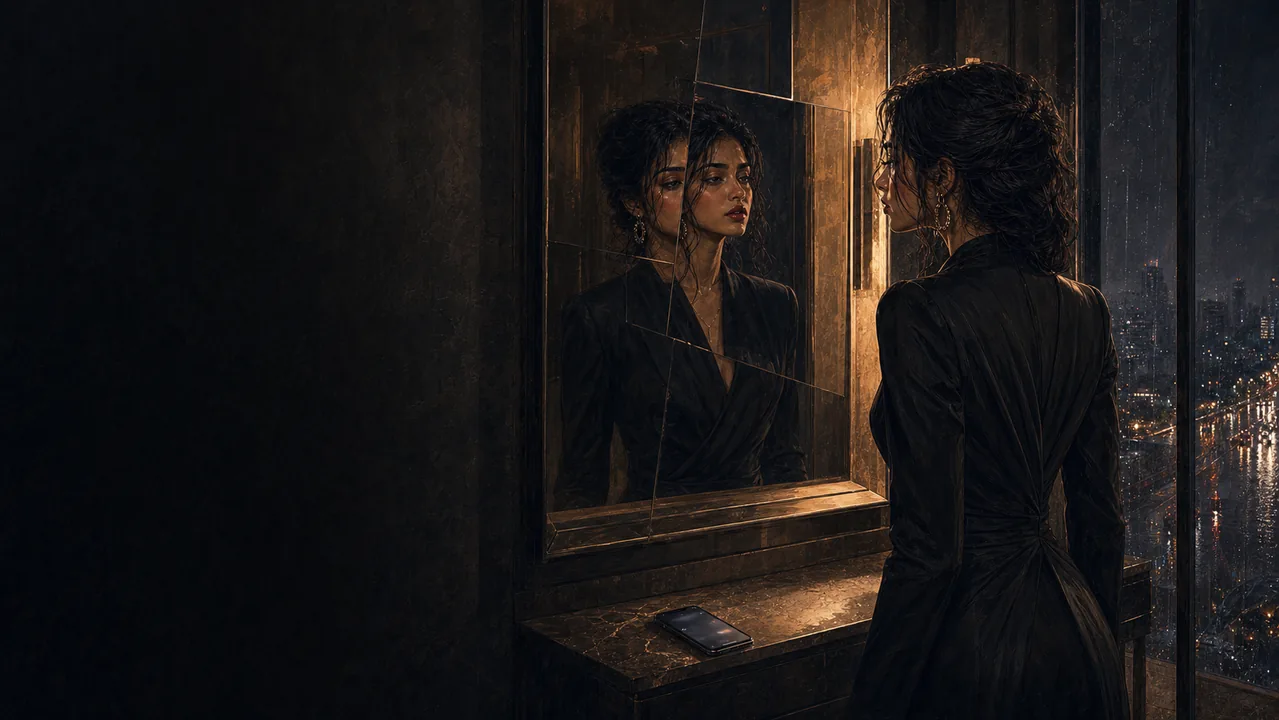
And then one evening, standing at the mirror in Khanna’s bathroom while the air conditioner hissed like an irritated snake, I looked at my own face and saw not youth, not glamour, not even danger. I saw a woman who had become very good at entering rooms and even better at leaving parts of herself behind in them.
I was wearing a black dress with a slit that had once made a casting director stare too long and later made a married producer forget his own surname. I had put on the dress because Khanna liked it. That alone was reason enough to hate it. The city outside the window was all wet sodium light and traffic, the monsoon pressing its damp palm against the glass. Somewhere below, a scooter horn kept bleating with the persistence of a small animal that had not yet understood it was doomed. Delhi never changed its mind about noise. It only changed the kind of noise.
My phone lay on the counter beside the basin. Three missed calls from Khanna, one from Sanjana, and a message from Arnav that was as neat and dangerous as a blade left on a table.
Evidence is enough now, he had written. He is starting to know. Be careful.
That was the thing about journalists, if they were any good. They could make panic sound like paperwork.
I had stared at the message for a long time. Then I had called Sanjana first, because if I was going to lie to someone, I preferred to do it to the person most likely to smell the lie and survive it.
She picked up on the second ring.
“Where are you?” she asked.
Her voice still had that mountain calm in it, the one I had once mistaken for weakness because I thought everything valuable had to arrive with fireworks. Sanjana had always been maddening in that way. She could stand in a room full of men who had been raised on entitlement and say one quiet sentence that made them look suddenly middle-aged and absurd.
“At work,” I said.
“It is almost midnight.”
“So?”
“So you sound like you are standing in a parking lot.”
I closed my eyes. “You are annoyingly observant.”
“I am trying to be helpful.”
“That is usually your first mistake.”
There was a small pause. I could picture her in her room, probably in an old T-shirt, hair tied up, one hand on the phone and the other holding her temper like a cup she did not want to spill. Sanjana did not waste anger. She used it like money.
“Are you safe?” she asked.
It was such a simple question that for a second I nearly laughed. Safety was for people who had not spent years converting charm into leverage and leverage into rent. Safety was for women who could afford to be boring.
“Yes,” I said, which was not a lie exactly. It was more like a prayer addressed to the wrong god.
“I do not think you are,” she said. “Not with him.”
I leaned my forehead against the cool mirror. “You sound dramatic.”
“I sound tired of watching you pretend that danger is the same thing as power.”
There it was. The sentence I had spent years keeping at the edge of my hearing because if I heard it clearly, it might begin to rearrange my life.
I smiled anyway, because smiling had become an old reflex whenever I was cornered. “And you sound like a schoolteacher.”
“And you sound like someone who is about to do something stupid.”
“Everything I have ever done has been stupid according to you.”
“No,” she said. “Only the things that can kill you.”
She had a way of saying these things without self-importance, which made them harder to dismiss. If Monika had said it, I would have rolled my eyes and accused her of importing slogans into private life. If some man had said it, I would have taken it as a challenge. From Sanjana it arrived like weather. I could argue with weather, but I could not make it stop.
“I am leaving him,” I said.
Silence.
Then, very quietly, “Are you serious?”
I looked at my own reflection again. The dress, the mouth, the carefully controlled face. All that expensive self-invention, and beneath it a girl from Mainpuri who had once believed Delhi would bow because she had arrived in heels. What a ridiculous faith. What a useful one.
“Yes,” I said. “I am tired.”
That was the truest thing I had said in months.
Sanjana breathed in slowly. “Where will you go?”
“I have a place.”
“With whom?”
“With nobody.”
“Nisha.”
“I said I have a place, not a wedding invitation.”
“You are making jokes because you are frightened.”
That annoyed me enough to be almost comforting. “And you are making moral speeches because you think they protect people.”
“They sometimes do.”
“They mostly irritate them.”
“This is not the time.”
“It is exactly the time.”
I turned off the tap, because the dripping had started to get on my nerves. The bathroom was narrow and over-bright, with one bulb that made every flaw in the tiles look like a moral failure. From the corridor came the smell of fried onions from the cook’s room, incense from someone’s door, and damp plaster. The building had that old Delhi smell of shared survival, of too many lives breathing through one wall.
“I have spoken to Arnav,” I said.
That shut her up for a beat. “About what?”
“About Khanna.”
Another pause. Then: “You should have told me.”
“You would have made a face.”
“You should have told me anyway.”
“I did not want your face.”
“I am serious.”
“So am I.”
I heard her shift on the other end, maybe sitting up straighter. “What did Arnav say?”
“That he has enough to make noise.”
“Noise is not the same as safety.”
“Neither is your version of virtue.”
She gave a short laugh, but there was no amusement in it. “That is such a dishonest way to speak.”
“And yet you keep answering.”
“Because you are my friend.”
That word landed like a hand on a bruise. Friend. As if I had not spent years pretending to be above needing anybody. As if I had not loved her in the only way I knew how: by mocking her, protecting her when I could, and resenting the parts of her that reflected my own failures back at me.
Outside, a generator kicked in somewhere, and the corridor lights flickered once before stabilizing. The building exhaled. Power cut, restored, cut, restored. Delhi’s daily theology.
“I am not asking for permission,” I said.
“I know.”
“I am just telling you.”
“I know that too.”
For a moment neither of us spoke. Then she said, “Meet me tomorrow.”
I laughed softly. “For what? An intervention?”
“For tea,” she said. “And because I do not trust this.”
“You never trust anything.”
“No,” she said. “Only your taste in men.”
That almost made me smile for real. Almost.
After I hung up, I stood there longer than necessary, listening to the building settle around me. Someone in the room next door was arguing on speakerphone about money. Someone else was washing utensils with the sharp violence of resentment. A child cried and was hushed. The world kept its ugly, ordinary rhythm. It was strange how a life could be ending or beginning and the neighbors still cared only about rent and gas cylinders.
I took a long breath and opened my email.
I had already moved most of my important papers into a folder under a false name, because being dramatic was one thing and being stupid was another. The copies of my contract, old campaign releases, booking slips, bank transfers, screenshots of messages from men who had been too confident to imagine consequences — all of it sat in a cloud account Arnav had told me to use. He had not been sentimental about it. That was why I trusted him more than most people. He had the sober face of a man who had seen enough rot to stop being impressed by perfume.
He had met me three days earlier in a café near Hauz Khas, the kind with exposed brick and fake plants and prices that insulted the poor while pretending to admire them. He wore a plain shirt and the expression of someone permanently late to a funeral. He had slid into the chair opposite me and said, without greeting, “He has done this before.”
I had stirred my coffee though it did not need stirring. “You are telling me this like I am new.”
“I am telling you because he has documents. Some of them are ugly.”
“So am I.”
He had looked at me then, not with lust, which was unusual and therefore suspicious, but with the mild irritation of a man trying to stop a train from entering a tunnel. “You are better than your arrangement.”
That had made me laugh. “You say the funniest things.”
“I am serious.”
“Everyone serious men say that.”
He had not smiled. “If you leave, do it with proof.”
“I did not ask for advice.”
“I know. You asked for the meeting. That is how women like you ask for advice.”
I had leaned back and studied him. He was not handsome in any profitable way. The jaw was too earnest, the eyes too tired, the hands too clean. But he had that rare quality that makes dangerous people uncomfortable: he believed he might still be useful. Men like Khanna hated that in other men.
“What do you want?” I asked.
“Truth, if possible. A story, if not.”
“There is always a story.”
“Yes,” he said. “But not always one the powerful expect to survive.”
I had laughed then too, because one does not survive Delhi without a sense of theater. But now, standing in Khanna’s bathroom with the mirror throwing my own face back at me, I thought of Arnav’s neat, unromantic caution. He had been right to sound tired. The city was full of men who mistook ownership for intimacy and women who mistook endurance for destiny.
I packed a small bag anyway. Not because I trusted the plan completely, but because action had become a habit stronger than prayer. Two dresses, one pair of jeans, my documents, charger, lipstick, a cheap watch, the blue shawl Sanjana had once lent me during a monsoon walk and never asked back. I folded it carefully and shoved it into the bag. Tiny sentimental objects were embarrassing, which was precisely why they mattered.
By the time I came out of the bathroom, Khanna was calling again.
I let it ring.
Then again.
Then again.
On the fourth call I answered, because I was brave in the stupid way that only the cornered can be.
“Where are you?” he asked immediately.
His voice was soft. That was always the worst sign. Men like him did not shout until they had exhausted the quieter methods of ownership.
“In the apartment.”
“Come downstairs.”
“I am tired.”
“I did not ask.”
I stared at the wall, at the framed print of a London street he had bought because he liked the idea of old money even when he could not pronounce half the names correctly. “I am not feeling well.”
“That is not my problem.”
“No,” I said. “It usually is.”
He laughed, but the sound had no humor in it. “Do not get clever with me tonight.”
“I am always clever.”
“Do not confuse that with safety.”
There was a small click on the line, as if he had turned away from the phone. I could hear music in the background, some old song with strings and regret. His parties were always more expensive than happy. The women at them wore diamonds borrowed from men who thought discretion was a form of virtue. I had learned that the rich were not happier than the poor; they were only better lit.
“Arnav has been asking questions,” I said.
He was quiet for a moment. “Who?”
“Do not insult me.”
“Why are you telling me this?”
“Because I thought you should know.”
Another silence, and this one had the weight of calculation in it. I could almost hear him rearranging his face into concern.
“You are making a mistake,” he said at last.
“I know.”
“No, you do not.”
I put the phone on speaker and set it on the bed while I pulled on my shoes. “I know enough.”
“You do not leave people like me by surprise.”
“People like you should have been less surprised by me in the beginning.”
That got him. I heard the little change in his breathing, the microscopic hardening in the line between his silence and his temper.
“You have forgotten who paid for what,” he said.
There it was. The ugly arithmetic under all male generosity.
I slipped the strap of my bag over one shoulder. “You paid for access. I provided entertainment. Do not make it sentimental now.”
“I gave you more than that.”
“You gave me a room, some clothes, and the delusion that you were generous.”
“You are very brave from a distance.”
“I am not far away.”
He said my name then, very slowly, like he was trying to pin a butterfly without damaging the wings. That should have frightened me more than it did. Or perhaps it did frighten me, and I had simply become too practiced at swallowing fear whole.
“Come downstairs,” he said again, softer now. “We will talk.”
“About what?”
“About what you think you are doing.”
“I am thinking of leaving.”
“Not tonight.”
“Yes, tonight.”
“No.”
The word was so flat that for a second I almost laughed. Men like Khanna did not really understand the concept of women as separate weather systems. They believed storms could be negotiated with enough money.
“I will see you tomorrow,” I said.
“No.”
I ended the call.
My hands were shaking now, though I refused to call it fear. Fear was too clean a word for what I felt. This was the body’s ancient knowledge that the room had changed while the mind was still busy performing superiority.
I walked out into the corridor. The building was half-lit, the tube lights buzzing like trapped insects. On the landing below, Bua Devi’s door was open and her television was on too loud, spilling a soap opera into the stairwell. She looked up as I passed.
“You are going out at this hour?” she asked.
She always spoke as if she had been appointed guardian of the entire moral architecture of the lane.
“Yes,” I said.
She eyed my bag. “Travel?”
I gave her my sweetest smile. “Sort of.”
Her mouth tightened. She knew enough to know she knew nothing, which made her more dangerous than people who asked direct questions. “These days, girls go out dressed like this and then cry later.”
“Then it is a good thing I do not cry easily.”
“Everybody cries.”
“Not in front of you.”
That almost made her laugh. Almost. Instead she muttered something under her breath about modern girls and their pride, then disappeared back into the flat. The door stayed open a crack, because in Delhi even privacy had to keep an ear on the staircase.
I went down the stairs and out into the lane.
The rain had stopped, but the road was still wet, reflecting the jaundiced light from the chai stall and the blue blink of the metro line beyond. A tea seller was wiping down his counter with a rag that had lost all claim to cleanliness years ago. He looked up, recognized me, and gave the tiny nod men give women they have decided not to objectify too openly. The lane smelled of damp concrete, fried batter, sewer water, and the faint sweet smoke of incense from somebody’s evening prayer. A dog darted across the road with the expression of a thief. Somewhere a pressure cooker hissed. Somewhere else an auto driver was shouting at a customer who had tried to bargain too much.
I walked fast because fastness looked intentional, and intentionality was the poor cousin of courage.
At the corner, I saw Sanjana waiting under the shop awning, exactly where I had told her to meet me if I changed my mind. She stood with one arm folded across her body, the other holding an umbrella she did not need. She was in a pale kurta and jeans, hair tied back, face bare except for the kind of calm that comes from stubbornness and long practice. She looked like a woman who had never once mistaken chaos for charisma.
“You came,” I said.
“You sounded strange.”
“I always sound strange.”
“You sounded frightened.”
I snorted. “You are impossible.”
“And yet here you are.”
She stepped toward me, eyes moving over my bag, my face, the set of my shoulders. Sanjana had never been fooled by the performance of me. That was infuriating and, in a buried corner of my heart, deeply comforting.
“Did you tell him?” she asked.
“Yes.”
“Stupid.”
“Thank you.”
“I am not insulting you for entertainment. I mean it.”
“I know what you mean.”
“You do not, or you would not be standing in this lane with a bag like a woman in a bad film.”
That made me laugh despite myself. A scooter rattled past, splashing a little dirty water onto my feet. The driver did not apologize because Delhi men rarely apologized unless they had just hit something expensive.
I looked at Sanjana. “You think I should have done this years ago.”
“I think you should have done it before you had to hide your documents like a criminal.”
“I am not a criminal.”
“You are not innocent either.”
“Thank God.”
She gave me a tired look. “Do you have somewhere safe tonight?”
“I told you, yes.”
“With whom?”
“With nobody,” I repeated.
“That is not an answer.”
“It is the answer you are getting.”
She exhaled through her nose, which for her counted as a tantrum. “If you are going to leave him, leave him properly. Not with drama. Not with a performance. Quietly. Cleanly. And not alone.”
I lifted one shoulder. “You sound like an aunt.”
“I sound like someone who does not want your corpse found in a parking lot.”
The words hit harder than they should have. I had spent years laughing at caution because caution had always looked too much like surrender. But tonight, under the wet streetlight, with the smell of frying snacks and wet dust around us, her warning did not sound weak. It sounded like wisdom arriving late to a party where arrogance had already drunk too much.
“I am not going to die,” I said, too quickly.
She looked at me in that long, steady way of hers. “No one plans to.”
The lane behind us was alive with the usual small brutalities. Two boys argued over a bike. A woman in a plastic raincoat dragged a child by the wrist. A monkey sat on a cable box like a corrupt little minister. Above us, the metro thundered across the line, silver windows flashing like a train of indifferent gods. I felt the city in my teeth.
“I have to meet him,” I said.
“Not alone.”
“I can handle him.”
“That is exactly what worries me.”
I wanted to snap back, to tell her she had no idea what handling men required, that she had spent her life being careful while I had learned to be effective. But the truth was uglier. The truth was that I had become very good at handling men who wanted pleasure, vanity, secrecy, and control. I had not yet met the version who wanted revenge.
Before I could answer, my phone buzzed in my bag.
Khanna.
Then again.
Then a message from Monika, which was somehow worse.
Still busy playing kept woman? I thought you were stronger than that. Then another line followed almost immediately. Shame is a chain. Break it.
I stared at the screen and almost laughed. Monika had always had the emotional subtlety of a brick thrown through a window, but even she managed to sound sanctimonious while pretending to be revolutionary. I showed the message to Sanjana.
She read it and made a face. “She still talks like she is auditioning for a panel discussion.”
“She thinks she is a political concept.”
“What did she want this time?”
“To tell me that women must be free.”
Sanjana handed the phone back. “And you told her?”
“That freedom is not the same as noise.”
“She will hate that.”
“She hates breathing when it disagrees with her.”
As if summoned by the insult, Monika called next. I looked at the screen, sighed, and answered on speaker so Sanjana could hear the inevitable nonsense.
“I knew it,” Monika said without greeting. “I knew you would make a mess of this.”
“Hello to you too.”
“Do not play cute. I heard from someone in the industry that Khanna is being looked at. If you are involved, you should be careful.”
“Thank you. I was just saying that to myself in the mirror.”
“I am serious.”
“So am I.”
“You have always been too comfortable with men like him. That is your class of hypocrisy.”
I laughed. “At least I have a class.”
Sanjana covered her mouth with her hand, not to hide a smile exactly, but to keep from becoming part of the scene.
Monika went on, voice sharp. “You people pretend choice exists when the structure is rotten. Then you call women weak if they do not sell themselves the way you do.”
There was one real argument in there, I had to admit. The structure was rotten. Men like Khanna did not arise from a vacuum. But Monika always ruined her own best point by setting fire to everything around it.
“I do not need your sermon,” I said.
“It is not a sermon. It is reality.”
“Reality with a megaphone and very bad manners.”
She made a disgusted sound. “You and Sanjana both think you are above politics because you have private opinions.”
Sanjana leaned closer to the phone. “We are not above politics. We are just not impressed by your version of it.”
Monika barked a laugh. “Of course you would say that. You are both addicted to patriarchy in your own ways.”
“Oh, shut up,” I said.
“There it is,” she snapped. “Abuse when you cannot answer.”
Sanjana’s eyes narrowed. “That is always your trick, isn’t it? Raise your voice, throw labels, and call it argument.”
Monika started speaking over her. “You two are exactly the kind of women who keep the system alive—”
I cut her off. “There you go again. Typical political nonsense. If you cannot answer, you start insulting.”
“Fuck you, Nisha.”
“See?” I said to Sanjana. “The moment the logic goes missing, the abuse arrives like a family member.”
Sanjana sighed. “Monika, if you want to help, help. If not, save the lecture.”
Monika was quiet for half a second, which in her case was an emotional landslide. Then she said, “Fine. Do what you want. It is your funeral.”
“Such a warm person,” I murmured.
She hung up.
Sanjana looked at me, unimpressed. The last thing Nisha remembered was not pain but the horrible certainty that she had waited too long to become honest.
It came to me later, in fragments, as if my mind had dropped a glass and was only now gathering the shards. First there had been the silence after Monika hung up, thick and indecent. Then Sanjana’s face, set in that expression she wore when she was deciding whether to laugh at me or save me. Then the sudden heaviness in my chest, as if someone had placed a wet towel over my heart and pressed down.
“You what?” I had asked her, though I no longer remembered what she had been saying.
Sanjana stepped toward me. “Nisha? Sit down.”
“I am sitting.”
“You are standing in the middle of the room.”
“I am perfectly fine.”
That, I was told later, was the first lie.
I remember the fan turning slowly above us, the air in the room going stale, and the strange, distant feeling that my own body had become a badly managed apartment: too much noise in one corner, a leak somewhere else, and no one answering the door.
Sanjana’s voice changed. It lost its sarcasm. “Nisha, look at me.”
I did not want to. Looking at her would have made the moment real, and I was still vain enough to believe reality could be negotiated if I refused it long enough.
There was a ringing in my ears. Not a dramatic ringing, not the cinematic kind that announces a collapse. Something smaller and more humiliating. Like cutlery dropped in another room.
“You are going pale,” Sanjana said.
“I am not.”
“You are.”
“No, I am just—”
And then the sentence broke. Not in my mouth. In me.
The floor tilted with such politeness that for one absurd second I thought I might be about to sit down very elegantly. Instead, my knees gave way. Sanjana lunged forward and caught my shoulder, but I was already sliding, my hand catching the edge of the table, my fingers skimming over a glass that toppled and rolled away with a bright, idiotic chime.
“Nisha!”
Her voice sounded far off, underwater, though she was right there in front of me. I remember the shock of it most clearly: not fear, not even pain, only astonishment that I could be so suddenly and thoroughly reduced.
Then the room dissolved.